What Is a Standard Operating Procedure (SOP)? A UK Guide
Skip to content

What Is a Standard Operating Procedure? The UK Guide to SOPs, Competence and Version Control

Standard Operating Procedures (SOP) full blog by Workprove

A good standard operating procedure gives a team one agreed way to do an important job, and it gives a manager something solid to train against, assess against and audit against. Written well and kept current, it is one of the most useful controls an organisation owns.

The difficulty is that most guidance on SOPs stops at the document. It explains how to format the page, then treats the procedure as finished once it is written and filed. UK regulatory guidance takes a noticeably different view, and this guide follows that view: what an SOP is, what belongs in one, and what has to happen to training and competence records every time one changes.

What Is a Standard Operating Procedure (SOP)?

A standard operating procedure, or SOP, is a written set of step-by-step instructions describing how a specific routine task should be carried out, by whom, and to what standard. SOP stands for standard operating procedure, and the plural is usually written SOPs.

The Health and Safety Executive describes procedures, including method statements, work instructions and permits to work, as agreed safe ways of doing things. It notes that they usually consist of instructions and related information needed to carry out tasks safely, and that they can take the form of step-by-step instructions, checklists, decision aids, diagrams or flowcharts (HSE, 2026).

That framing is worth holding onto, because it defines an SOP by what it achieves rather than by how it looks on the page. A flowchart taped to a machine and a twelve-page controlled document can both be procedures, provided each one is the agreed safe way of doing that job.


SOP, Work Instruction, Policy or Process: What’s the Difference?

These four terms are used interchangeably in everyday conversation, which causes real confusion during audits. The distinctions below are the ones most UK organisations work to.

TermWhat it definesTypical scopeExample
PolicyWhat the organisation requires and whyOrganisation-wideAll hygiene-critical areas require documented cleaning
ProcessThe sequence of activities that deliver an outcomeCross-functionalReceiving goods through to despatch
Standard operating procedureHow one task within a process is carried outOne task, one or more rolesChangeover and clean-down of filling line two
Work instructionThe detailed actions in a single step of a procedureOne step, usually one roleDismantling and sanitising the filling nozzle

In practice, the hierarchy matters more than the labels. If an auditor asks why a task is performed a particular way, the answer should trace upward to a policy or a standard, and downward to the records showing that the people doing it were trained and assessed against the current version.

What Goes Into a Standard Operating Procedure?

Most SOP formats share a common core, and each field exists to answer a question somebody will eventually ask. At minimum, a procedure needs a title with a unique ID and version number, effective and review dates, a purpose, a defined scope, named roles and responsibilities, the step-by-step procedure itself with acceptance criteria, and a revision history showing what changed and on whose authority.

Two details commonly get left out. First, any risks to the operator should be documented at the start of the procedure, based on a risk assessment of the task. Second, warnings, cautions and notes should sit immediately before the step they relate to, rather than being collected on a cover page where nobody reads them at the moment they matter (HSE, 2025a).

[Download the free SOP template and writing checklist] A two-page Word file with every field laid out ready to complete, plus a version control and retraining log.

The Types of SOP That Matter Most

Most SOP guides sort procedures by format: step-by-step, hierarchical, flowchart or checklist. That is a design choice. HSE guidance sorts them by operating state instead, which is far more useful for compliance. Written operating procedures should cover standard operations, abnormal operations, temporary procedures, plant trials, emergency procedures, commissioning, start-up, shutdown, bulk loading and unloading, process change and plant change (HSE, 2025a).

Three of those carry most of the risk:

  • Temporary procedures. Written under pressure, rarely given a training record or a review date, and often still in use months later.
  • Abnormal and emergency procedures. Trained once, then almost never practised, so competence decays invisibly.
  • Change procedures. The point at which every existing training record against the old version silently goes out of date.

A manufacturing example shows how quickly this compounds. A guard interlock fails on a packing line, so a temporary procedure is issued for manual feeding with a supervisor present. Eleven weeks later the replacement part finally arrives. Throughout that period the task being performed was not the task anyone was trained against, and the training matrix reported full compliance the whole time.

How to Write a Standard Operating Procedure

The writing itself is straightforward, provided the groundwork is done first.

  1. Confirm a procedure is the right control for this hazard, using the risk assessment (HSE, 2026).
  2. Analyse the task as it is actually performed, walking and talking it through with the people who perform it (HSE, 2025a).
  3. Match the format and level of detail to the user and the consequences of failure.
  4. Put task risks at the start, and each warning immediately before the step it applies to.
  5. Write every step with acceptance criteria, so that “done” is never a judgement call.
  6. Validate it by walking it through on site before issuing it, not after (HSE, 2025a).
  7. Assign a version number, an effective date and a review date, then identify who needs training before it takes effect.

HSE also offers a blunt usability test for any procedure: there should be no easier, more dangerous alternative to following it (HSE, 2025a). Where an easier unsafe route exists, the procedure is competing with it, and procedures tend to lose that competition under time pressure.

Download the free SOP template and writing checklist

More Procedures Does Not Mean More Control

It is worth being clear about something that mainstream SOP content rarely acknowledges. HSE states that problems with procedures are linked to numerous incidents and frequently cited among the causes of major accidents, and that inadequate management of procedures contributed to Bhopal, Piper Alpha and Clapham Junction, as well as to individual fatalities and injuries. Crucially, it identifies three main causes: too much reliance placed on procedures to control risk, a failure to follow safe working procedures, and the use of inadequate procedures. It adds that operating procedures may not be the best way of controlling hazards, at least not as the sole defence against human error (HSE, 2026).

Over-reliance sits first on that list. An organisation can therefore increase its procedure count, its document control rigour and its sign-off coverage while weakening its actual control of the risk, because writing a procedure feels like action and is considerably cheaper than engineering the hazard out.

A professional services firm with a procedure for every administrative task is managing low-consequence risk and losing little by over-documenting. A construction contractor relying on a method statement as the sole control for work at height is in a different position entirely, because the hierarchy of control expects physical and engineering measures to come first and a procedure to support them rather than replace them.

Procedures and Competence Are Two Sides of the Same Coin

HSE defines competence as the combination of training, skills, experience and knowledge a person has, together with their ability to apply them to perform a task safely (HSE, 2025b). A procedure supplies part of the knowledge and nothing else.

Two lines from HSE guidance should reshape how organisations manage SOPs:

  • Procedures and competency are two sides of the same coin, and should support each other.
  • Procedures do not replace competency (HSE, 2026).

That cuts against how most organisations are set up. The procedure sits with quality, the training records sit with HR, and the competency assessments sit somewhere else again. Nothing connects a revision in the first system to the records in the other two, so version drift happens quietly.

HSE names four reasons to revise a standard operating procedure (HSE, 2025a):

  • New equipment introduced into the process
  • New chemicals introduced into the process
  • Significant change to process, task, personnel or equipment
  • Successful plant trials that need incorporating

The third is worth pausing on. A change of personnel is a reason to revise the procedure itself, not only a reason to retrain, which reverses the usual assumption that documents stay still while people move around them.

The table below shows what happens in most organisations when a procedure is revised, and what should happen.

After a procedure is revisedTypical outcomeWhat the link to competence requires
The documentNew version issued and controlledSame
Training recordsUnchanged, still showing “trained”Records against the superseded version flagged as out of date
Competency assessmentsUnchanged, still showing “assessed”Reassessment triggered where the change affects the assessed task
Authorisation to perform the taskUnchangedSuspended until retraining or reassessment is complete
The compliance dashboardFully greenShows exactly who is trained against the current version

Example: A food manufacturer revises a changeover procedure after an allergen incident at another site, adding two verification steps and a second signature. The new version is issued properly and the old one is withdrawn. Forty-one operators across three shifts hold training records against the previous version.

Their records still read “trained”, with a completion date and a trainer name, and the matrix still shows green. Formally, every one of those records now evidences competence in a procedure the business has withdrawn.

👉🏻 Suggested Reading: Temporary Worker Training: Why Peak Season Exposes the Gap Between Trained and Competent Why a record saying “trained” does not say “trained on version three while version five is running”, and how to separate authorisation from training.

A related problem affects procedures that are never formally reviewed. HSE suggests that each time a procedure is produced it should be dated and, where appropriate, marked with a shelf life, giving the example of a procedure valid for six months from its date (HSE, 2025a). Very few organisations treat procedures as expiring, even though most treat certificates that way without hesitation. The result is a document library in which nothing ever turns amber, which is the same blind spot that non-expiring qualifications create in a skills matrix.

👉🏻 Suggested Reading: What Is Competency Management? And Why Most Organisations Are Getting It Wrong The three layers of workforce capability, and why assessed competence cannot be inferred from a completed training record.

How Workprove Connects Procedures to Competence

Once procedures and competence are understood as two sides of the same coin, the practical question becomes how to keep them connected without manual cross-checking between systems. Workprove is a training and compliance management platform built for safety-critical and regulated industries, and the link between a procedure version and the records that prove people can follow it is central to how it works.

  • Version control with automatic supersession: When a procedure changes, the change is recorded and the affected training records are superseded automatically, so everyone requiring retraining against the new version is flagged.
  • SCORM authoring: Procedures can be built into training modules and rolled out quickly across a shift or a site, with certificates generated on completion.
  • Role-based training matrix: Workers are mapped to the procedures their role requires by job title, department, site or shift, so a move between lines updates the requirements rather than leaving them behind.
  • Competency assessments: Assessment against a defined standard is recorded with the assessor, date and supporting evidence, which keeps assessed competence distinct from course completion.
  • Live compliance reporting: Managers see who is currently trained and authorised against the version in force, rather than a historical snapshot.
  • Workpass mobile app: Workers can access their own records and procedure training on site, which makes evidence easy to produce during an audit.

Because the records respond to the revision, the dashboard answers the question an auditor actually asks, which is not whether a procedure exists but whether the people performing the task today are trained and assessed against the version currently in force. To see how this works across your own sites-

Take A Product Tour    Speak with Experts

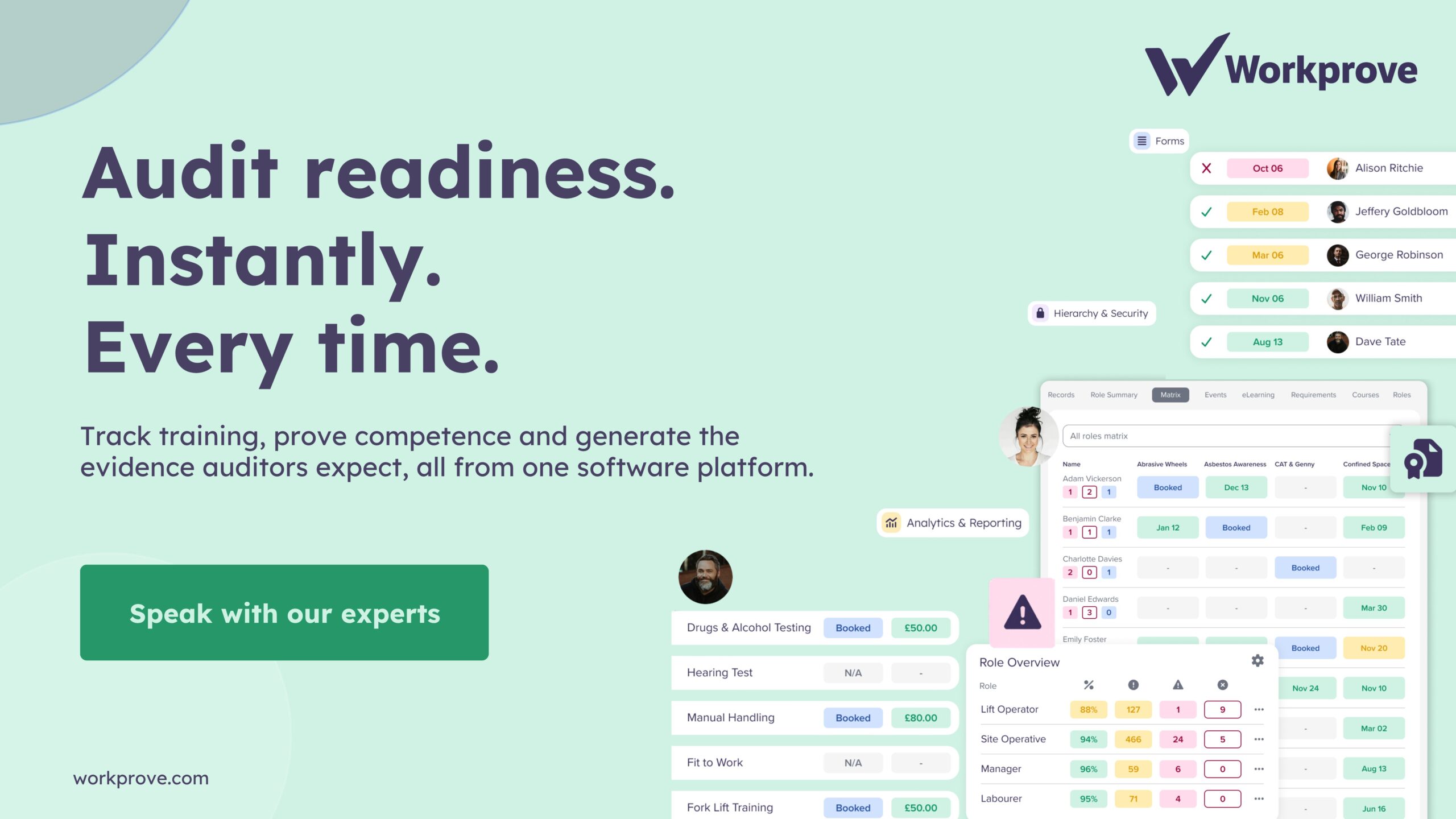
Workprove gives organisation audit-readiness and visibility instantly, every time with smart training tracker and skills tracker. blog image png

Conclusion: The Document Is the Easy Half

Writing a good SOP is a solvable problem. The format is well established, the elements are uncontroversial, and a task analysis plus a walk-through will produce something genuinely usable. Most organisations are reasonably good at this part, and the volume of SOP templates available online reflects that it is the part people ask about.

The harder half is what UK regulatory guidance has been saying for years and mainstream SOP advice largely omits. Procedures support competence rather than substituting for it, over-reliance on procedures is itself a recognised contributor to major accidents, and a revision to a procedure invalidates something in the competence record whether or not anyone acts on it. Judged against those three points, the organisations with the most impressive document libraries are not reliably the ones in the strongest position. The ones in the strongest position are those where changing a procedure automatically raises a question about the people who follow it.

Frequently Asked Questions

What does SOP stand for?

SOP stands for standard operating procedure. It is a written set of step-by-step instructions describing how a specific routine task should be carried out, by whom and to what standard.

What is an SOP in business?

In a business context, an SOP is a documented method for performing a recurring task consistently, whether that task is operational, administrative or safety-critical. The purpose is the same across settings: one agreed way of doing the job, which can be trained against, assessed against and audited.

What is the difference between an SOP and a work instruction?

An SOP describes how a complete task is carried out, usually covering several steps and sometimes several roles. A work instruction details the actions within a single step, typically for one person. HSE treats both, along with method statements and permits to work, as types of procedure (HSE, 2026).

What is the difference between a policy and a standard operating procedure?

A policy states what the organisation requires and why, and it applies broadly. An SOP states how a particular task is performed in order to meet that requirement. A policy rarely changes when equipment changes, whereas a procedure usually should.

What should a standard operating procedure include?

At minimum: title, unique ID and version number, effective and review dates, purpose, scope, roles and responsibilities, equipment and PPE, task risks and prerequisites, numbered steps with acceptance criteria, monitoring and records, corrective action, and a revision history with approvals.

How often should an SOP be reviewed?

Procedures should be controlled documents kept fully up to date, with changes formally controlled. HSE identifies new equipment, new chemicals, significant change to process, task, personnel or equipment, and successful plant trials as reasons to revise a standard operating procedure. It also suggests dating procedures and, where appropriate, marking them with a shelf life (HSE, 2025a).

Do SOPs replace training?

No. HSE states that procedures and competency are two sides of the same coin and should support each other, and that procedures do not replace competency (HSE, 2026). Issuing a procedure does not establish that anyone can follow it.

What happens to training records when an SOP is updated?

Formally, a training record against a withdrawn version no longer evidences competence in the current procedure. Unless records are linked to procedure versions, they continue to display as valid, which is why a revision should trigger a review of who needs retraining or reassessment.

Is an SOP a legal requirement in the UK?

There is no general legal duty to produce SOPs by that name. However, employers must assess risk and provide adequate information, instruction, training and supervision, and documented procedures form part of a safety management system. Where a procedure is relied upon as a control measure, its adequacy becomes a legitimate question for a regulator.

References

Health and Safety Executive (2025a) Operating procedures: technical measures document. Available at: https://www.hse.gov.uk/comah/sragtech/techmeasoperatio.htm.

Health and Safety Executive (2025b) What is competence? Available at: https://www.hse.gov.uk/competence/what-is-competence.htm.

Health and Safety Executive (2026) Procedures. Available at: https://www.hse.gov.uk/humanfactors/topics/procedures.htm.

You might also like

View All Resources
What is a training matrix blog
Blog

What is a Training Matrix? 8 Steps to Create One Effectively

Find Out More