Temporary Worker Training: Closing the Peak Season Gap
Skip to content

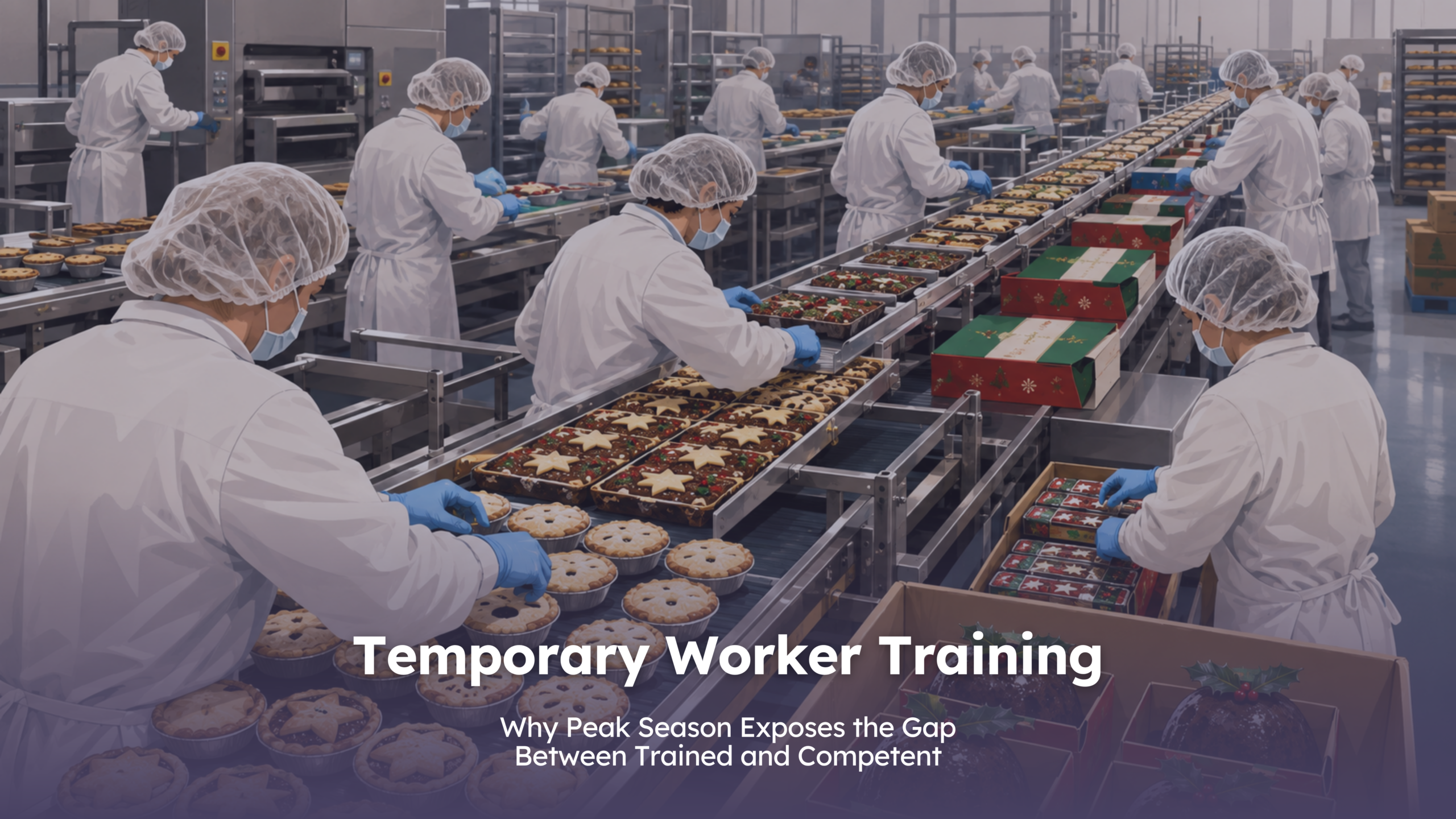
Temporary Worker Training: Why Peak Season Exposes the Gap Between Trained and Competent

image showing Temporary Worker Training: Why Peak Season Exposes the Gap Between Trained and Competent

Every autumn, food production sites and manufacturing plants across the UK scale up. Extra lines open, shift patterns extend, and headcount can climb by a third within weeks. Meanwhile, capacity for temporary worker training stays exactly where it was, and so do the systems that verify competence.

That mismatch is the real problem with temporary worker training, and it is rarely a recruitment failure. The people get hired. What breaks is the ability to answer a much harder question on any given shift: can this site demonstrate that the person running the line is currently competent to do it?

This article covers why temporary worker training breaks when a workforce scales faster than verification can follow, what UK regulation and food safety standards actually require, and how to fix it before the ramp rather than during it.

Why temporary worker training breaks when a workforce scales

The scale of temporary work in the UK is significant. Around 872,000 temporary or contract workers were on assignment on any given day in 2024, according to the Recruitment and Employment Confederation (REC, 2025).

However, the more revealing figure sits alongside it. The average assignment fell to 18 weeks in 2024, down from 22 weeks the previous year (REC, 2025). Induction and verification are a largely fixed cost per worker. A shorter assignment therefore recovers that cost over less productive time. Consequently, the pressure to compress induction rises at exactly the moment the number of inductions rises. Peak season shortcuts are therefore not carelessness. They are arithmetic.

Four failures a completion report will not show you

As a result, seasonal staff training tends to fail in four recognisable ways:

  • Returners are treated as strangers. Most systems archive or delete leavers, so last season’s trained workers re-enter as new starters. The site pays the induction cost twice on the same person and discards evidence it already generated.
  • Procedures move on, records do not. Peak is when SOPs change most. A returner’s record says “trained.” It does not say “trained on version three while version five is running.”
  • Supervision thins without a decision. Adding 40% to headcount does not add 40% to supervisors. Sites monitor completion percentages closely and supervision ratios almost never, despite supervision being the control that compensates for shallow experience.
  • Agency records stay with the agency. The site holds an assurance rather than a record. During an audit, an assurance is not evidence.

Where the pressure lands hardest

The pattern is consistent, but what has to be proved differs by sector.

SectorWhat drives the surgeThe record that has to hold
Food and beverage productionChristmas and seasonal SKU runs, extended shiftsAllergen awareness for agency and temporary staff, tied to the current allergen matrix
ManufacturingOrder surges and additional line capacitySite authorisation for plant and equipment, separate from the external licence
Transport and logisticsPeak parcel and grocery volumes across extended night shiftsManual handling and MHE authorisation verified at the zone, not the classroom
Health and social careWinter pressures met through bank and agency staffMandatory training and safeguarding currency, evidenced by the provider rather than the agency

Temporary worker training in each of these sectors fails for the same structural reason, even though the standard being audited against changes.

Underneath all four sits the same substitution, and it is the reason temporary worker training needs treating differently from permanent induction. Training completion is an input. Competence is an outcome. For permanent staff, tenure quietly absorbs the difference through daily supervision and repeated exposure. Temporary worker training has no such buffer, because a worker on a 12-week assignment may never be observed performing the task after initial sign-off.
What the rules actually require

Ask three people on site who is responsible for an agency worker’s training and you may get three answers. On temporary worker training, the regulation is clearer than the practice.

The Health and Safety Executive states that day-to-day responsibility for health and safety during an assignment lies with the end user business, because that business directs the work and controls the premises. The end user must therefore ensure the safety of all workers, including agency and temporary workers (HSE, 2024).

Nevertheless, the supplier’s duty is narrower than most sites assume. Before placing a worker, the agency must obtain information on the duties involved and the skills and qualifications needed to do the job safely, then check the worker meets those stated requirements (HSE, 2024).

ResponsibilityEmployment agencyHost site (end user)
Day-to-day health and safety during the assignmentNoYes
Obtaining details of duties, risks and skills requiredYesSupplies the information
Checking the worker meets the stated job requirementsYesNo
Competence for this task, on this line, to this procedure versionNot coveredNot covered

Rows one to three adapted from HSE (2024). The fourth row is the gap: neither party’s stated duty covers it.

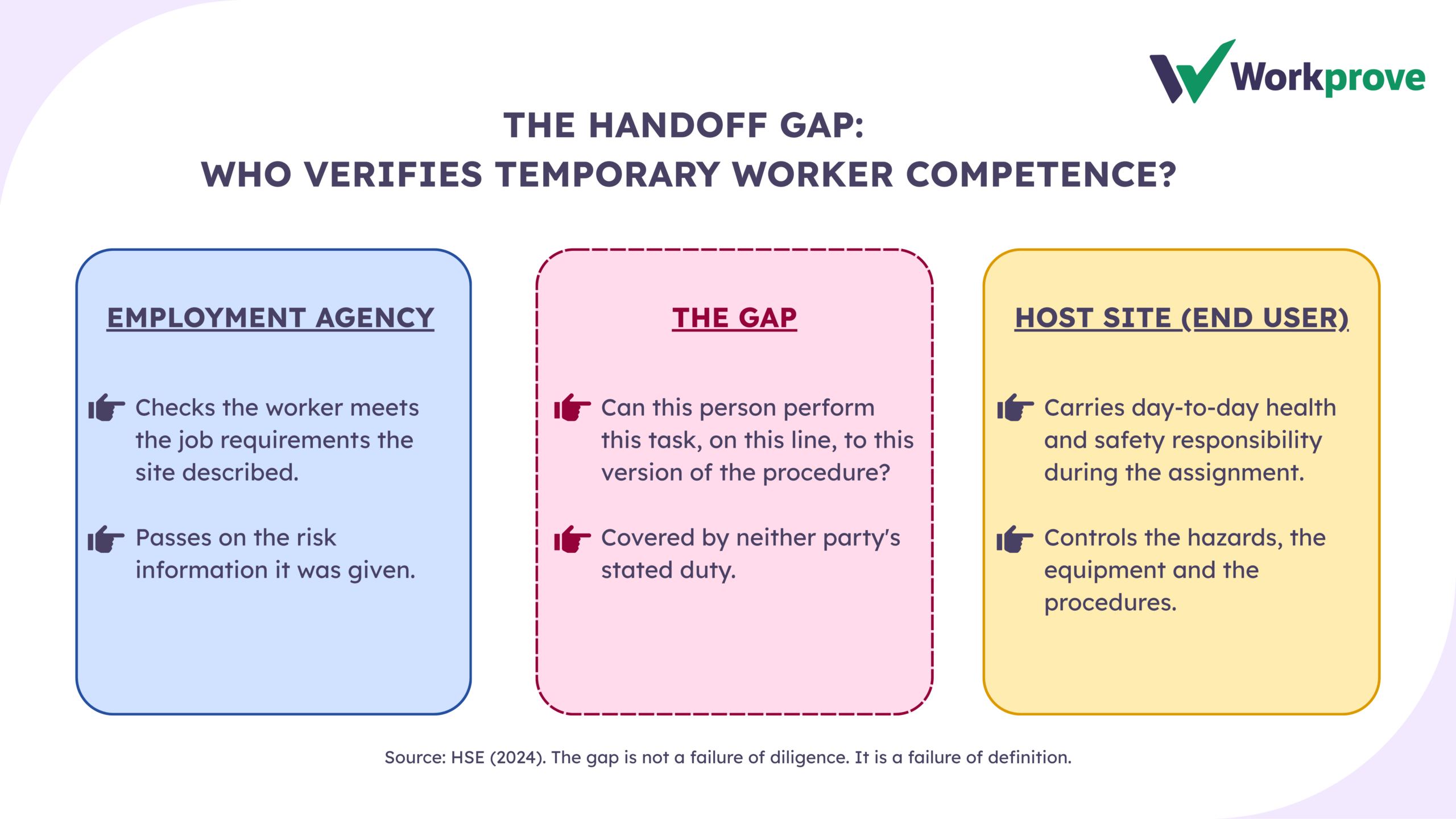
Read those two duties together and that gap appears. The agency verifies the worker against the requirements the site described. The site controls the actual hazards, equipment and procedures. Site-specific competence falls between the two. By that we mean the ability to perform this task, on this line, to this version of the procedure. Contractually, it is nobody’s deliverable. HSE effectively acknowledges the risk when it warns organisations to agree who does what and never assume someone else has taken responsibility (HSE, 2024).

This is the most useful reframe available to anyone managing seasonal staff training. The handoff gap is not a failure of diligence. It is a failure of definition.

For food manufacturers, the standards go further. BRCGS Global Standard Food Safety Issue 9 places training in Section 7, Personnel, where clause 7.1 is a fundamental requirement, meaning a major non-conformity there threatens certification outright (BRCGS, 2022). Issue 9 also widened the allergen obligation. Where Issue 8 required training for relevant staff, Issue 9 extends general allergen awareness training to all staff. That explicitly includes agency-supplied staff, temporary staff and contractors (Nkosi, 2022).

👉🏻 Suggested Reading: Lessons from UK Workplace Incidents: Are Training Gaps the Real Cause? examines what incident investigations repeatedly reveal about the distance between recorded training and demonstrated competence.

For food manufacturers, the standards go further. BRCGS Global Standard Food Safety Issue 9 places training in Section 7, Personnel, where clause 7.1 is a fundamental requirement, meaning a major non-conformity there threatens certification outright (BRCGS, 2022). Issue 9 also widened the allergen obligation. Where Issue 8 required training for relevant staff, Issue 9 extends general allergen awareness training to all staff. That explicitly includes agency-supplied staff, temporary staff and contractors (Nkosi, 2022).

👉🏻 Suggested Reading: Lessons from UK Workplace Incidents: Are Training Gaps the Real Cause? examines what incident investigations repeatedly reveal about the distance between recorded training and demonstrated competence

The handoff gap: who verifies temporary worker competence?

How to fix temporary worker training before peak

A verification-first approach to temporary worker training does not require more training. In most cases it requires less training and better evidence. Four changes to how seasonal staff training is recorded do most of the heavy lifting.

  • Separate authorisation from training. Training says someone learned. Authorisation says someone is currently permitted to perform this task. An agency may confirm every operative holds a valid counterbalance forklift licence, exactly as specified. Yet the licence says nothing about the site’s one-way system, pedestrian crossing points or restricted-visibility loading bay. Hold two records. Then make site authorisation, rather than the licence, the status that gates access to the task. The distinction that does most of the work is the first one. It looks like this in practice:  
      
    Training recordAuthorisation record
    What it assertsA person completed an activity on a dateA person is currently permitted to perform this task
    Tied toA calendar expiryA procedure version and a site
    Answers “have they been trained?”YesYes
    Answers “can they run line four today?”NoYes
    Behaviour when an SOP changes mid-seasonUnchangedSupersedes automatically
  • Tie records to procedure versions, not dates. A record expiring on a calendar cycle will miss a mid-season procedure change entirely. A record tied to a version supersedes automatically when that version changes, which matters most in September and October when recipes and pack formats move.
  • Retain returners rather than deleting them. If a worker completed induction and assessment last season, that history has value. Keeping it converts a repeated expense into an advantage in both speed and safety.
  • Track supervision ratio as a compliance variable. If the ratio at peak differs materially from the ratio the risk assessment assumed, the control has changed and the assessment needs revisiting.

    Applied together, these turn temporary worker training from an annual scramble into a maintained position. The practical test is simple: if an auditor asked you to evidence competence for a named person, on a named task, on a named date, how long would it take?

    👉🏻 Suggested Reading: Audit Ready in 30 Days: The Complete Compliance Roadmap for UK Businesses sets out a structured approach to closing evidence gaps before an audit rather than during one.

Automating temporary worker training across sites and shifts

Sustaining temporary worker training manually across multiple sites and shifts is where most organisations lose the thread. Three Workprove capabilities address the failure patterns above directly.

People management with an active and former pool. Rather than deleting leavers, Workprove moves agency and seasonal staff between active and former status. Their training history, assessments and authorisations stay intact. When the same worker returns next peak, they are restored rather than rebuilt. The site keeps a standing pool of pre-verified people and reduces the induction burden on those who need it least.

Version control with automatic supersession. When a procedure changes, Workprove records the change and automatically supersedes the affected training records. Everyone requiring retraining against the new version is flagged. Nobody is left holding a record that references a superseded revision, and the change is visible to managers the moment it happens.

SCORM authoring with automatic certification. Standard operating procedures can be built into SCORM modules and rolled out rapidly across a large intake. On completion, certificates generate automatically and the training matrix updates in real time, so the compliance picture reflects the floor rather than lagging behind the admin queue.

The common thread is visibility. The site stops assembling evidence when someone asks for it. Instead it holds a live view of who is trained, who is authorised and who is permitted to work each task, across permanent and temporary staff alike.

👉 Learn more about how Workprove supports
Food and Beverage Production       Manufacturing

Workprove gives organisation audit-readiness and visibility instantly, every time with smart training tracker and skills tracker. blog image png

Conclusion

The instinct heading into peak is to train faster. That instinct is understandable and mostly wrong. Training faster addresses a delivery problem when the real constraint is evidential. A compressed induction, after all, produces exactly the same record as a thorough one.

The organisations that handle seasonal surges well are not the ones with the most temporary worker training hours logged. They are the ones carrying less to rebuild each cycle, because they retained verification from the last one. That advantage compounds. Each season a site keeps its competence evidence intact, the following ramp costs less and exposes it to less risk. Conversely, each season it deletes that evidence, it starts from zero again while the assignment window gets shorter.

Peak season does not create the competence gap. It simply makes it visible.

Frequently asked questions

Who is legally responsible for temporary worker training in the UK?

HSE guidance places day-to-day responsibility for health and safety during an assignment with the end user business, because it directs the work and controls the premises. The agency must verify the worker meets the stated job requirements and pass on risk information, but site-specific competence remains the host site’s responsibility (HSE, 2024).

Does agency-delivered training satisfy audit requirements?

Not on its own. An auditor asks for evidence rather than assurance. If the record sits in the agency’s system, the site cannot demonstrate compliance at the moment of the audit. Records need to be held, or at least mirrored, by the organisation carrying the duty.

Does a valid licence mean a temporary worker is competent?

No. A licence confirms a general qualification, while competence is task and site specific. A forklift licence confirms the holder can operate that class of vehicle, but says nothing about a particular site’s traffic management or loading arrangements. Site-specific assessment remains necessary.

References

BRCGS (2022) Global Standard Food Safety Issue 9. London: BRCGS. Available at: https://www.brcgs.com/media/2170948/fsi9-gn-sample.pdf.

Health and Safety Executive (2024) Health and safety for gig economy, agency and temporary workers: roles of suppliers and end user businesses. Available at: https://www.hse.gov.uk/vulnerable-workers/gig-agency-temporary-workers/employer/roles-of-suppliers-end-user-businesses.htm.

Nkosi, M. (2022) BRCGS Issue 9 changes, part 7: personnel. ASC Food Safety. Available at: https://ascfoodsafety.com/brcgs-for-food-safety-changes-personnel/.

Recruitment and Employment Confederation (2025) Recruitment sector contributes more than £40 billion a year to the UK economy despite tough job market. Available at: https://www.rec.uk.com/our-view/news/press-releases/recruitment-sector-contributes-more-40-pounds-billion-year-uk-economy-despite-tough-job-market.

You might also like

View All Resources
What is a training matrix blog
Blog

What is a Training Matrix? 8 Steps to Create One Effectively

Find Out More
Best skills management software
Blog

Best Skills Management Software (2026): 10 Platforms Compared

Find Out More
Toolbox talk blog cover image showing a site supervisor delivering a targeted safety briefing to workers in a busy logistics yard after a damaged barrier creates a risk near a forklift and pedestrian route. The scene illustrates how effective toolbox talks should respond to real workplace hazards, involve the relevant employees and lead to clear safety actions rather than simply recording attendance.
Blog

What Is a Toolbox Talk? Meaning, Importance and the UK Guide to Getting It Right

Find Out More