What Is Proficiency? Meaning, Levels and How It Applies at Work
Skip to content

What Is Proficiency? Meaning, Levels, and How It Applies in the Workplace

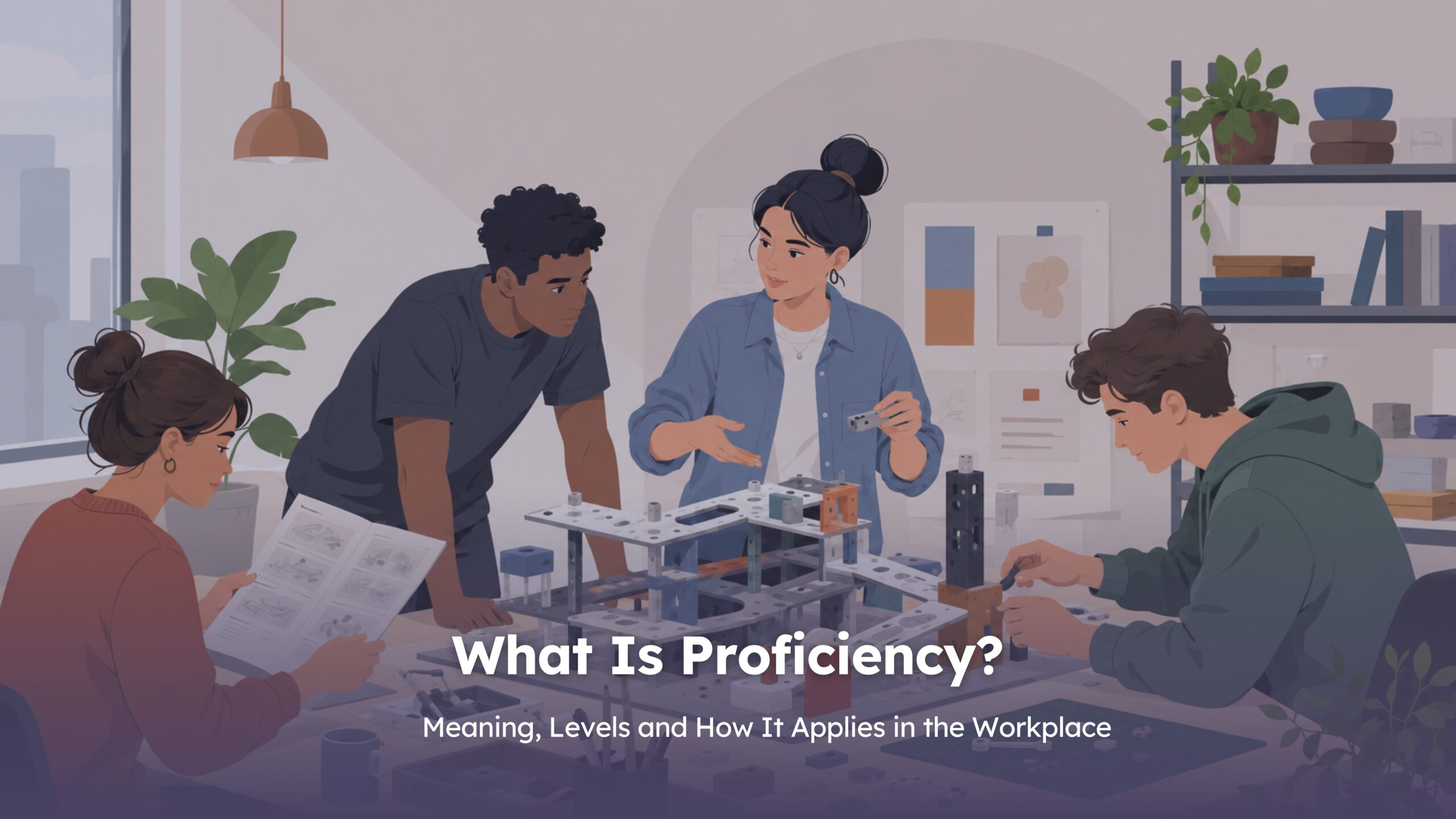
A diverse group works together on a complex model, showing different levels of skill, guidance and independent problem-solving and different proficiency

You might describe yourself as proficient in French, proficient on the guitar, or proficient at parallel parking. In each case you would mean roughly the same thing: you have practised a specific skill enough that you can now perform it reliably, without having to think through every step. Proficiency is one of those words that gets used constantly and defined rarely, which is exactly why it is worth pinning down properly before looking at what it means, specifically, once you bring it into a professional or workplace setting.

What Does “Proficiency” Mean?

At its core, proficiency describes a good, reliable level of ability in a particular skill or subject. Notably, the word’s origin points to exactly this idea of advancement through effort. It comes from the Latin proficere, meaning “to make progress” or “to advance,” and it entered English in the late 1500s to describe someone who had progressed in a business, art, or science through application rather than natural gift.

That origin still shapes how the word is used today. People develop proficiency through practice and instruction rather than raw talent. Someone can have natural aptitude for a skill without ever practising it into proficiency, and equally, someone with no particular gift for a skill can become genuinely proficient through sustained, deliberate effort. In other words, proficiency is earned, not inherited.

Everyday Examples of Proficiency

Because proficiency applies to any learnable skill, it shows up in some very different contexts:

  • Language learning: the Common European Framework of Reference for Languages (CEFR), maintained by the Council of Europe, groups language ability into six levels from A1 to C2, with the upper levels explicitly labelled “Proficient User”
  • Sport and physical skill: a proficient swimmer or skier can perform the core techniques smoothly and adapt to changing conditions, without needing to consciously think through each movement
  • Music and creative skill: a proficient guitarist can play confidently across a range of pieces, though proficiency here is still a step below the fluency and improvisation associated with mastery
  • Everyday practical skills: people commonly describe driving, cooking and using software in terms of proficiency once someone moves beyond the basics and performs each task reliably without constant guidance.

Across all of these examples, proficiency sits in a similar place: past the beginner stage, but before the kind of effortless, intuitive expertise that comes only with extensive real-world experience.

The Levels of Proficiency: Where Does “Proficient” Actually Sit?

Proficiency is not a single, binary state of “has it” or “doesn’t have it.” Researchers widely reference the Dreyfus model of skill acquisition to explain how people develop skills. Stuart and Hubert Dreyfus first proposed the model at the University of California, Berkeley. The model describes five, and in later revisions six, developmental stages that a person moves through as they build any skill:

  • Novice: following fixed rules and instructions with little ability to adapt to context
  • Advanced beginner: starting to recognise recurring situations and apply learned rules more flexibly
  • Competent: able to plan deliberately, prioritise, and cope with a wider range of situations, though still relying on conscious analysis
  • Proficient: perceiving situations as a whole, recognising patterns intuitively, and adjusting approach without stepping through every rule
  • Expert: acting with fluent, near-automatic judgement, drawing on deep experience rather than conscious deliberation

There is a genuinely useful nuance here that everyday conversation tends to flatten. In the original academic model, “competent” and “proficient” are not synonyms or alternative lenses on the same thing. They are sequential stages on the same ladder, with competent coming before proficient. Everyday and workplace usage often treats the two words as though they describe different dimensions of capability altogether, rather than different points on a single developmental path. Understanding where someone actually sits on that ladder is a more precise way to think about ability than a simple “trained or not trained” label allows.

Five levels of proficiency image

How Is Proficiency Measured?

Measurement approaches vary by domain, but they tend to fall into a few recognisable types. Standardised frameworks, such as CEFR for languages, use structured “can-do” descriptors to place someone at a specific level based on defined criteria. Practical or skills-based domains more commonly rely on direct observation: a person demonstrates the skill, and an assessor judges the performance against a benchmark. In both cases, the method matters less than the consistency of the standard behind it. A proficiency measurement is only as reliable as the criteria used to produce it, and two assessors applying different standards to the same performance will produce two different verdicts about the same person.

Proficiency in Education and Daily Life

Proficiency is also one of the most common ways schools, universities, and everyday learners describe progress, often with more structure behind it than people realise.

In UK schools, the language shifts slightly but the idea is the same. National curriculum assessments at Key Stage 1 and Key Stage 2 describe pupils as “working towards,” “working at,” or “working at greater depth within” the expected standard, a graded scale that functions in much the same way as a proficiency level, even without using the word directly. The National Assessment of Educational Progress (NAEP) places students into Basic, Proficient or Advanced achievement bands for each subject and grade. NAEP Proficient represents solid academic performance and competency over challenging subject matter rather than simply a passing grade.

At university level and beyond, proficiency tends to become less formally graded but no less real. Degree learning outcomes, professional accreditation bodies, and postgraduate research all describe capability in similar terms: has the student progressed from following instruction to applying knowledge independently, and eventually to producing original, reliable work without step-by-step guidance? The Dreyfus stages outlined earlier map onto this journey closely, which is part of why the model has been so widely adopted well beyond its original engineering and skills-training context.

In daily life, proficiency shows up with far less formality but the same underlying logic. Learning to cook, picking up a new hobby, or getting comfortable with a piece of software all follow the same rough arc: early reliance on instructions, growing pattern recognition, and eventually confident, largely automatic performance. The stakes are lower than in a classroom or a workplace, but the mechanism by which someone becomes proficient does not really change.

Proficiency in the Workplace

Workplace proficiency narrows the general definition considerably. Rather than proficiency in a broad subject like a language, workplace proficiency is almost always task-specific: can this person, right now, complete this particular procedure, operate this particular machine, or apply this particular technique to the standard the organisation requires? It is a practical, applied version of the same underlying idea, but with considerably higher stakes attached in regulated, high-risk environments.

Because workplace proficiency is task-specific, it is also, by nature, a snapshot rather than a permanent state. A worker demonstrates proficiency at the moment an assessor evaluates them under the conditions of that assessment. Whether that same proficiency holds six months later, on updated equipment, under real operational pressure, is a separate matter entirely, and one that a one-off pass mark cannot answer on its own.

How Proficiency Is Assessed at Work

In a workplace setting, proficiency assessment usually takes one of a few recognisable forms, often used in combination:

  • Practical demonstration: the individual physically performs the task under observation, against a defined checklist or standard
  • Scenario-based assessment: the assessor presents the individual with a realistic situation, sometimes including a deliberate complication, to test judgement as well as technique.
  • Supervisor or assessor sign-off: a trained assessor observes real, on-the-job performance rather than a simulated test
  • Self and peer assessment: organisations use this approach more often for lower-stakes or developmental skills, although it is generally not sufficient on its own for safety-critical tasks.

Why These Records Have a Shelf Life

Proficiency decays for reasons that have nothing to do with the original assessment being wrong. Skills fade without regular practice. Equipment gets upgraded. Organisations revise procedures after incidents elsewhere in the sector. A worker moves site, moves team, or returns from extended leave. Any one of these can quietly move someone from proficient to no-longer-demonstrably-proficient without anyone updating the record to reflect the change.

This is why proficiency, on its own, is a limited basis for ongoing workforce assurance. It answers “could this person do it, once, under assessment conditions.” It does not answer “can this person still do it, today, under the conditions they actually work in,” which is a broader and more durable question. That broader question sits closer to competency than proficiency, and it is worth understanding the distinction properly rather than treating the two words as interchangeable.

ProficiencyCompetency
MeasuresA specific, defined taskSkill, judgement, and behaviour combined
Time horizonA snapshot, assessed onceA standard held consistently over time
What causes it to lapseLack of practice, a process changeRole change, absence, equipment upgrade
Typical recordA certificate or pass markAn ongoing, evidenced log

👉🏻 Suggested Reading: What Is Competency Management? And Why Most Organisations Are Getting It Wrong. It explains how competency builds on proficiency and why most organisations only manage the narrower, task-level layer.
 

Scenario-Based Analysis: Where the Gaps Show Up

Manufacturing. A production line may show that 95% of machine operators hold a valid proficiency sign-off for their equipment.However, fewer than 60% have been reassessed since a recent guarding and lockout procedure change. The paperwork looks complete. The actual risk is that most operators are being assumed proficient against a procedure they were never formally tested on.

Healthcare. Assessors may sign off care staff as proficient in a manual handling technique during induction. The organisation later introduces a new hoist model across two wards. Assessors never formally reassess proficiency on the new equipment. Staff remain “trained” on paper. Whether they are still proficient on the equipment they use every day remains an unanswered question.

Construction. An operative assessed as proficient on one scaffolding system two years ago may later work on a different configuration. They often learn it through informal, on-the-job experience rather than a fresh assessment. The record still shows a proficient, qualified worker. In reality, proficiency has never been verified against the system currently in use. This is exactly the type of gap an HSE inspector looks for after an incident involving access equipment.

Logistics. A distribution centre may proficiency-test every new starter before they are cleared to work unsupervised. The gap usually appears later. Workers rotate between sites with different racking heights and vehicle fleets. Assessors often assess agency staff once but never reassess them for the specific site where they work. It was never confirmed against the conditions of the new site.

Why Proficiency Alone Isn’t Enough for Compliance

Regulators are generally not asking whether a proficiency test happened at some point. Under the Management of Health and Safety at Work Regulations 1999, employers must ensure that people carrying out safety-related tasks are genuinely competent. The accompanying guidance makes it clear that this requires more than sufficient training. It requires demonstrated ability to apply that training appropriately, on an ongoing basis, not a single historical pass mark.

Consequently, an organisation may only be able to produce proficiency certificates. Without evidence of reassessment as conditions change, it cannot answer the question a regulator or investigator is actually asking. That is not a paperwork failure. It is a verification failure, and it is one of the most common reasons organisations with extensive training records still fail audits.

How Workprove Helps You Track Proficiency (and Keep It Current)

Most systems capture a single proficiency event and stop there. A certificate is issued, a box is ticked, and the record sits unchanged until it expires. Workprove is built to treat workplace proficiency as something that needs to stay current, not just something that needs to be logged once:

  • Structured assessments with defined criteria, so proficiency is judged consistently across assessors, sites, and shifts
  • Evidence capture, including photos, documents and sign-offs, backs every proficiency record with verifiable evidence rather than a simple tick box.
  • Automatic expiry and trigger-based reassessment, flagging when an equipment change, procedure update, role change, or extended absence should prompt a fresh check
  • A live skills matrix, showing who is currently proficient, rather than who passed a test at some point in the past
  • Instant audit-ready reporting, so the gap between “trained once” and “verified now” never has to be manually reconstructed before an inspection

For organisations in these and related sectors , where “they passed the test in January” is not an acceptable answer if the equipment changed in June, that is exactly the gap Workprove is designed to close.

Take a Product Tour: see how Workprove keeps proficiency records current rather than static.
Speak with an Expert: talk through how trigger-based reassessment would work across your sites.

Workprove gives organisation audit-readiness and visibility instantly, every time with smart training tracker and skills tracker. blog image png

Frequently Asked Questions

What does proficiency mean?

Proficiency means a good, reliable level of ability in a particular skill, built through practice and instruction rather than natural talent alone. It sits above beginner level but below the fluent, intuitive judgement associated with true expertise.

What are the levels of proficiency?

One widely referenced framework, the Dreyfus model, describes five developmental stages: novice, advanced beginner, competent, proficient, and expert, with some versions adding a sixth stage of mastery. Each stage reflects a different degree of judgement, pattern recognition, and reliance on fixed rules.

How is proficiency different from competency?

Proficiency is generally a task-level or skill-level snapshot of ability at a given point in time. Competency is broader, combining that skill with judgement, knowledge, and behaviour, and is expected to hold consistently over time rather than just on the day of an assessment.

How is proficiency assessed in the workplace?

Workplace proficiency is typically assessed through practical demonstration against a checklist, scenario-based testing, or supervisor sign-off based on observed, on-the-job performance. Self and peer assessment are sometimes used for lower-stakes skills but are generally not sufficient on their own for safety-critical tasks.

How often should workplace proficiency be reassessed?

Proficiency should be reassessed whenever the relevant task, equipment, or procedure changes, rather than relying solely on a fixed annual date. Trigger events such as a role change, equipment upgrade, or return from extended absence should also prompt a fresh check.

How does Workprove help track workplace proficiency?

Workprove combines structured, criteria-based assessments with evidence capture and automatic trigger-based reassessment, keeping a live skills matrix that reflects who is currently proficient rather than who passed a test at some point in the past.

References

Chartered Institute of Personnel and Development (CIPD) (2024) Competence and competency frameworks. CIPD.

Council of Europe (no date) The CEFR Levels. Available at: https://www.coe.int/en/web/common-european-framework-reference-languages/level-descriptions 

Department for Education (2026) Key Stage 2 Teacher Assessment Guidance. Available at: https://www.gov.uk/government/publications/key-stage-2-teacher-assessment-guidance

Dreyfus, S.E. and Dreyfus, H.L. (1980) A Five-Stage Model of the Mental Activities Involved in Directed Skill Acquisition. Berkeley: University of California, Operations Research Center. Available at: https://www.researchgate.net/publication/235125013_A_Five-Stage_Model_of_the_Mental_Activities_Involved_in_Directed_Skill_Acquisition 

Harper, D. (no date) Proficient (adj.). Online Etymology Dictionary. Available at: https://www.etymonline.com/word/proficient 

Health and Safety Executive (HSE) (no date) A competent person. Available at: https://www.hse.gov.uk/involvement/competentperson.htm 

National Assessment Governing Board (NAGB) (no date) NAEP Achievement Levels. Available at: https://www.nagb.gov/naep/NAEP-achievement-levels.html

The National Archives (1999) The Management of Health and Safety at Work Regulations 1999, SI 1999/3242. Available at: https://www.legislation.gov.uk/uksi/1999/3242 

You might also like

View All Resources
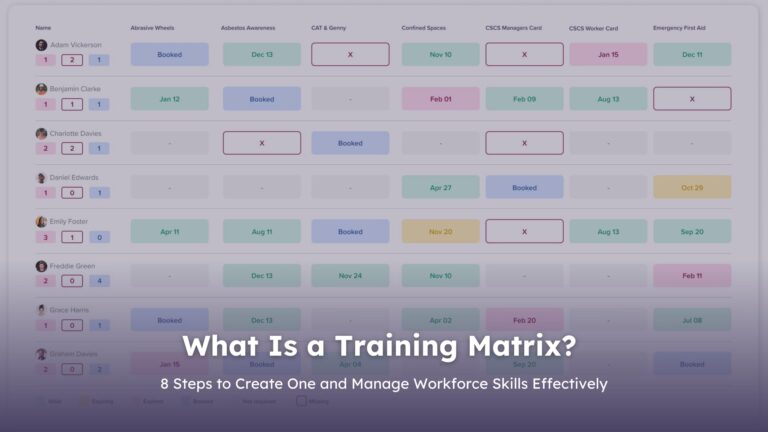
What is a training matrix blog
Blog

What is a Training Matrix? 8 Steps to Create One Effectively

Find Out More
Best Training and Compliance Management Software: 2026 comparison guide
Blog

Best Training & Compliance Management Software (2026): 10 Platforms Compared

Find Out More