Refresher Training Requirements: What UK Law Actually Says
Skip to content

What Is NEBOSH? A UK Employer’s Guide to What the Certificate Proves

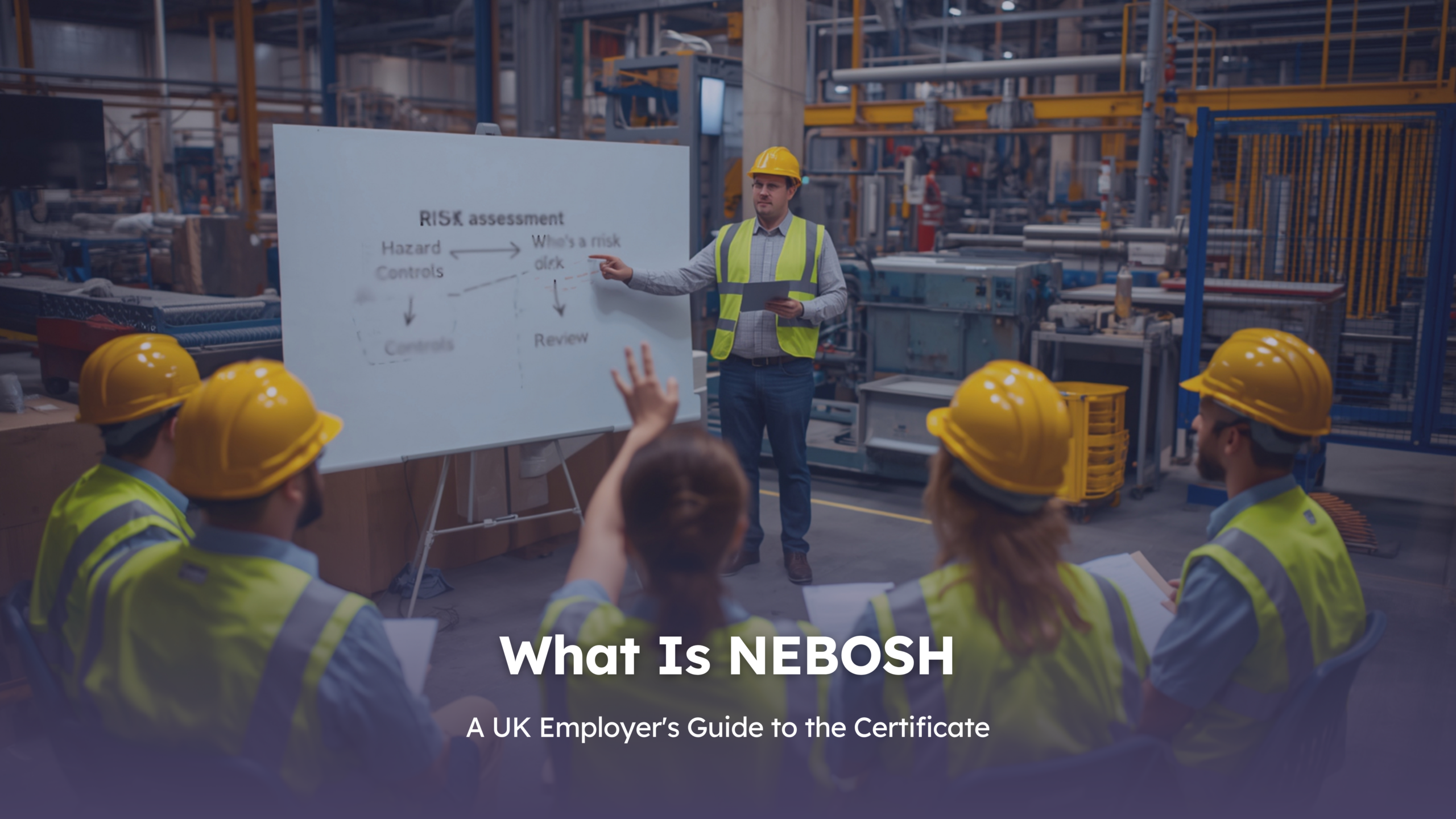
NEBOSH full recent comprehensive guide blog image cover

A NEBOSH certificate is one of the most useful signals a UK employer can find on a CV or in a skills matrix. It shows that someone has studied health and safety management to a nationally recognised standard, and that they have completed a real risk assessment under examination conditions. To get full value from it, though, employers need to know exactly what the certificate evidences and where their own verification has to begin.

This guide answers the question “what is NEBOSH?” from the employer’s side. It covers what NEBOSH stands for, how the qualification levels compare, and what changed in the 2026 General Certificate. Most importantly, it explains how to record NEBOSH so that it strengthens, rather than overstates, your competence evidence.

What Is NEBOSH?

NEBOSH stands for the National Examination Board in Occupational Safety and Health. It is a UK awarding body established in 1979 (NEBOSH, n.d.a) and a registered charity. NEBOSH writes the syllabuses, sets and marks the assessments, and awards the qualifications. The teaching itself is delivered by accredited Learning Partners, and NEBOSH states plainly that it is not possible to self-study for its qualifications (NEBOSH, n.d.b).

In short, NEBOSH is an examination board rather than a training provider. That distinction matters because the certificate tells you who assessed the learner, while the Learning Partner named on an invoice tells you who taught them.

NEBOSH Qualification Levels at a Glance

NEBOSH qualifications fall into three main tiers, each aimed at a different depth of responsibility. The table below maps the most common UK qualifications to their framework levels.

QualificationFramework levelTypical audienceWhat it is designed to build
NEBOSH Health and Safety at Work AwardSCQF 5, comparable to RQF Level 2Team leaders, supervisors, HR and facilities staffAn introduction to workplace hazards and risk
NEBOSH National General Certificate (NGC)SCQF 6, comparable to RQF Level 3Managers, supervisors, people starting a safety careerBroad health and safety management plus a practical risk assessment
NEBOSH Level 6 National Diploma for Occupational Health and Safety Management ProfessionalsRQF Level 6Dedicated health and safety practitionersProfessional-level knowledge and judgement across complex risks

What the NEBOSH General Certificate Assesses

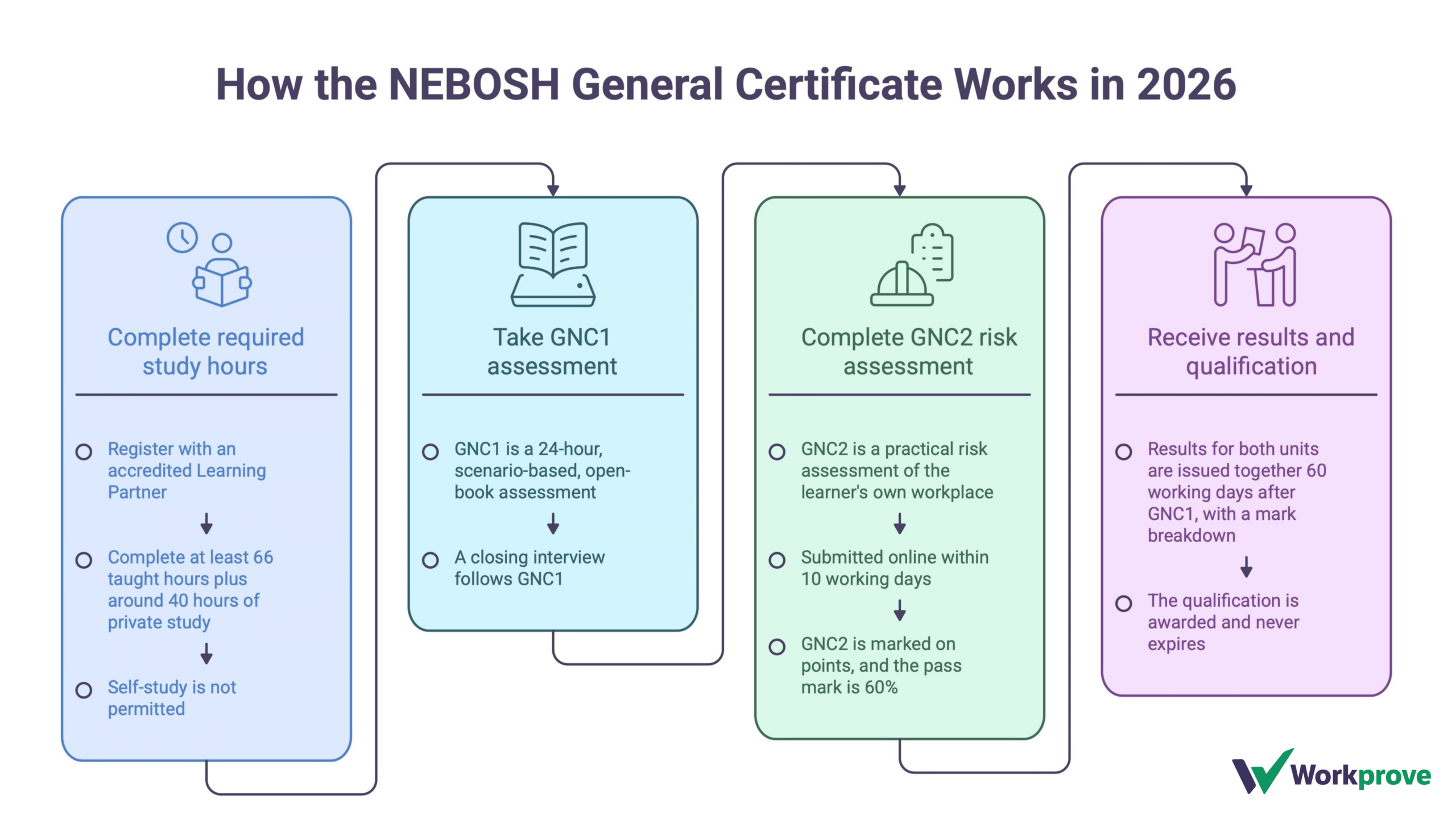
According to NEBOSH, the NGC covers how to manage health and safety effectively, how to identify and control common workplace hazards, how to measure success, and the UK’s key legal requirements. It involves a minimum of 66 taught hours plus around 40 hours of private study, although fast-track learners can complete it in 10 working days (NEBOSH, n.d.b).

Assessment happens in two parts. The first unit is a 24-hour, scenario-based, open-book assessment followed by a closing interview. The second is a practical risk assessment, in which learners assess their own workplace and produce an action plan (NEBOSH, n.d.b). Both units must be passed to earn the qualification.

What Changed in 2026

The 2026 update mainly changed how the qualification is assessed rather than what it teaches (NEBOSH, n.d.c). For employers, this creates two practical points. First, a CV listing NG1 and NG2 and one listing GNC1 and GNC2 describe the same qualification, so recruiters should not treat the older codes as out of date. Second, the new GNC2 mark breakdown shows which parts of the risk assessment process a new hire handled strongly and which they found harder. That makes it a ready-made input to their induction plan and training needs analysis.

How the NEBOSH General Certificate Works in 2026 imforgraphic/ flowchart

Do NEBOSH Qualifications Expire?

No, they don’t. NEBOSH confirms that once all units are passed, the qualification never expires and never has to be retaken. However, NEBOSH also notes that legislation, standards and best practice keep changing. For that reason, it recommends that longstanding holders keep their knowledge current, and says they would benefit from taking the latest version of the qualification (NEBOSH, n.d.d).

At first glance, this looks like good news for employers, since there is no renewal date to track. In practice, however, it creates a blind spot. Every other safety-critical line in a skills matrix eventually turns amber and then red, which prompts someone to act. A NEBOSH cell, by contrast, turns green once and stays green permanently. As a result, a certificate earned fifteen years ago looks exactly the same on a dashboard as one earned last month.

Consider a manufacturing business that appointed its production manager as the site’s health and safety lead on the strength of an NGC passed in 2011. Since then, the site may have added robotic cells, changed its chemical inventory and moved to a different shift pattern. The certificate is still valid, yet the knowledge behind it was built for a different workplace and an older body of guidance. The compliance risk is not the certificate itself. The risk lies in treating a permanent qualification as permanent evidence of current capability.

Therefore, the question to ask about NEBOSH is not “has it expired?” but “when was this person’s capability last checked against the work they do now?” Workprove’s guide to refresher intervals makes the same argument for training that does carry an expiry date, showing that calendar-driven renewal is a convention rather than a legal test.

👉🏻 Suggested Reading: Refresher Training Requirements: How Long Is Workplace Training Actually Valid For? Why the three-year refresher cycle is industry habit rather than law, and what the real legal test of ongoing competence looks like.

What a NEBOSH Certificate Proves, and Where Your Own Evidence Takes Over

The HSE describes competence as the combination of training, skills, experience and knowledge a person has, together with their ability to apply them to perform a task safely. It adds that attitude and physical ability can also affect competence (HSE, 2025). Set against that definition, a NEBOSH certificate evidences some elements strongly and leaves others for the employer to establish.

Element of competenceWhat NEBOSH evidencesWhat the employer still needs to evidence
KnowledgeStrong: the syllabus and a scenario-based assessmentKnowledge of site-specific procedures, equipment and hazards
TrainingStrong: accredited, taught learningTraining in any changes since the certificate date
SkillsPartial: one practical risk assessment, marked externallySkills applied to the risks of the current role and site
ExperienceNot evidencedTime spent applying the knowledge in comparable settings
Ability to applyEvidenced once, in one workplaceOngoing observation, review of assessments produced, supervision records

Adapted from the HSE definition of competence (HSE, 2025) and the NGC assessment structure (NEBOSH, n.d.b).

The last row is the one most often overlooked. In GNC2, learners risk assess their own workplace (NEBOSH, n.d.b), which is strong evidence that they could apply the method at that site, at that time. However, that evidence stays with the context it came from.

For example, a construction site manager who earned the NGC on a housing development might later join a food manufacturer. Their principles carry over, but their assessed work covered working at height and plant movement rather than allergen controls and machine guarding. The employer should therefore record the NGC as a foundation and assess the person against the new site’s significant risks before signing them off.

NEBOSH and the “Competent Person”: What the Law Actually Requires

Regulation 7 of the Management of Health and Safety at Work Regulations 1999 requires every employer to appoint one or more competent persons to help them meet their health and safety duties. It defines competence as sufficient training and experience or knowledge and other qualities, and it names no qualification (Legislation.gov.uk, 1999). Similarly, the HSE says formal qualifications are not usually essential (HSE, n.d.) and that competence only needs to be proportionate to the job (HSE, 2025).

As a result, employers tend to make one of two opposite mistakes. The first is over-buying. A low-risk professional services firm, for instance, may assume it needs a Diploma-qualified consultant, when an office manager with the NEBOSH Award, relevant experience and access to specialist advice could be entirely proportionate.

The second mistake, under-covering, is riskier. Regulation 7(3) requires the number of competent persons, their time and their resources to be adequate for the size of the business and the way its risks are distributed (Legislation.gov.uk, 1999). Consequently, a logistics company that names one NGC holder at head office as the competent person for five distribution centres is likely to fail that test, however strong the certificate is.

Finally, Regulation 7(8) says an in-house competent person should be appointed in preference to an external one where one exists (Legislation.gov.uk, 1999). This is a strong reason to develop NEBOSH-qualified people internally, and to evidence their competence properly once you have them.

👉🏻 Suggested Reading: What Is Competency Management? And Why Most Organisations Are Getting It Wrong How to build the three layers of competence evidence (qualifications, assessed competence and live readiness) that regulators expect to see.

National or International? A Hiring Detail That Matters

NEBOSH offers both a National General Certificate and an International General Certificate (IGC). The NGC explicitly covers the UK’s key legal requirements (NEBOSH, n.d.b). By contrast, Learning Partners describe the IGC as focused on international standards and best practice rather than UK-specific legislation (Make UK, n.d.; commercial source).

For UK employers, this becomes relevant when recruiting internationally. For instance, a care group hiring a health and safety adviser who trained overseas may receive a CV listing the NEBOSH IGC. The qualification is well respected and the risk management principles are the same. However, the candidate’s formal study will not have centred on UK regulations such as the Management of Health and Safety at Work Regulations. The practical fix is simple: record the IGC accurately rather than as “NEBOSH General Certificate”, and include a structured briefing on UK legislation in their induction.

How to Record NEBOSH Properly in a Skills Matrix

Because NEBOSH never expires, the value of the record depends entirely on what you capture alongside it. A single tick in a “NEBOSH” column hides almost everything a regulator or auditor would want to know. The fields below turn that tick into usable evidence.

FieldWhy it matters
Exact qualification title (for example NGC, IGC, Construction Certificate, Level 6 Diploma)Different qualifications cover different legal frameworks and risk areas
Specification and date awardedShows how current the underlying syllabus is
Unit codes (NG1/NG2 or GNC1/GNC2)Prevents confusion between old and new naming for the same qualification
Verification dateConfirms the certificate was checked with NEBOSH rather than accepted at face value
Linked site-specific assessmentsShows competence against the risks of the current role, not only the qualification
Next review date for applied competenceReplaces the missing expiry date with a deliberate, risk-based check

The verification field matters most. NEBOSH’s Online Verification Tool lets employers and recruiters confirm that a person holds the qualification they claim, which helps prevent qualification fraud (NEBOSH, n.d.e). The check takes minutes, so recording its date is one of the cheapest controls available, and it answers an auditor’s question before they ask it.

The final field fills the gap left by the missing expiry date. Because the qualification never prompts a review, the employer sets its own review point based on risk, such as a change of site, a significant process change, or a fixed interval for high-risk roles.

How Workprove Supports NEBOSH Records

Once your NEBOSH records capture the right fields, the next challenge is keeping them current without adding another spreadsheet.

Workprove is a training and skills management platform built for safety-critical and regulated industries. It lets a NEBOSH qualification sit alongside the site-specific evidence that shows how the holder applies it today.

  • Digital worker profiles: Each worker’s certificates, training history and competency evidence are held together in one place, so qualifications and assessed competence can be reviewed side by side.
  • Role-based training matrix: Workers are mapped to the requirements of their role, so a NEBOSH holder who moves site or role is assessed against the new requirements.
  • Competency assessments: Site-specific assessments can be recorded against each worker, giving the permanent NEBOSH record a current, verified layer on top.
  • Automatic expiry alerts: Renewals for time-limited qualifications are flagged before they lapse, keeping the wider matrix accurate around your NEBOSH holders.
  • Workpass mobile app: Workers can access their own records and certificates on the go, which makes evidence easy to produce on site or during an audit.
  • Real-time compliance reporting: Records update as assessments and certifications are added, giving managers a live view of competence across every team and site.

With qualifications and competence evidence in one system, you can show an auditor not only who holds NEBOSH but also who is currently competent for the risks they manage. To see how this works for your own sites, take a tour of Workprove or speak with our experts about your current setup.

Take a Tour    Book a Time with Experts


Workprove gives organisation audit-readiness and visibility instantly, every time with smart training tracker and skills tracker. blog image png

Conclusion: Treat NEBOSH as a Foundation, Then Build the Evidence on Top

NEBOSH deserves its reputation. It is externally assessed, it includes practical application, and its 2026 marking changes give employers more insight into a candidate’s strengths than before. The weakness lies in how organisations record it, not in the qualification itself. A permanent certificate stored as a permanent green tick invites the assumption that capability is permanent too, and neither the law nor the HSE supports that assumption.

The organisations that get this right do three things consistently. They verify the certificate with NEBOSH, they assess the holder against the risks of the role they actually hold, and they set their own review points because the qualification never will. On that basis, NEBOSH becomes what it was always meant to be: a strong foundation for competence, rather than a substitute for proving it.

Frequently Asked Questions

What does NEBOSH stand for?

NEBOSH stands for the National Examination Board in Occupational Safety and Health. It is a UK awarding body, founded in 1979, that sets and awards qualifications in health, safety and environmental management (NEBOSH, n.d.a).

Is NEBOSH a legal requirement in the UK?

No. UK law requires employers to appoint a competent person to help them meet their health and safety duties, but it does not require any specific qualification. The HSE states that formal qualifications are not usually essential, although they can help (HSE, n.d.; Legislation.gov.uk, 1999).

How long is a NEBOSH certificate valid for?

No. NEBOSH qualifications do not expire and never need to be retaken. However, NEBOSH recommends that longstanding holders keep their knowledge up to date because legislation and best practice change over time (NEBOSH, n.d.d).

What is the difference between NEBOSH and IOSH?

NEBOSH is an examination board that awards qualifications, whereas IOSH is the Chartered professional body for occupational safety and health practitioners. IOSH also designs courses such as Managing Safely, which is a shorter course for managers and supervisors (IOSH, n.d.). The NEBOSH General Certificate is a longer, more in-depth qualification, and holders are entitled to Affiliate Membership of IOSH (NEBOSH, n.d.b).

How long does the NEBOSH General Certificate take?

The NEBOSH National General Certificate involves at least 66 taught hours and around 40 hours of private study. Fast-track learners can complete it in 10 working days (NEBOSH, n.d.b).

Can you study NEBOSH on your own?

No. Every learner must register with a NEBOSH-accredited Learning Partner and complete the relevant learning before taking an assessment (NEBOSH, n.d.b).

How can an employer check a NEBOSH certificate is genuine?

Employers can use the NEBOSH Online Verification Tool, which is designed for employers and recruiters to confirm that an individual holds the NEBOSH qualification they claim (NEBOSH, n.d.e).

References

Health and Safety Executive (2025) What is competence? Available at: https://www.hse.gov.uk/competence/what-is-competence.htm 

Health and Safety Executive (n.d.) Appoint a competent person. Available at: https://www.hse.gov.uk/simple-health-safety/gettinghelp/index.htm

IOSH (n.d.) IOSH Managing Safely. Available at: https://iosh.com/qualifications-and-courses/courses/managing-safely

Legislation.gov.uk (1999) The Management of Health and Safety at Work Regulations 1999, regulation 7. Available at: https://www.legislation.gov.uk/uksi/1999/3242/regulation/7 

Make UK (n.d.) NEBOSH International General Certificate in Occupational Health and Safety. [Commercial source: NEBOSH Learning Partner.] Available at: https://www.makeuk.org/training/all-training-courses/nebosh-international-general-certificate-in-occupational-health-and-safety-e-learning 

NEBOSH (n.d.a) Home. Available at: https://www.nebosh.org.uk/home/ 

NEBOSH (n.d.b) National General Certificate in Occupational Health and Safety. Available at: https://www.nebosh.org.uk/qualifications/national-general-certificate/ 

NEBOSH (n.d.c) Updates to the NEBOSH General Certificate. Available at: https://www.nebosh.org.uk/our-news-and-events/our-news/updates-to-the-nebosh-general-certificate/

NEBOSH (n.d.d) FAQs: Do NEBOSH qualifications have an expiry date? Available at: https://www.nebosh.org.uk/faqs/?p=7

NEBOSH (n.d.e) FAQs: NEBOSH Verified and the NEBOSH Online Verification Tool. Available at: https://www.nebosh.org.uk/faqs/ 

NEBOSH (n.d.f) Health and Safety at Work Award. Available at: https://www.nebosh.org.uk/qualifications/health-and-safety-at-work-award/ 

NEBOSH (n.d.g) NEBOSH Level 6 National Diploma for Occupational Health and Safety Management Professionals. Available at: https://www.nebosh.org.uk/qualifications/national-diploma-for-safety-and-health-management-professionals/ 
You might also like

View All Resources
What is a training matrix blog
Blog

What is a Training Matrix? 8 Steps to Create One Effectively

Find Out More
Refresher training blog cover image
Blog

Refresher Training Requirements: How Long Is Workplace Training Actually Valid For?

Find Out More
image showing Temporary Worker Training: Why Peak Season Exposes the Gap Between Trained and Competent
Blog

Temporary Worker Training: Why Peak Season Exposes the Gap Between Trained and Competent

Find Out More