Skills Gap Analysis Template
Skip to content

Skills Gap Analysis Template: How to Identify, Prioritise and Close Workforce Skills Gaps

Skills gap analysis template full comprehensive blog by workpprove

Identifying workforce skills gaps is becoming easier. Prioritising the right ones is where organisations create the greatest impact. 

A skills audit or a skills matrix will show you the shortfall: who is missing a certification, who hasn’t been reassessed in eighteen months, where a team is thin on a critical skill. That’s diagnosis. A skills gap analysis is what happens next: turning that list of shortfalls into a ranked, resourced plan for closing the ones that carry real consequence first.

This guide explains what a skills gap analysis actually is, why most templates treat every gap as equally urgent when they aren’t, and how to build a process that prioritises by risk rather than by whichever gap is easiest to close. You’ll also get a free skills gap analysis template to work from.

The scale of the problem makes this more than an academic distinction. More than half of UK employers currently report a skills shortage, yet fewer than half have a written plan for addressing it (The Open University, 2025). Identifying a gap and having a structured, prioritised plan for closing it are, for most organisations, still two separate things.

What Is a Skills Gap Analysis?

A skills gap analysis is the process of comparing the competencies your workforce currently holds, verified and current, against the competencies each role actually requires, then ranking the resulting shortfalls by the consequence of leaving them open.

That last part is where most definitions stop short. Plenty of guidance describes a skills gap analysis as simply “identifying the difference between current and required skills.” Identifying the gap is step one. The analysis is the judgement that follows: which gaps threaten safety, compliance or delivery if left unaddressed, and which are lower-stakes and can wait a quarter.

This is also where a skills gap analysis differs from a skills audit, even though the two are frequently used interchangeably.

A skills audit is the evidence-gathering exercise. It answers: what does our workforce actually hold today, verified against a defined standard, rather than assumed?

A skills gap analysis is the decision layer that sits on top of that evidence. It answers: of everything the audit found missing, what do we act on first, and why?

An organisation can run a technically excellent skills audit and still make poor training decisions, because nothing in an audit tells you that a missing forklift recertification in a high-traffic warehouse aisle is a different order of risk to a missing advanced spreadsheet module in finance. That prioritisation is the gap analysis.

👉🏻 Suggested Reading: Free Skills Audit Template: How to Assess Workforce Competence Effectively. Covers how to run the evidence-gathering process that a skills gap analysis depends on, including what auditors actually check for and why training records alone don’t hold up.

Why Treating Every Gap the Same Is the Most Expensive Mistake

Imagine a manufacturing site carrying out a skills gap analysis.

The results show:

  • 95% of forklift operators hold a valid licence.
  • 78% of the quality control team have completed the latest ISO 9001 refresher.

At first glance, quality control appears to have the bigger gap.

However, a closer look reveals that only 60% of licensed forklift operators have been assessed against the site’s current racking layout and load procedures following a warehouse expansion eight months earlier. Meanwhile, the quality control process includes secondary checks and has no history of incidents.

If you only measure missing certifications, the 22% ISO refresher gap looks like the highest priority.

But if you assess risk and consequence, the real issue is different.

The compliance risk was never the forklift licence itself. It was the assumption that a valid licence still meant current, site-specific competence.

This is the pattern behind many HSE and CQC investigations. The gap that matters is rarely the biggest one on the spreadsheet. It’s the one with the greatest potential consequence.

The impact of getting this wrong is significant. Work-related injury and ill health cost the British economy an estimated £22.9 billion in 2023/24, while 124 workers lost their lives in work-related incidents during 2024/25 (Health and Safety Executive, 2025).

A skills gap analysis should do more than count missing training. It should help you identify the gaps that pose the greatest operational and safety risk.

Why Generic Skills Gap Analysis Templates Fall Short in Regulated Industries

Most freely available skills gap analysis templates, including the well-known HR versions built for general workforce planning, follow the same basic format: list a skill, rate current proficiency from 1 to 5, rate importance from 1 to 5, and let the gap be the arithmetic difference. It’s a reasonable starting point for planning a leadership development programme. It is not built for environments where a gap has legal and safety consequences.

What Generic Templates AssumeWhy It Breaks Down in Regulated Environments
Proficiency is self-reported or manager-ratedAuditor evidence requires verified competence, not opinion.
Every gap is scored equallyA missing soft skill is not the same as a missing safety-critical certification.
Gap analysis is a one-off exerciseRoles, equipment and regulations change, so skills gaps must be monitored continuously.
Training alone closes the gapHigh-risk roles require reassessment, not just course completion.
A spreadsheet is sufficientAuditors expect a clear evidence trail of the gap, assessment and corrective action.

Generic templates are not inherently flawed. They simply aren’t designed for organisations where a skills gap analysis must withstand regulatory scrutiny, not just support training planning.

That limitation is especially clear when gap analysis is treated as a one-off exercise. CIPD found that only 59% of L&D professionals felt able to respond agilely to changing skills needs, down from 69% two years earlier (CIPD, 2023). Annual reviews alone cannot keep pace with a workforce where skills requirements are constantly evolving.

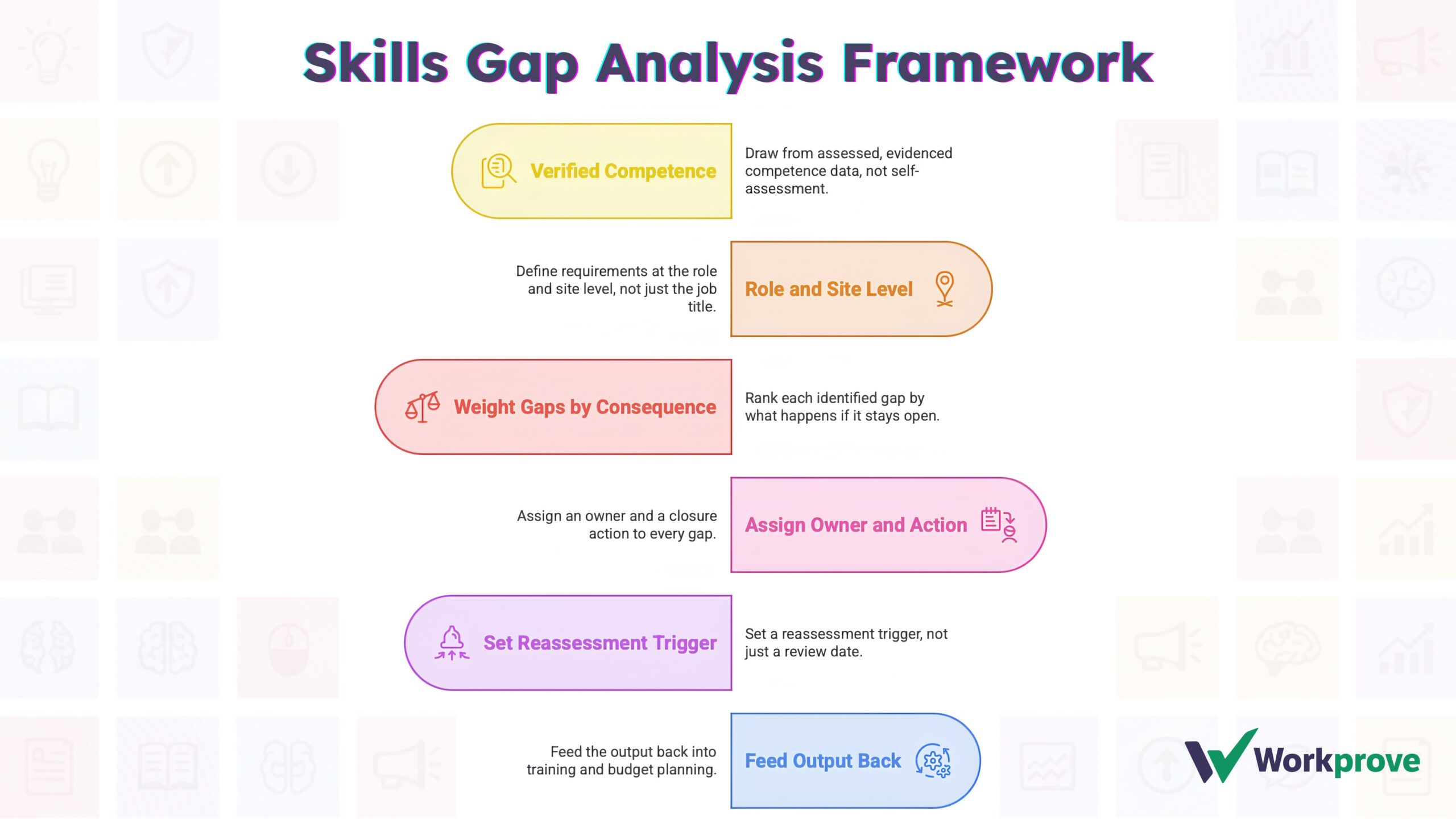
A Skills Gap Analysis Framework That Holds Up Under Scrutiny

Best skills gap framework by workprove

Skills Gap Analysis vs Skills Matrix vs Competency Management: What’s the Difference?

These three terms sit close together and are often used as if they’re interchangeable. They aren’t.

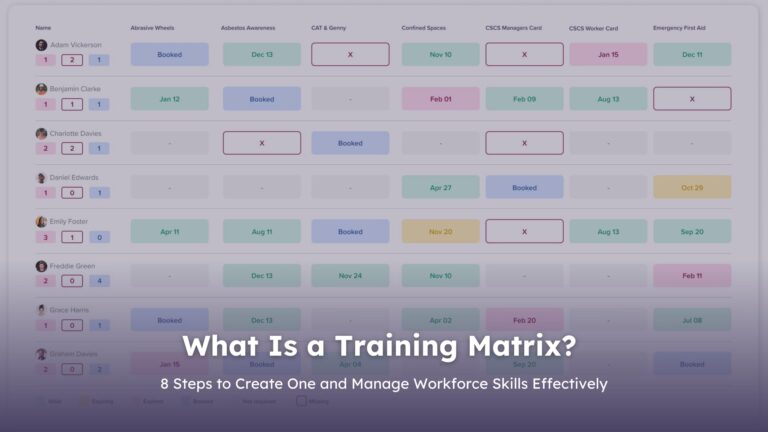
A skills matrix is the visual record: a grid showing who holds which skill, at what level, across a team or site. It’s a snapshot.

A skills gap analysis is the comparison and prioritisation exercise run against that record: what’s missing, and which missing pieces matter most right now.

Competency management is the ongoing system that keeps the first two honest over time, defining what competence actually looks like for each role, running the assessments that verify it, and feeding new gaps back into the matrix automatically as roles, equipment and regulations change.

Thus, the matrix shows you the picture, the gap analysis tells you what to do about it, and competency management is what stops the picture from going stale six weeks later.

Need a Ready-Made Skills Gap Analysis Template?

Rather than building a scoring system from scratch, download our free skills gap analysis template, including:

✓ Role requirement mapping sheet
✓ Verified-competence scoring framework, not self-assessment
✓ Consequence-weighted gap prioritisation matrix
✓ Action and ownership tracker
✓ Reassessment trigger log

Download Free Skills Gap Analysis Template

Using Workprove to Support Your Skills Gap Analysis

Workprove is built for organisations where a skills gap analysis can’t afford to be a once-a-year spreadsheet exercise.

Instead of exporting data and reviewing it periodically, Workprove continuously identifies skills gaps as they happen.

With Workprove you can:

  • See skills gaps by person, role, team or site.
  • Compare verified competence against role requirements in real time.
  • Link each gap directly to the required training.
  • Track costs and training budgets in one place.
  • Maintain a complete, audit-ready evidence trail.

Whether you’re managing multiple sites, agency workers or a rapidly changing workforce, Workprove keeps your skills gap analysis live, accurate and ready for action.

Take a Product Tour — explore the platform without any commitment.
Speak with Experts — talk through your specific compliance and competency challenges.

Conclusion: The Template Isn’t the Hard Part

Building a skills gap analysis template is the easy half of this. Rating current skill against required skill on a 1 to 5 scale takes an afternoon. The hard half, the part that actually determines whether the analysis prevents an incident or just documents one after the fact, is deciding which gaps get acted on first, and being able to show your reasoning if someone asks.

Most organisations that fail an audit despite having a completed skills gap analysis on file didn’t fail because the template was wrong. They failed because the analysis ranked gaps by how easy they were to count rather than by what they actually risked, and because nobody revisited it between the point it was signed off and the point something changed on the ground.

A skills gap analysis earns its place in a compliance framework only when it does two things a spreadsheet snapshot can’t: weight gaps by consequence rather than volume, and stay current enough that the answer it gives today still holds tomorrow. Everything else, the formatting, the colour coding, the scoring scale, is detail that matters far less than getting those two things right.

FAQs

What is the difference between a skills gap and a skills gap analysis?

A skills gap is a single instance of missing or outdated competence. A skills gap analysis is the broader process of identifying every gap across a workforce, then ranking them by consequence so the ones that matter most get addressed first.

How often should a skills gap analysis be run?

As a minimum baseline, annually. In regulated or high-risk environments, it should also be triggered by specific events, a role change, new equipment, a procedure update or a regulatory change, rather than relying solely on a calendar date, since those events are what actually create new gaps.

Is a skills gap analysis the same as a training needs analysis?

They overlap but aren’t identical. A training needs analysis typically starts from business or strategic objectives and asks what capability the organisation will need. A skills gap analysis usually starts from current role requirements and asks what’s missing right now. Many organisations run both together.

Can a spreadsheet-based skills gap analysis template be enough?

For a small, single-site team with low regulatory exposure, a well-designed spreadsheet can work as a starting point. In multi-site, high-turnover or safety-critical environments, a spreadsheet struggles to stay current and rarely produces the kind of dated, attributable evidence trail that auditors expect to see.

How can Workprove help with skills gap analysis?

Used across a wide range of industries, Workprove is a smart workforce training and competency management system that gives organisations a real-time view of skills, training and competence. It helps identify skills gaps, assign the right training, track progress and maintain an audit-ready evidence trail from a single platform.

References

CIPD (2023) Learning at Work 2023. Available at: https://www.cipd.org/en/knowledge/reports/learning-at-work/

Health and Safety Executive (2025) Key figures for Great Britain 2024 to 2025. Available at: https://www.hse.gov.uk/statistics/overview.htm 

The Open University (2025) Business Barometer 2025. Available at: https://business.open.ac.uk/business-barometer

You might also like

View All Resources
What is a training matrix blog
Blog

What is a Training Matrix? 8 Steps to Create One Effectively

Find Out More