DVLA Licence Check for Employers
Skip to content

DVLA Licence Check for Employers

DVLA licence check employer blog cover image

What the DVLA Licence Check Actually Is, and What It Is Not

A DVLA licence check for employer means to verify that staff who drive for work hold a valid licence and remain legally entitled to carry out their driving duties. It’s also precisely defined and deliberately bounded. It tells you what was true about a driver’s legal standing at the moment the check was run. It says nothing about what’s changed since, whether a medical condition now affects fitness to drive, or whether the person behind the wheel is competent, assessed, and current for the vehicles, routes, and conditions they’re actually working in.

A check confirms legal entitlement to drive. It does not confirm operational readiness to do so safely. Both matter under UK law, and only one is captured by the DVLA record.

A DVLA Licence Check ConfirmsIt Does Not Confirm
Valid driving licenceDriver competence
Licence categoriesRole-specific authorisation
Penalty pointsRefresher training completed
EndorsementsSite-specific driving assessments
DisqualificationsSafe driving behaviours
Vehicle entitlementsCurrent operational readiness

Legal Requirements for Driving Licence Checks for Employees

UK legislation expects considerably more than confirming someone holds a valid licence:

  • Road Traffic Act 1988, s.87(2) makes it a criminal offence to permit someone to drive without a licence authorising that vehicle class. For employers, this is a direct criminal liability, not a civil risk.
  • Health and Safety at Work etc. Act 1974, s.2 places a duty on employers to ensure employee safety, which HSE applies explicitly to driving: employers must be satisfied drivers are competent and capable of driving safely in the context of their role, not just licensed (HSE, 2014).
  • Corporate Manslaughter and Corporate Homicide Act 2007 means organisations can be found guilty where serious management failures cause a death through gross breach of duty of care. Director and senior manager liability under health and safety law remains fully intact alongside it (HSE, 2024).

Together, these create a layered obligation for: verify the licence, monitor regularly enough for that verification to stay meaningful, act on what you find, and be able to prove all of it. Most organisations meet the first requirement and treat it as the whole.

The Risks of Missing an Employee Licence Check in the UK

Employees are not legally required to inform their employer of new penalty points, endorsements, or changes to licence status (Safety Forward, 2026). That’s not an edge case, it’s the default legal position, and in a business running manual, infrequent checks, it creates a compliance window that can stay open for months or years.

When a vehicle incident occurs, the investigation doesn’t just examine the driver’s conduct. It asks what the employer knew, when they knew it, and whether a process existed to detect a change in status and was systematically applied. A one-off onboarding check, filed and never revisited, answers none of those questions favourably.

The financial exposure compounds the legal exposure. An at-fault incident involving a suspended licence will often invalidate commercial vehicle insurance, push liability for third-party claims onto the organisation directly, and damage tender eligibility in regulated sectors. The cost of not monitoring consistently outweighs the cost of doing so.

Where Driver Licence Compliance in the UK Breaks Down

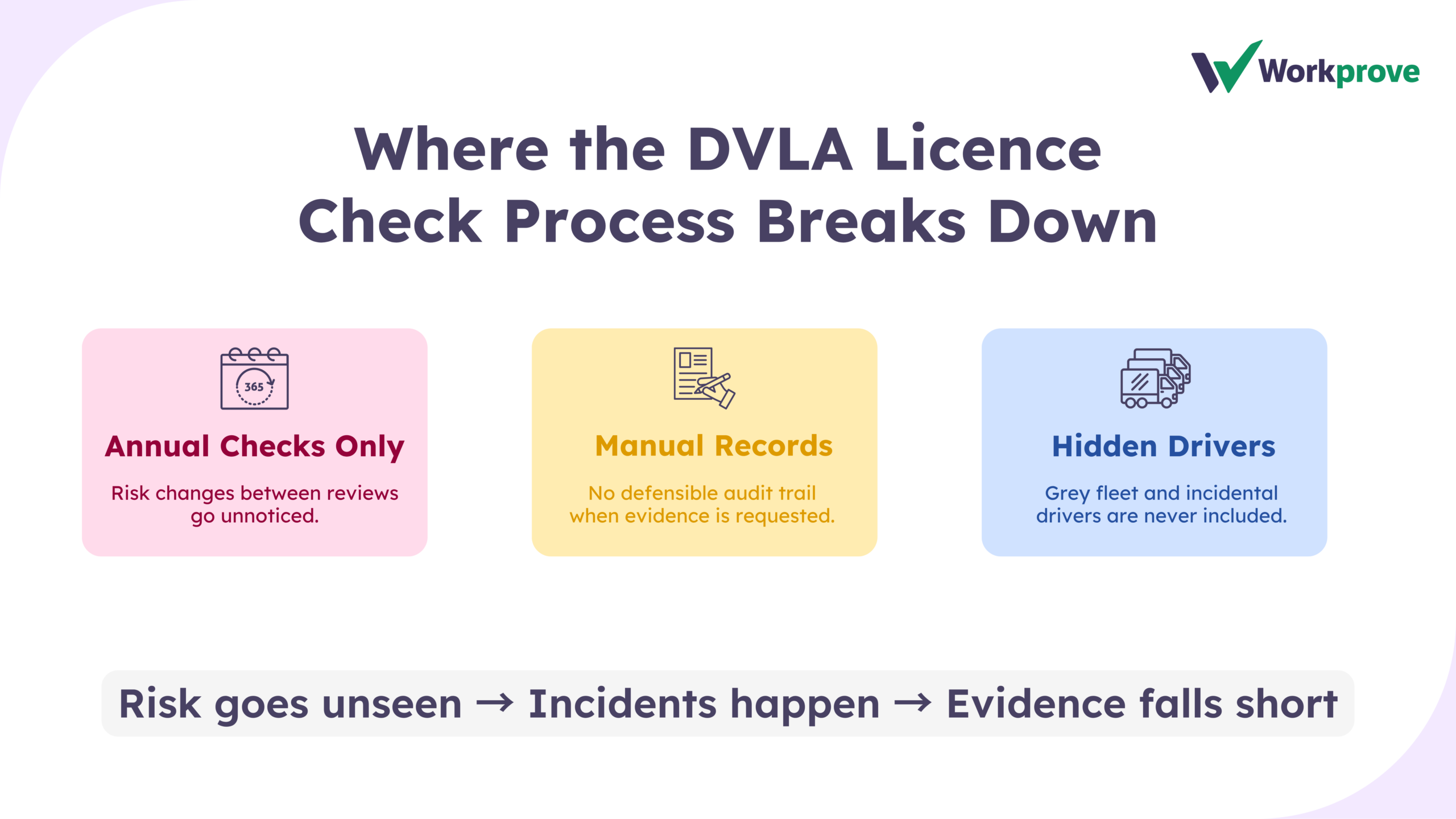
Most failures happen because employers treat the DVLA licence check as a one-off task instead of an ongoing compliance process.

The Annual Check That Isn’t

A national logistics company employs 200 drivers across four depots. The compliance team conducts manual DVLA checks each April, documents results in a shared spreadsheet, and notifies depot managers of any driver with four or more points. The process runs as designed.

What the process cannot see is what happens between checks. Between April 2024 and April 2025, eleven drivers accumulate new penalty points. Four of them reach six or more. Two reach eight. Under the company’s own fleet risk policy, any driver with six or more points should be referred for a driving duties review. That policy is never triggered, because no one has visibility of those points until the following April.

During that same period, one of the eight-point drivers is involved in a serious collision resulting in life-changing injuries to a third party. The investigation surfaces not only the driver’s points history but the absence of any monitoring process capable of detecting a change in risk status between annual checks. The employer cannot demonstrate ongoing duty of care. Its insurer declines to settle. The legal and reputational consequences far exceed anything a monitoring platform would have cost.

This scenario illustrates a pattern HSE has identified repeatedly: organisations believe they are compliant because a process exists, without recognising that the process only covers a fraction of the time period during which risk is actually accumulating. Penalty points for mobile phone use and speeding offences remain on a licence for between four and eleven years (RAM Tracking, 2026). A driver can reach twelve points and face a ban without any automated alert reaching their employer. The check does not fail. The frequency at which it is run is what fails.

The Spreadsheet That Cannot Prove Anything

A regional groundworks contractor employs 40 operatives, around half of whom drive for work. DVLA licence check runs by employer or operations manager when capacity allows, notes results in a spreadsheet, and files it on a shared drive. The spreadsheet has columns for driver name and last check date. It does not record what specific information was returned, what action was taken, or who authorised the review. 

Following a near-miss incident involving one of those operatives driving a tipper truck, HSE requests evidence of the contractor’s driver compliance process. The spreadsheet is produced. The inspector asks for the specific date the most recent check was conducted, the precise result it returned, whether the driver had accumulated any points in the preceding two years, and what action the contractor took when the driver reached six points in January. None of those questions can be answered from the spreadsheet.

Manual checks of this kind typically leave no audit trail capable of demonstrating duty of care under investigation (RAM Tracking, 2026). Employers are expected to retain consent records alongside dated, method-attributed check results precisely so that the record is defensible rather than merely present (RAM Tracking, 2026; EBC Global, 2025). A process that took place but cannot be evidenced is, from a compliance standpoint, functionally indistinguishable from a process that never happened.

The Drivers Nobody Thought to Check

A community healthcare provider employs 60 district nurses across two county areas. Each nurse uses their own vehicle to travel between patient homes, covering 30 to 50 miles per working day. Management or employer has never initiated a DVLA licence check for this group. The rationale, when examined, is that the vehicles are privately owned and therefore the employer’s obligations are limited.

That position is not supported by law. When an employee drives for work purposes, the employer’s duty of care applies regardless of vehicle ownership (RAM Tracking, 2026). HSE’s guidance on work-related road safety does not distinguish between employer-owned and employee-owned vehicles in its application of the duty (HSE, 2014, p.1).

Employees using personal vehicles for work journeys, commonly described as grey fleet, sit squarely within the scope of employer compliance obligations. For organisations in healthcare, facilities management, social care, and professional services, this is one of the largest concentrations of unmanaged driving licence risk in UK workplaces: not drivers with hidden penalty points, but drivers who have never been identified as drivers at all.

The same pattern emerges in manufacturing. At a food processing site, 12 operatives drive company vans between production bays and external loading docks as an incidental part of their role. Driving was not listed in their job descriptions when those descriptions were written three years ago. No DVLA licence check has ever been initiated by employer. Following a vehicle incident on the loading approach road, the investigation finds that two operatives involved held licence restrictions that no one at the organisation had ever reviewed. The compliance gap was not in the checking process. There was no checking process, because the task had never been formally classified as driving.

👉🏻 Suggested Reading: Transport, Logistics and Warehousing Training and Compliance Management. A detailed guide to how compliance obligations apply across driving-intensive sectors, including how grey fleet and incidental driving roles sit within the employer’s duty of care framework.

Why a Valid Licence Does Not Mean a Competent Driver

This is where the most significant compliance risk actually sits, and it’s what most guidance misses entirely. HSE estimates up to a third of all road traffic accidents involve someone at work at the time, accounting for over 20 fatalities and 250 serious injuries every week (HSE, 2014). Some employers assume that a valid MOT and a valid licence are enough. They’re not; health and safety law applies to on-road work exactly as it does to fixed workplaces.

Take a logistics operator running 40 vehicles across three sites. Every driver holds a valid DVLA licence, every annual check comes back clean by employer. What the checks don’t show: fourteen drivers were never formally assessed against site-specific procedures updated 18 months ago, eight haven’t completed a refresher since a change in load configuration, five are operating categories they trained on four years ago and haven’t been reassessed since. The licence is valid. The competence picture isn’t. yay it’s done all 6 of 6. yeh yada nahi a

This gap persists for a structural reason. Licence data sits with HR or fleet management, training records live with L&D, competency assessments belong to operations, and none of these systems talk to each other. So the question “is this driver both licensed and competent for this role, today?” can’t be answered from any single source. When an investigator asks it after an incident, assembling the answer takes hours and exposes exactly the fragmented audit trail that signals an absence of oversight rather than its presence.

The gap isn’t a missing-data problem, it’s an architecture problem: the failure to connect information that, taken together, would show whether someone is safe to drive today.

👉🏻 Suggested Reading: Free Skills Audit Template. A practical guide with free template to your workforce competence records reflect genuine and role-specific capability.

Building a Better DVLA Employer Check Process

The organisations that withstand scrutiny after serious incidents aren’t the ones that ran the most checks. They’re the ones that built a process capable of detecting change, escalating it, and evidencing every step. Five things distinguish that process:

  • Documented consent at hire:dated, stored with expiry, and renewed, not filed once and treated as permanent (Veremark, 2024; EBC Global, 2025).
  • Risk-based monitoring frequency: a driver with nine points and a prior disqualification needs a different cadence than one with a clean ten-year record (RAM Tracking, 2026).
  • Automated, continuous monitoring: manual checks take 20-30 minutes per driver, leave no verifiable audit trail, and are out of date the moment they’re taken (RAM Tracking, 2026). Automated checks flag changes as they happen.
  • Complete, method-attributed audit trail: date, method, result, and action taken, logged and available for inspection without preparation.
  • Integration with competency records: when licence monitoring sits in the same system as training and role-specific assessments, the gap between legal permission to drive and demonstrated competence becomes visible and manageable.
Manual DVLA ChecksContinuous Monitoring
Annual or ad hocOngoing monitoring
Spreadsheet recordsAutomatic audit trail
Changes found months laterChanges identified immediately
High admin effortMinimal administration
Difficult to evidenceTimestamped evidence
ReactiveProactive

How Workprove Makes This Manageable Across Any Organisation, at Any Scale

The scenarios above share a common thread: decisions made, or not made, without accurate and timely visibility of driver status. These are system failures, and they’re exactly what Workprove’s Driving Licence Monitoring is built to address.

Workprove provides provides continuous, automated monitoring against DVLA data, with points, convictions, and disqualifications surfaced in real time. Built-in risk scoring categorises drivers as low, medium, or high risk automatically. GDPR-compliant consent tracking removes the manual burden of managing expiry dates. And because every check produces a timestamped, method-attributed record, the audit trail builds itself rather than getting assembled retrospectively under pressure.

Because licence monitoring sits within the same platform as training and competency records, compliance leads get a single, continuously updated view across licence validity, training currency, and competency, rather than three disconnected data sources to chase down when it matters most.

Take a product tour or speak to our team about building a driving compliance process that goes beyond the licence check.

Workprove gives organisation audit-readiness and visibility instantly, every time with smart training tracker and skills tracker. blog image png

Conclusion: The Licence Is the Floor, Not the Standard

A DVLA licence check confirms a driver was legally entitled to drive at the moment the check ran. That’s a necessary condition for compliance. It isn’t a sufficient one. A driver can hold a valid licence, pass every annual check, and still present a material, unmanaged risk if their competence has never been assessed against the actual demands of their role.

Proactive compliance isn’t about doing more checks. It’s about building a system where the relevant information is connected, current, and acted on, without anyone having to chase it down after the fact.

References

Corporate Manslaughter and Corporate Homicide Act 2007 (c.19). London: The Stationery Office. Available at: https://www.legislation.gov.uk/ukpga/2007/19/contents (Accessed: 1 July 2026).

EBC Global (2025) DVLA licence checks simplifies compliance and reduces risk. Available at: https://ebcglobal.co.uk/simplified-dvla-licence-checks/ (Accessed: 1 July 2026).

Health and Safety at Work etc. Act 1974 (c.37). London: The Stationery Office. Available at: https://www.legislation.gov.uk/ukpga/1974/37/section/2 (Accessed: 1 July 2026).

Health and Safety Executive (HSE) (2014) Driving at work: managing work-related road safety. INDG382(rev1). Bootle: HSE. Available at: https://www.hse.gov.uk/pubns/indg382.htm (Accessed: 1 July 2026).

Health and Safety Executive (HSE) (2024) About corporate manslaughter. Available at: https://www.hse.gov.uk/corpmanslaughter/about.htm (Accessed: 1 July 2026).

RAM Tracking (2026) DVLA driver licence checks for UK fleets. Available at: https://www.ramtracking.com/fleet-management-software/driver-licence-checks (Accessed: 1 July 2026).

RAM Tracking (2026) Grey fleet management. Available at: https://www.ramtracking.com/vehicle-tracking/grey-fleets(Accessed: 1 July 2026).

Road Traffic Act 1988 (c.52). London: The Stationery Office. Available at: https://www.legislation.gov.uk/ukpga/1988/52/section/87 (Accessed: 1 July 2026).

Safety Forward (2026) Driving licence check for employees: DVLA employer guide. Available at: https://safetyforward.co.uk/do-you-check-your-employees-driving-licence/ (Accessed: 1 July 2026).

Veremark (2024) DVLA licence check: a guide for employers. Available at: https://www.veremark.com/blog/dvla-licence-check-a-guide-for-employers (Accessed: 1 July 2026).

You might also like

View All Resources
What is a training matrix blog
Blog

What is a Training Matrix? 8 Steps to Create One Effectively

Find Out More
Training tracker full guide. best comprehensive blog on employee training tracker and skills tracker
Blog

What Is a Training Tracker? Complete Guide to Tracking Employee Training

Find Out More
Blog

What is a Skills Matrix? Definition, Examples and a Free Template.

Find Out More
Competency management full blog cover image
Blog

What Is Competency Management? And Why Most Organisations Are Getting It Wrong and How to Fix it?

Find Out More