What Is a Training Tracker?
Skip to content

What Is a Training Tracker? Complete Guide to Tracking Employee Training

Training tracker full guide. best comprehensive blog on employee training tracker and skills tracker

Every organisation with mandatory training eventually asks the same question: how do we actually know who is qualified, right now, today? The honest answer, for most businesses, is that they don’t. Not with confidence. They have a spreadsheet, a folder of certificates, and a general sense that things are “mostly up to date.” A training tracker exists to close that gap between believing you’re compliant and being able to prove it.

This guide explains what a training tracker is, what it should track, how it differs from related tools such as a skills tracker or training matrix, and why the systems most organisations rely on quietly fail long before anyone notices.

What Is a Training Tracker?

A training tracker is a system, whether a spreadsheet or dedicated software, that maintains a live, structured record of who has completed which training, when it was completed, when it expires, and whether the person is currently compliant for their role. At minimum, a functioning training tracker needs to answer four questions for every member of staff:

  • Who holds which qualifications and certifications
  • What training each role actually requires
  • When each qualification was completed and when it expires
  • Status, meaning whether someone is currently valid, expiring soon, or already non-compliant

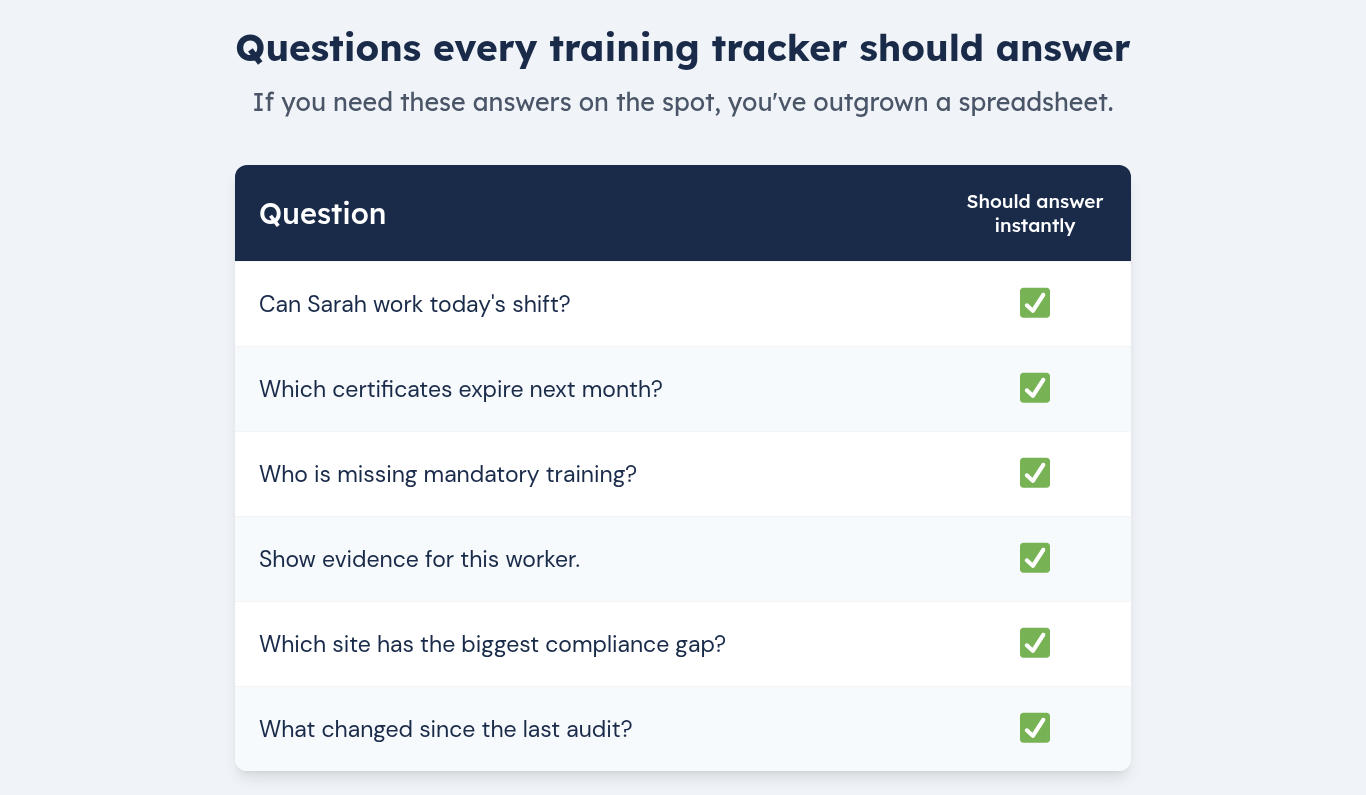
That register needs to be the single source of truth. If a manager, an auditor, or a new team lead cannot answer “is this person currently qualified to do this task?” within seconds, the tracker isn’t doing its job, regardless of how much data it contains.

👉🏻 Suggested Reading: Is Your Training Tracker Audit Ready? Take a quick audit health check to see whether your current training tracker would hold up under real scrutiny, or simply give the appearance of control.
Training Tracker or Skills Tracker? Why the Terminology Doesn’t Matter (But the Data Does)

Ask five compliance leads what they call this system and you’ll likely get five different answers. Some call it a training tracker. Others call it a skills tracker, a training register, or a certification log. In construction and manufacturing, it’s often bundled into the term training matrix. None of these labels are wrong, and none of them are more correct than the others.

Whether you call it a training tracker or a skills tracker, the goal is the same: knowing at a glance who’s qualified, who’s expiring, and who’s falling behind. The terminology tends to reflect emphasis rather than a genuinely different tool. “Training tracker” usually points to the operational log, the who, what, when, and status of individual records. “Skills tracker” more often points to the same underlying data viewed through a competency lens, mapping what people can actually do rather than simply what they’ve attended.

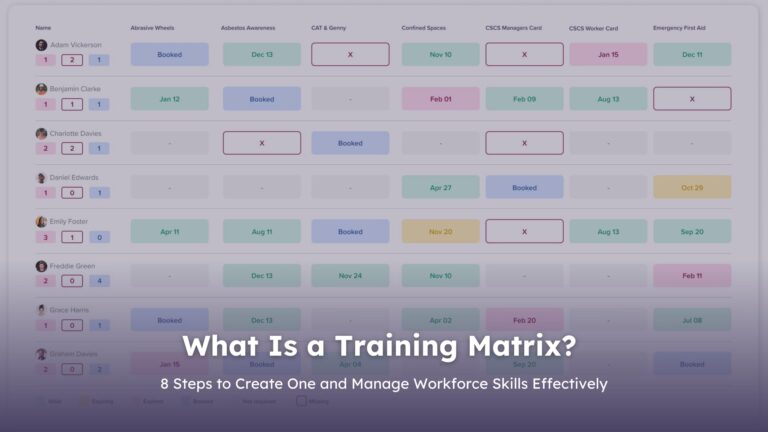
A related but distinct tool is the training matrix, which visualises training requirements against roles in a grid format. If you’re building that structure from scratch, our guide on what a training matrix is and how to build one covers the step-by-step process in detail.

What a Training Tracker Actually Needs to Record

A common mistake is treating a training tracker as a list of course names with tick boxes next to them. That structure answers “did this happen?” but not “does it still hold?” A properly built training tracker, or skills tracker, should capture:

  • Every member of staff, including part-time, agency, and contract workers, not just permanent employees
  • The specific course, certification, or licence, mapped to the role that requires it
  • Completion date and expiry date, in a consistent format
  • Current status: valid, expiring soon, expired, or never completed
  • The evidence itself, such as a certificate, assessor sign-off, or completion record

Notably, that last point is where most spreadsheet-based trackers fall down. A cell that says “Completed” is not evidence. An auditor, a client, or an incident investigator will eventually ask to see the certificate, the assessor’s name, or the assessment criteria behind that tick, and “we’re pretty sure it happened” is not an acceptable answer.

Can you answer if your training or skills tracker be able to show that

Where Manual Trackers Quietly Fail

Most training trackers don’t fail dramatically. They fail slowly, in ways that look fine until someone needs the data under pressure. Three patterns show up repeatedly across regulated sectors.

First, expiry drifts out of view. A spreadsheet only flags an expiring certificate if someone remembers to check it. In practice, that check happens sporadically, often only when an audit is announced, by which point several qualifications may have already lapsed unnoticed.

Second, the tracker records completion, not competence. This is the distinction that matters most, and it’s one we return to throughout our content because it consistently trips organisations up: a training record confirms that someone attended a course. It does not confirm they retained the content, can apply it under real operating conditions, or are still applying it correctly a year later. Consequently, a tracker that only logs completion dates is measuring the wrong thing.

Third, ownership is unclear. When no single person is accountable for keeping the tracker current, everyone assumes someone else is handling it. That gap is rarely visible until an inspector, client, or incident investigation exposes it.

Training Tracker in Practice: How the Same Gap Shows Up Across Industries

The mechanics of a training tracker stay consistent, but the risk it’s protecting against changes considerably by sector. The following scenarios illustrate how the same underlying failure, a tracker that shows “compliant” without verifying it, plays out differently depending on the environment.

Manufacturing. A plant might find that 95% of its forklift operators hold a valid licence, yet only 60% have been assessed against site-specific operating procedures in the last twelve months. The compliance risk here isn’t the licence itself. The risk is the assumption that competence has remained unchanged since the licence was issued, when equipment, layouts, and procedures may have moved on considerably.

Healthcare. A care setting managing medication administration competency might have every staff member showing a green “trained” status in the tracker, while the underlying assessment behind that status is two years old and pre-dates a change in dosing protocol. The tracker looks reassuring. The evidence underneath it has quietly gone stale.

Construction. A site manager reviewing a subcontractor’s CSCS card records might see full compliance on paper, yet discover during a toolbox talk that several workers have never received site-specific induction for the particular hazards on that job. The national qualification is valid. The local competence has never been checked.

In each case, the tracker wasn’t empty. It was confidently, visibly wrong, which is a considerably more dangerous position than having no tracker at all, because it removes the instinct to check further.

👉🏻 Suggested Reading: Free Skills Audit Template: How to Assess Workforce Competence Effectively A practical, downloadable template for verifying whether training has actually translated into current, role-appropriate competence.

Spreadsheet Training Tracker vs Smart System

For a small team with a handful of qualifications to track, a spreadsheet can work perfectly well. The strain typically shows once an organisation grows past roughly 15 to 20 staff in a regulated sector, at which point manual tracking becomes a genuine operational risk rather than a minor inconvenience.

Spreadsheet Training TrackerAutomated Training Tracker
Manual updates; relies on someone remembering to check expiry datesAutomatic expiry alerts sent before certification lapses
Compliance reports built by hand, often taking hours before an auditAudit-ready reports generated in a single click
Version control issues when shared across teams or sitesLive, single source of truth accessible to the right people in real time
No structured evidence attached to completionCertificates, assessor sign-off, and evidence stored against each record
Difficult to scale across multiple sites, shifts, or departmentsBuilt to scale across teams, sites, and shifts without added admin

Neither option is inherently right or wrong. The relevant question is whether your current tracker can still answer “who is compliant, right now, and can you prove it?” in under a minute. If that answer is no, the tracker has already outgrown its format.

Building a Tracker That Actually Reflects Competence

If the goal is a skills tracker rather than a simple completion log, the build process shifts slightly. Instead of starting with course names, start by defining what “competent” genuinely looks like for each role, then work backwards to the training, assessment, and evidence needed to support that standard. This is the same principle underpinning structured competency management: training records show attendance, while competency management measures whether skills can actually be performed to standard.

In practice, this means a skills tracker should show not just whether training happened, but whether it was assessed, by whom, against what criteria, and when that assessment is due for renewal. That additional layer of verification is what separates a genuinely useful skills tracker from a longer list of course completions.

How Workprove Supports Training Tracking

Workprove is a training and compliance management platform built for safety-critical and regulated industries. Its smart training matrix maps every worker to the training their role requires, tracks completion and expiry automatically, and sends alerts before certifications lapse rather than after.

Instead of relying on manual updates, Workprove keeps training records current in real time, giving managers a live view of workforce readiness across every team, site and shift.

Key capabilities include:

  • Role-based training matrix that automatically maps workers to mandatory training requirements.
  • Real-time training records that update instantly as completions, assessments and certifications are added.
  • Automatic expiry alerts so qualifications are renewed before they lapse.
  • Digital worker profiles with certificates, training history and competency evidence in one place, accessible through the Workpass mobile app.
  • Audit-ready reporting that filters records by individual, team, site or qualification in just a few clicks.

The result is a single source of truth for training and competency, replacing scattered spreadsheets, paper files and email chains with live, verifiable records that are always ready when you need them.

Take a Product Tour — explore the platform without any commitment.
Speak with Experts — talk through your specific compliance and competency challenges.

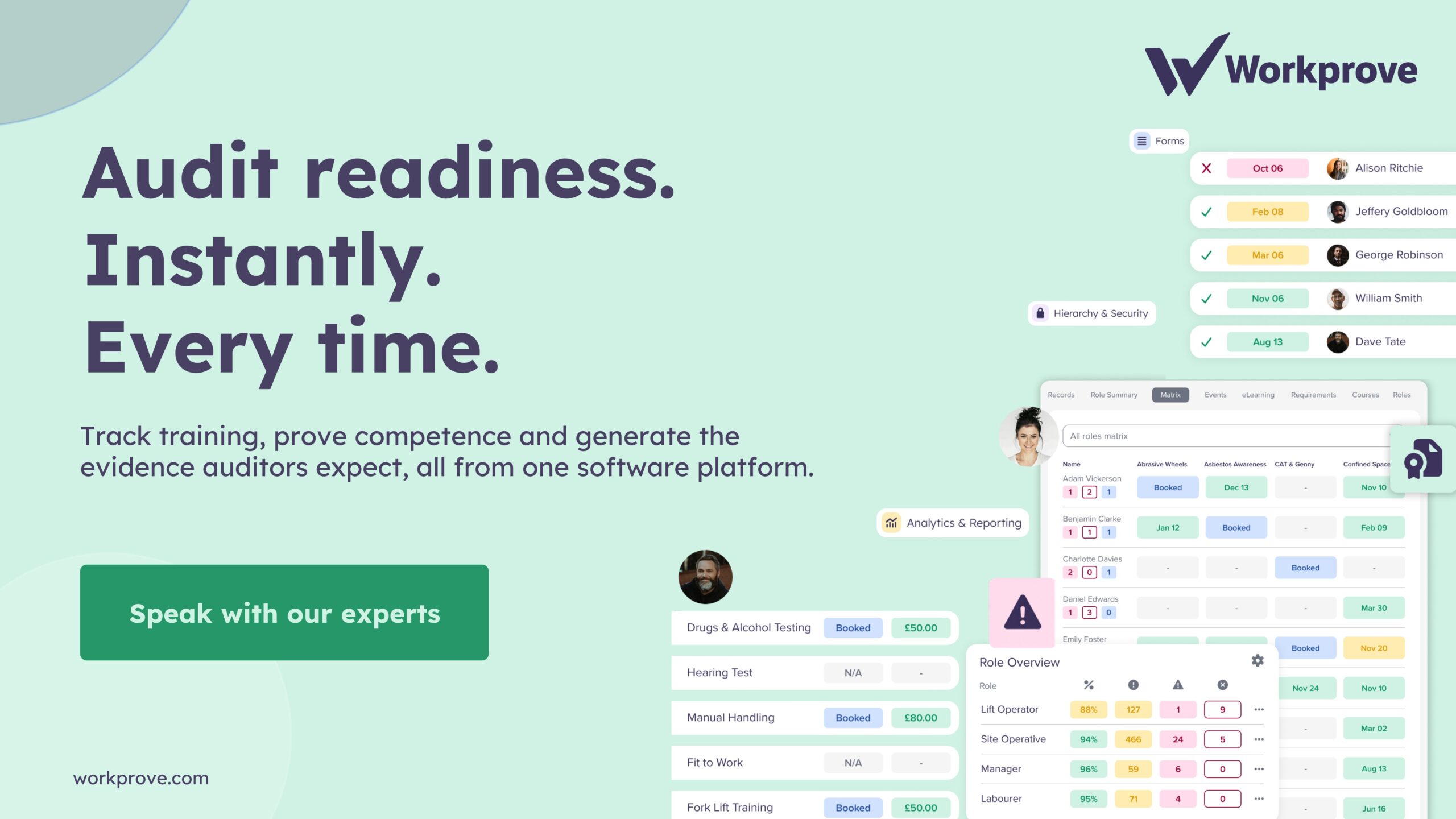
Workprove gives organisation audit-readiness and visibility instantly, every time with smart training tracker and skills tracker. blog image png

What Good Training Tracking Actually Looks Like

By the time a training tracker, or skills tracker, is doing its job properly, an organisation should be able to say the following without hesitation: every employee’s record maps to their current role, expiring qualifications are flagged automatically rather than discovered by accident, evidence sits behind every completion rather than a bare tick box, and one named person owns the process end to end. That is not an aspirational standard. It’s the baseline that separates organisations that pass audits calmly from those that scramble the night before one arrives.

The distinction that actually matters, in the end, is not what you call the system. It’s whether it tells you the truth about your workforce today, not the truth as it stood when the training was originally completed.

FAQs

What is the difference between a training tracker and a training matrix?

A training tracker is the underlying record of individual training completions, expiry dates, and status. A training matrix typically visualises that same data in a grid format, mapping roles against required training so gaps are visible at a glance. Many organisations use the terms interchangeably, and in practice, most modern software combines both functions in one system.

Is a skills tracker the same thing as a training tracker?

Largely, yes, though the emphasis differs slightly. A training tracker tends to focus on completion and expiry of specific courses or certifications. A skills tracker more often frames the same data around competency, meaning what an individual can actually demonstrate, not just what they’ve attended. Whichever term your organisation uses, the underlying data requirements are the same.

Can I build a training tracker in a spreadsheet?

Yes, and for very small teams this may be sufficient. However, spreadsheets rely entirely on someone remembering to check and update them manually, offer no automatic expiry alerts, and become increasingly error-prone as headcount and qualification types grow. Most organisations outgrow a spreadsheet once they pass roughly 15 to 20 staff in a regulated sector.

Why is Workprove a better choice than a spreadsheet training tracker?

While spreadsheets can work for very small teams, they quickly become difficult to manage as organisations grow. Workprove automates training tracking by sending expiry reminders, updating training matrices in real time, storing evidence against every record, and generating audit-ready reports in a single click. Instead of relying on manual updates, managers always have a live view of workforce training, competence and compliance across every team, site and shift.

How often should a training tracker be reviewed?

At minimum, expiring qualifications should be reviewed monthly, with a fuller audit of the entire tracker, including whether assessments behind completions remain current, carried out quarterly. Software-based trackers reduce this burden considerably by flagging expiries automatically rather than requiring a manual review cycle.

Does a training tracker prove competence, or just training completion?

On its own, a basic training tracker typically proves only that training took place. Proving competence requires an additional layer: documented assessment against defined criteria, by an identifiable assessor, refreshed on a defined cycle. Organisations that treat the two as identical are often the ones caught out during an audit

You might also like

View All Resources
What is a training matrix blog
Blog

What is a Training Matrix? 8 Steps to Create One Effectively

Find Out More
Blog

What is a Skills Matrix? Definition, Examples and a Free Template.

Find Out More
Competency management full blog cover image
Blog

What Is Competency Management? And Why Most Organisations Are Getting It Wrong and How to Fix it?

Find Out More