Training and Compliance Management for Schools and Nurseries
Skip to content

Training and Compliance Management for Schools and Nurseries

Training and Compliance Management for Schools and Nurseries Blog Cover image

Introduction to School Compliance Management

Schools and nurseries operate in one of the most regulated and high‑responsibility environments in the United Kingdom. Not only are they responsible for delivering education and early years development, but they are also carry responsibility for safeguarding children, meeting statutory compliance, and ensuring all staff can perform their roles safely and effectively.

Moreover, this responsibility has intensified considerably in recent years. Updated statutory guidance such as Keeping Children Safe in Education (KCSIE) places stronger expectations on settings to train staff effectively and to maintain reliable evidence of competency. At the same time, workforce shortages persist, and regulatory scrutiny from Ofsted and enforcement bodies continues to rise. Consequently, senior leadership teams are required not simply to educate, but to sustain continuous assurance of training, competency, and compliance across their workforce.

Crucially, in many settings, training completion is often mistaken for competency. However, completing a course does not guarantee that an individual can apply that knowledge effectively in real-world situations.

In this context, training and compliance management for school and nurseries should be understood not as administrative functions, but as operational safeguards. Without clear and real‑time visibility into staff proficiency, risk moves from theory into everyday reality, affecting classrooms, playgrounds, and care environments.
The Sector: Scale, Structure and Responsibility

The education and early years sector in England spans a wide range of settings, including maintained schools, academies, multi-academy trusts, independent schools, and private nurseries operating under the Early Years Foundation Stage (EYFS) framework. As a result, the regulatory landscape is broad and encompasses multiple statutory frameworks.

Firstly, the scale of the workforce in state-funded schools alone remains substantial. In the 2024/25 reporting year, there were around 986,000 full-time equivalent (FTE) staff working in state-funded schools in England, nearly half of whom are teachers, with thousands of support staff and assistants completing the workforce composition (Department for Education, 2025).

Similarly, the early years workforce is significant, with approximately 277,900 staff in group-based childcare provision and a further 59,800 in school-based early years roles (House of Commons Library, 2025).

Despite this scale, the sector currently faces sustained pressure. Teacher vacancy rates recently reached their highest levels in a decade, while recruitment challenges remain acute and temporary staff are increasingly common (National Audit Office, 2025). Likewise, the early years workforce, although having grown in absolute terms in recent years, has struggled to expand quickly enough to meet new policy commitments such as extended childcare entitlements, which would require tens of thousands of additional qualified early years practitioners (NFER, 2026).

As a result, many settings operate with a blended workforce model, where permanent staff, agency workers and temporary practitioners work interchangeably across different days and roles.

Consequently, many settings are heavily reliant on supply teachers, agency staff, volunteers and temporary practitioners. While the use of these staffing models is often necessary, it introduces complexity in verifying training, safeguarding compliance, and ensuring suitability for role-specific responsibilities. In this environment, school training and compliance management becomes significantly more complex due to constant workforce variation and fluctuating responsibility coverage.

RoleCommon Training AreasNotes
All StaffSafeguarding (KCSIE), Prevent awarenessRequired for all staff, with regular updates
Nursery PractitionersSafeguarding, Paediatric First AidEYFS requires at least one person with valid paediatric first aid present at all times
Designated Safeguarding Lead (DSL)Advanced SafeguardingMust receive enhanced training and regular updates in line with statutory guidance
Teaching StaffSafeguarding, Behaviour management, Health & SafetyRequirements vary by school and role responsibilities
Support / Temporary StaffSafeguarding (induction level)Must understand setting-specific safeguarding procedures before working

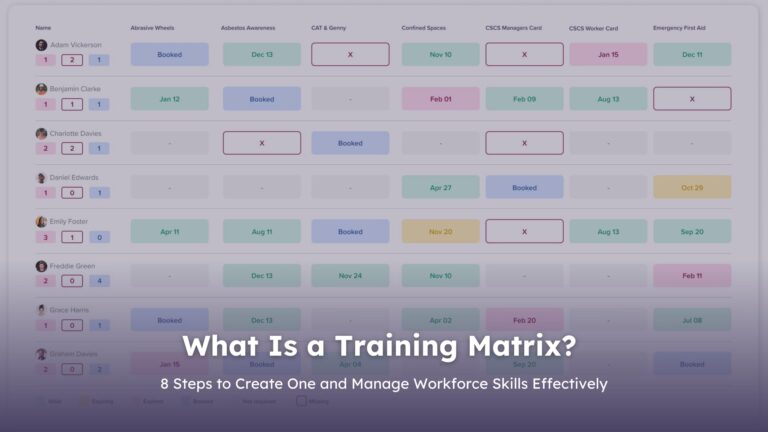
👉🏻 Suggested reading: What is a Training Matrix? A practical guide explaining how structured training matrices help schools and nurseries map competency requirements clearly across roles and responsibilities.

Safeguarding Training in Schools UK and Statutory Expectations

Safeguarding is the most critical compliance responsibility within schools and early years settings. This reflects the fundamental duty to protect children from harm and ensure staff are equipped to identify and respond to safeguarding concerns appropriately.

In England, referrals to children’s social care remain consistently high, with over 620,000 referrals recorded in 2023/24, including more than 139,000 re-referrals where prior concerns had already been identified (Department for Education, 2026). This highlights the ongoing and complex safeguarding demands placed on education settings.

Statutory guidance, including Keeping Children Safe in Education, requires that all staff receive appropriate safeguarding training on induction and at regular intervals. This training must be clearly documented and updated in line with guidance, with content tailored to role-specific responsibilities such as recognising indicators of abuse and escalating concerns correctly.

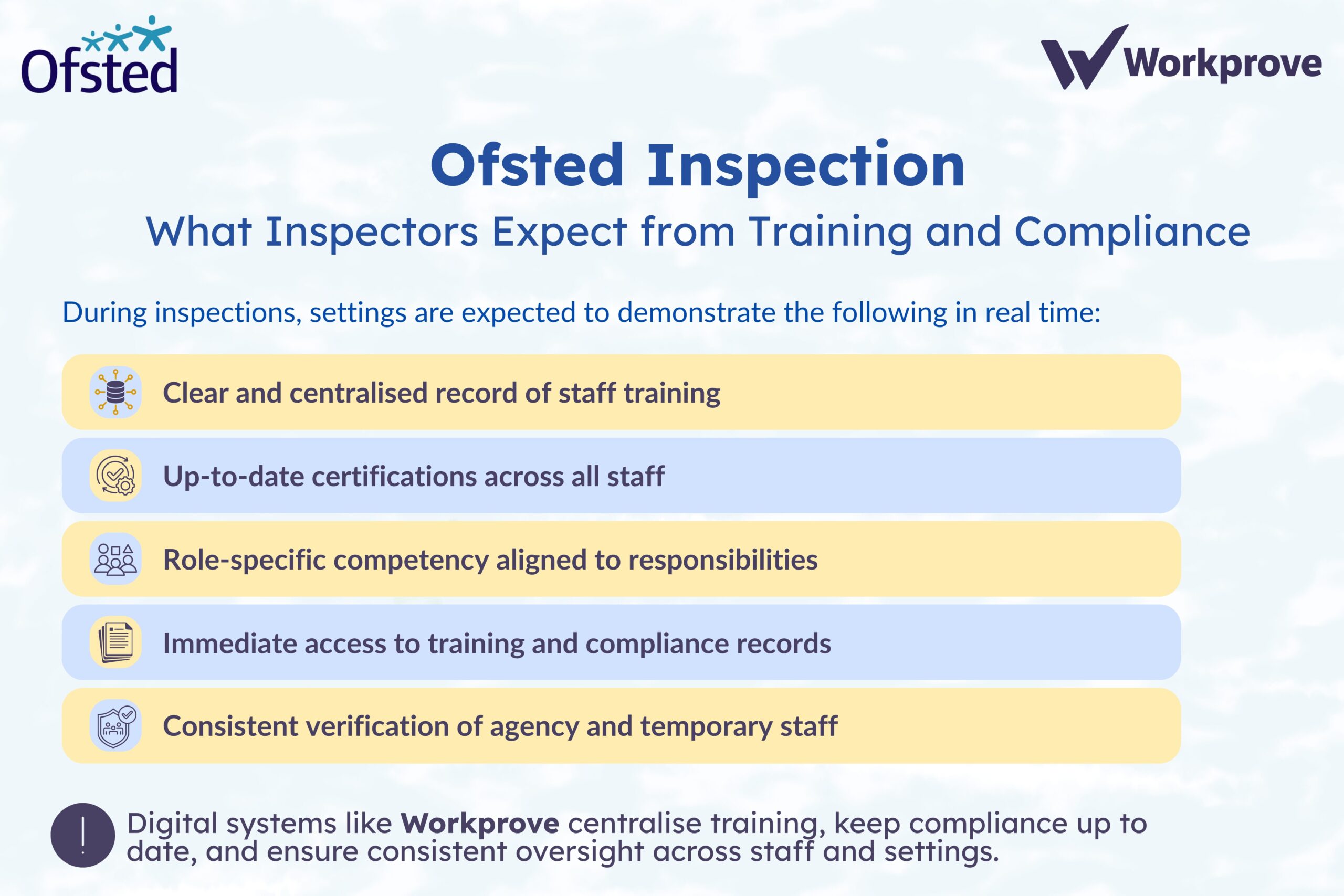
Ofsted inspections place equal emphasis on implementation as well as policy. Inspectors typically expect organisations to demonstrate that:

  • Staff have completed relevant safeguarding training
  • Training is current and role-appropriate
  • Safeguarding risks are identified and managed effectively
  • Compliance is monitored continuously rather than retrospectively

Thus, this creates a significant operational expectation: leadership teams must be able to evidence compliance instantly during inspection or review. The challenge for many settings is not the absence of training, but the lack of real-time visibility into whether training records are complete, current, and aligned to role requirements.

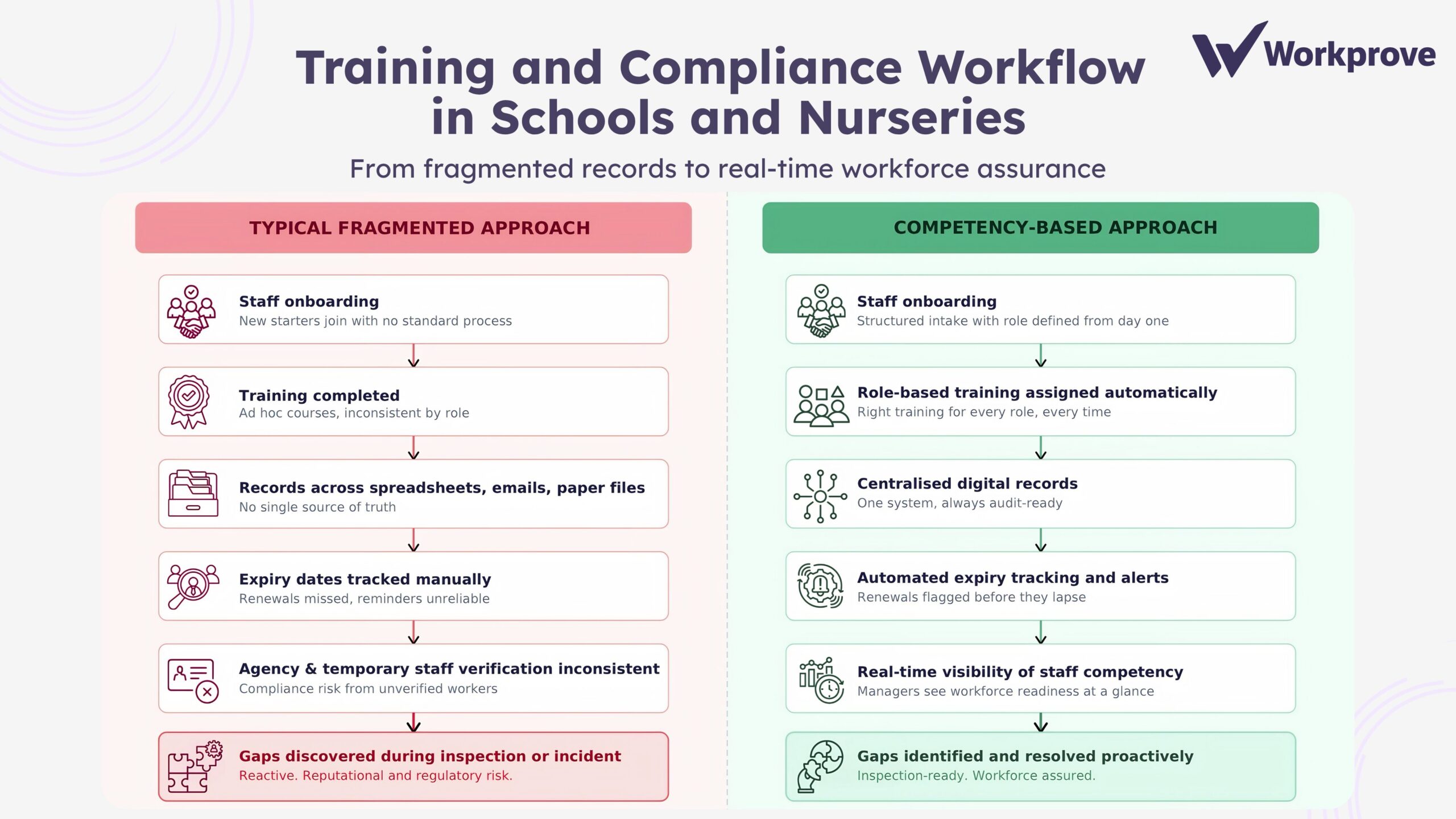
In practice, this is how school and nurseries training and compliance management typically operates across many schools and nurseries, and where gaps begin to emerge:

training and complaince management in schools and nurseries- wrong vs right approach comparison table png

Health and Safety Law: Practical Obligations and RIDDOR Reporting

In addition to safeguarding, schools and nurseries training and compliance management are subject to health and safety law under the Health and Safety at Work etc. Act 1974. This legislation places a duty on employers to protect the health, safety and welfare of employees, pupils and visitors so far as is reasonably practicable, and it is enforced by the Health and Safety Executive (HSE) and, where relevant, local authorities (GOV.UK, 2022).

Moreover, Reporting of Injuries, Diseases and Dangerous Occurrences Regulations (RIDDOR) 2013 requires employers and those in control of premises to report specified work‑related injuries, certain occupational diseases and dangerous occurrences. However, most incidents in schools, including minor accidents, play injuries and slips with no reportable outcome do not need to be reported under RIDDOR. Only serious injuries, fatalities, and dangerous occurrences with significant potential for harm must be formally notified to HSE (HSE, 2023).

For example, a minor playground injury would typically be recorded internally, whereas a serious injury to a staff member requiring hospital treatment may trigger a RIDDOR report.

Importantly, RIDDOR reporting duties apply not only to employers, but also to those in control of premises and responsibilities, typically the headteacher, proprietor or governing body, depending on setting type and they must maintain accurate records of reportable incidents even where no external notification is required.

Furthermore, HSE guidance requires schools to maintain internal incident recording systems and clearly define when external reporting applies.

Because most incidents in education settings are not reportable under RIDDOR, compliance teams and leaders must nonetheless ensure they manage, record and investigate all incidents to inform risk controls and to demonstrate effective health and safety management, particularly during inspections or enforcement reviews. 

The Shift Towards Competency‑Based Workforce Management

Many organisations are beginning to move away from checklist‑based compliance toward competency‑based workforce management. This approach emphasises:

  • Mapping training and regulatory requirements directly to job roles rather than individuals only;
  • Continuous monitoring of competency status rather than periodic checks;
  • Live dashboards providing visibility of workforce training and compliance;
  • Automated alerts for upcoming renewals and gaps before they become regulatory risks.

This shift is critical because it moves organisations from simply recording activity to actively managing risk in real time. In practice, school training and compliance management is evolving into a continuous oversight function rather than a periodic administrative task.

👉🏻 Suggested reading: Transport, Logistics and Warehousing Training and Compliance Management.
Shows how other high-risk industries are already using real-time competency systems to move beyond manual compliance tracking.

How Workprove Supports Schools and Nurseries

Workprove was designed with these operational challenges in mind. Unlike fragmented systems that silo records, Workprove brings training, certification and compliance data together in a single platform for care-critical industries like schools and nurseries.

Its key strengths include:

  • A central repository for all training and compliance records;
  • A live competency matrix showing staff training status in real time;
  • Automated tracking of expiry dates for safeguarding, first aid and other statutory certifications;
  • Alignment of compliance requirements with role profiles, ensuring that training is not only completed, but verified against what the role actually demands;
  • Audit‑ready documentation that can be produced quickly during inspections or enforcement reviews.

By consolidating records in one place, school training and compliance management becomes more transparent, structured, and proactive. Workprove allows leadership teams with these objectives to move away from chasing fragmented evidence and towards confident, data‑driven decisions about workforce readiness.

ofsted inspection showing school and nurseries training and compliance management requirement png

If your organisation is facing similar challenges around training visibility, compliance tracking, or workforce assurance, our team can help you assess where the risks sit and how to address them.

Book a Discovery Call

Looking Ahead: The Future of Compliance in Education

Regulatory expectations are increasing rather than decreasing. Safeguarding standards evolve continuously, and accountability is becoming more data‑driven.

At the same time, the sector faces ongoing workforce pressures. Manual and fragmented approaches to training and compliance will become increasingly untenable. Digital, competency‑based systems will cease to be “nice to have” and will instead become an operational necessity, especially as settings expand workforce models, integrate agency staff more widely, and face higher data demands from inspectors.

Conclusion

Schools and nurseries operate in environments where safety, safeguarding and compliance are critical at every moment. While training itself is widely recognised as important, the real challenge lies in maintaining continuous visibility and assurance that every member of staff is competent for their role at all times.

Without this visibility, risk is not eliminated, it is simply hidden.

By adopting structured, competency-based approaches and implementing platforms like Workprove, organisations can move from reactive compliance practices to proactive workforce assurance, thereby creating safer, more confident, and more resilient learning environments.

FAQs

Why is safeguarding training such a critical requirement in schools and nurseries?
Because staff are responsible for identifying and responding to child protection risks. Up‑to‑date, documented training ensures staff have the knowledge and confidence to act appropriately.

What is RIDDOR and when does it apply to schools and nurseries?
RIDDOR mandates reporting of specific work‑related incidents including fatalities, specified injuries and dangerous occurrences. Most everyday incidents do not require reporting, but serious ones must be notified to the Health and Safety Executive (HSE) (HSE, 2023).

How do Ofsted inspections assess training and compliance?
Inspectors request evidence that staff are trained and competent, that records are complete and up to date, and that the organisation demonstrates consistent oversight of compliance.

What is the biggest challenge in managing compliance?
Maintaining accurate, real‑time visibility across a diverse and constantly changing workforce.

How can schools and nurseries improve compliance tracking?
By replacing manual methods with centralised, role‑based, real‑time tracking systems that integrate training, certification, expiry tracking and audit‑ready reporting.

References

Department for Education (2025) School workforce in England: Reporting year 2024. Available at: https://explore‑education‑statistics.service.gov.uk/find‑statistics/school‑workforce‑in‑england/2024.

Department for Education (2026) Children in need: a focus on re-referrals, GOV.UK. Available at: https://www.gov.uk/government/publications/children-in-need-a-focus-on-re-referrals.

HSE (2023) Incident reporting in schools (accidents, diseases and dangerous occurrences) Available at: https://www.hse.gov.uk/pubns/edis1.htm

House of Commons Library (2025) Early years workforce statistics. Available at: https://commonslibrary.parliament.uk/.

National Audit Office (2025) Teacher recruitment and retention. Available at: https://www.nao.org.uk.

NFER (2026) The education workforce in England. Available at: https://www.nfer.ac.uk.

You might also like

View All Resources
What is a training matrix blog
Blog

What is a Training Matrix? 8 Steps to Create One Effectively

Find Out More
Transport, Logistics and Warehousing Training & Compliance Management full guide blog
Blog

Transport, Logistics and Warehousing Training and Compliance Management

Find Out More
EDI in safety-critical Industries and how workprove supports EDI- equity, diversity and inclusion
Blog

EDI in the real world: why frontline teams are being left behind

Find Out More