Introduction
Imagine, a production line slows down unexpectedly. A machine fault occurs, but only one engineer on shift is fully competent to fix it. Meanwhile, an audit is scheduled next week and training records are scattered across spreadsheets, folders and outdated systems. No one is fully confident who is actually authorised to perform critical tasks.
This is a familiar scenario across many manufacturing environments, where operational reality often moves faster than workforce visibility.
UK manufacturing today is under increasing pressure from skills shortages, automation, regulatory scrutiny and rising expectations around safety and quality assurance. In this environment, the ability to clearly understand and evidence workforce competence is becoming as important as production efficiency itself, particularly in relation to manufacturing training compliance.
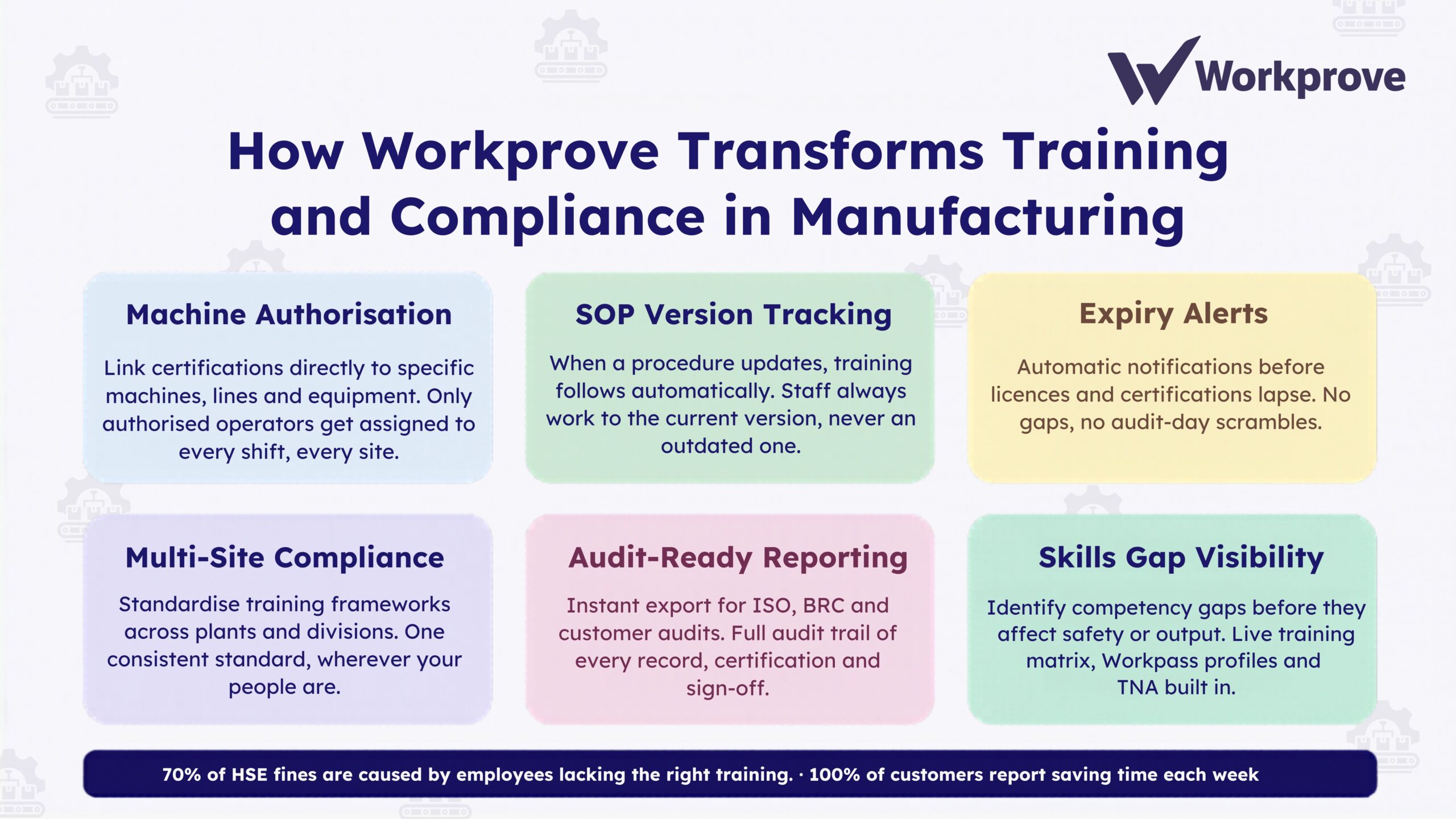
This blog explores the current state of UK manufacturing, the regulatory landscape, the limitations of traditional systems, a free checklist of what inspectors typically look for during audits, and the shift towards competency-based workforce management, along with how modern platforms like Workprove are supporting manufacturing training compliance transformation.
Current State of the UK Manufacturing Sector
The UK manufacturing sector continues to demonstrate resilience despite sustained economic and structural challenges. Output remains substantial, with total manufacturing sales reaching £452.2 billion in 2024, although this reflects a slight decline compared to the previous year (ONS, 2025).
While output remains strong, the sector is not without pressure. Workforce shortages remain one of the most persistent constraints, particularly in engineering, maintenance and technical roles. These gaps are compounded by an ageing workforce and slower inflow of skilled labour, increasing reliance on internal training and upskilling (Make UK, 2025), directly impacting manufacturing training compliance across organisations.
At the same time, manufacturing work is becoming more technologically advanced. Automation, robotics and data-driven production systems are now widely integrated across facilities. As a result, the required skill profile is shifting towards a combination of technical expertise, digital literacy and adaptive problem-solving (World Economic Forum, 2025).
Safety performance remains a critical concern. Despite long-term improvements, manufacturing still records significant levels of work-related injury and ill health, with associated costs estimated in the billions annually for UK industry (HSE, 2025). This reinforces the importance of robust workforce competence and risk control mechanisms.