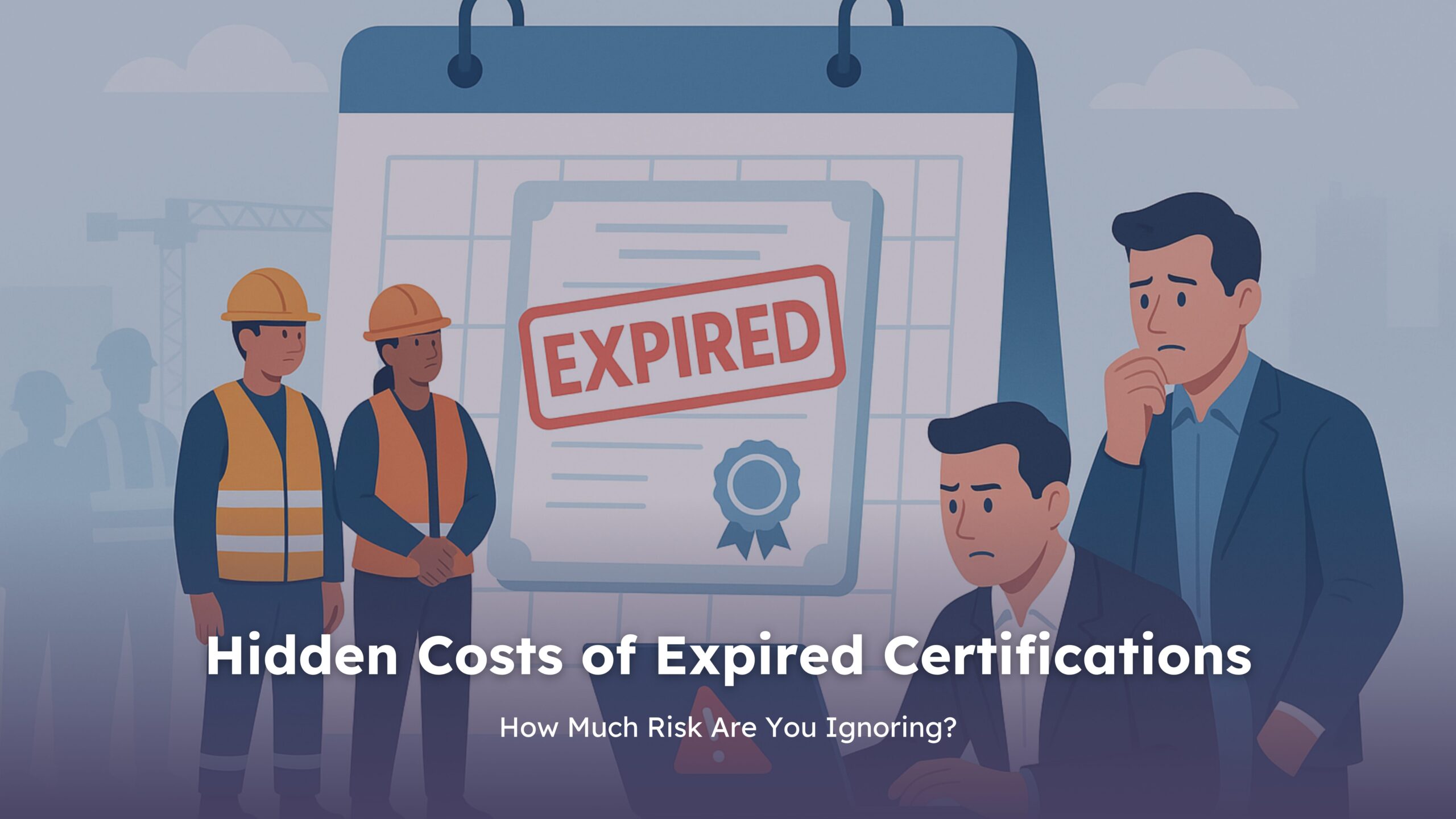
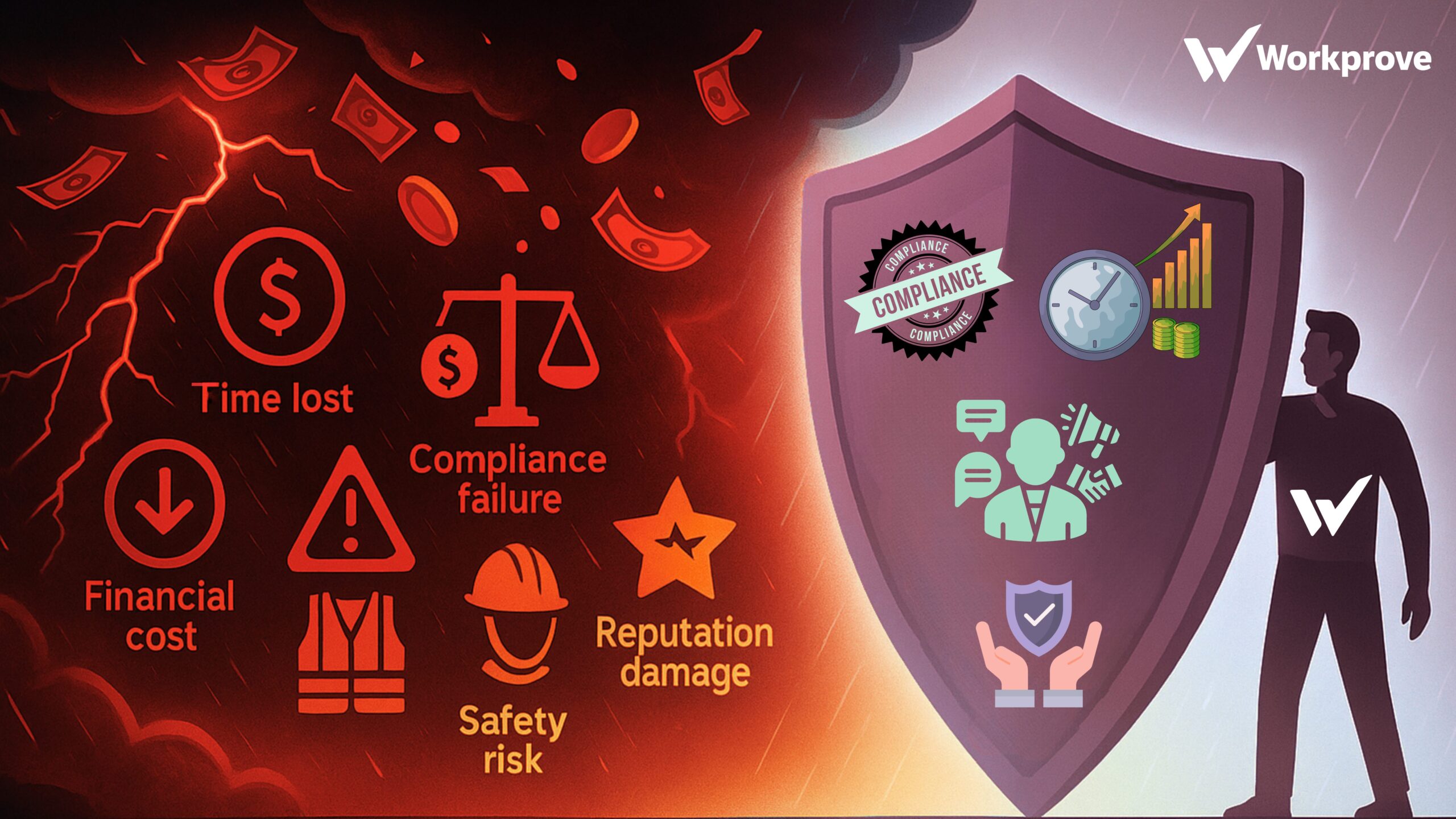
Figure 1: Workprove Shielding Against the Hidden Costs of Expired Certifications
👉 To explore how organisations assess real-world capability beyond the risk of expired certificates, you might find our guide on Competency-Based Assessment useful.
A pause for reflection
Consider your organisation for a moment.
How many certifications are currently being tracked? Also, check if you are managing them through spreadsheets, manual reminders, or fragmented systems? Have you ever faced a near miss, where a project was nearly delayed by an expired certificate? If an auditor asked for five years of complete certification records tomorrow, could you deliver them confidently?
If any of these questions cause hesitation, you are not alone. Many organisations do not realise their vulnerability until they are forced to.
Estimating your own risk of expired certificates
You can begin to estimate your hidden costs using a simple model.
| Metric | Definition | Example |
| Total certifications | The number of certificates you need to monitor | 1,000 |
| Average cost to train or renew | Direct cost per certificate | £500 |
| Lapse rate | Expected percentage of unnoticed expiries | 3 percent |
| Admin cost per lapse | Investigation and correction | £200 |
| Probability of major breach | Chance of a large fine or penalty | 0.5 percent |
| Penalty value | Size of fine or financial loss | £50,000 |
For example, here, 3 percent of 1,000 certifications is 30 lapses. At £700 per lapse, the direct cost is £21,000. Add the expected value of a major compliance breach at £250. Also, add reputational and contract risks, which can easily equal tens of thousands more. The total hidden cost is more than £41,000 annually.
This conservative estimate demonstrates why investment in automation pays off quickly.
Want to calculate this for your own organisation ? Download our FREE Calculator to access the risk of expired certificates.
Download our FREE Expired Certification Risk Calculator (Excel)
👉 If you are interested in building a broader view of training records and spotting gaps early, take a look at our blog on ‘What is a Training Matrix?‘.
Why spreadsheets fail over time
However, spreadsheets are useful for small, temporary tasks. But,they are not designed for compliance. Problems accumulate as organisations scale and complexity grows.
Collaboration breaks down because multiple versions circulate with no single source of truth. Audit trails disappear as data is overwritten. Formulas and conditional logic deteriorate as they are changed. Large sheets slow down and crash. Updating formats and formulas requires constant maintenance. Above all, spreadsheets give a false sense of control. People trust what they see, but hidden errors undermine that trust.
What you need to fix the risk of expired certificates
Organisations that move beyond spreadsheets consistently report two major benefits: confidence and time. They achieve this with systems built specifically for compliance and certification management. Essential features include the following:
- Expiry and renewal alerts with automated workflows
- Complete audit logs and version histories
- Dashboards that show upcoming risks and training gaps in real time
- Secure role-based access and permissions
- Integration with HR, scheduling, and training systems
- Analytics and reporting tools that highlight trends and cost savings
- Secure backups that guarantee data integrity
These are exactly the challenges Workprove was designed to solve. By replacing manual spreadsheets with a single source of truth, Workprove gives organisations the assurance that nothing slips through the cracks. Customers tell us that instead of chasing dates and reconciling versions, they now focus on building skills, passing audits with confidence, and protecting both safety and reputation.
Transitioning without disruption
Change does not need to be disruptive. In fact, many organisations have successfully taken a phased approach. Begin with a baseline audit of certifications and data sources. Run a pilot group alongside existing spreadsheets. Clean and import your data. Configure alerts, permissions, and workflows. Train your users and highlight the time saved. Then expand to full roll-out and retire the spreadsheets.
This is where Workprove makes a difference. Because it is intuitive and designed around real-world compliance workflows, adoption is straightforward. Teams quickly see the benefits: fewer errors, faster reporting, and real-time visibility. The result is a smooth transition that builds confidence rather than resistance.
Ready to overcome the risk of expired certification?
Many times, expired certifications risk may appear to be small oversights, but they carry hidden costs across time, money, compliance, safety, and reputation. They are not simply administrative mistakes. They are silent risks that grow until they cause project delays, fines, or worse.
If your organisation is still relying on spreadsheets, you are not alone. Many start there. But more and more are choosing to move beyond spreadsheets and embrace platforms designed for this exact challenge. Workprove has been built with those needs in mind. By automating alerts, maintaining audit-ready records, and providing clear dashboards help organisations transform compliance from a daily worry into a source of confidence and growth.
Ask yourself: what is the hidden cost of expired certifications in your organisation, and how much peace of mind would you gain from knowing nothing is slipping through the cracks?
FAQs
What happens if employee certifications expire?
If an employee has expired certification, organisations risk compliance failures, project delays, safety incidents, and potential fines. Expired certificates can also result in failed audits and loss of accreditation or contracts.
Why are spreadsheets risky for managing certifications?
Spreadsheets are prone to human error, version control issues, and lack a of audit trails. Studies show that the majority of business spreadsheets contain errors, meaning even well-maintained files can miss expiry dates or overwrite historic data.
How can organisations prevent certifications from expiring unnoticed?
The most effective approach is to use a dedicated compliance management system. Tools like Workprove provide automated alerts, dashboards, and audit-ready records, ensuring that training and certifications are always up to date without relying on manual spreadsheets.
References
Crockford, R. (2023) ‘Corporate manslaughter and gross negligence manslaughter sentencing’, Clyde & Co Insights, 20 September. Available at: https://www.clydeco.com/en/insights/2023/09/corporate-manslaughter-and-gross-negligence-mansla (Accessed: 30 September 2025).
Crown Prosecution Service (2018) Corporate manslaughter. Legal Guidance. Updated: 16 July 2018. Available at: https://www.cps.gov.uk/legal-guidance/corporate-manslaughter (Accessed: 30 September 2025).
Good Jobs First (2025) ‘Revealed: The corporate mistakes that cost UK businesses the most in fines’, Good Jobs First, 28 May. Available at: https://goodjobsfirst.org/revealed-the-corporate-mistakes-that-cost-uk-businesses-the-most-in-fines/ (Accessed: 30 September 2025).
Great Britain (2007) Corporate Manslaughter and Corporate Homicide Act 2007: Chapter 19. London: The Stationery Office. Available at: https://www.legislation.gov.uk/ukpga/2007/19/contents (Accessed: 30 September 2025).
Health and Safety Executive (2012) Health and safety training: A brief guide (INDG345). Available at: https://www.hse.gov.uk/pubns/indg345.htm (Accessed: 30 September 2025).
HSE: Corporate manslaughter (2019) Hse.gov.uk. Available at: https://www.hse.gov.uk/corpmanslaughter (Accessed: 30 September 2025).
Health and Safety Executive (2019) Training and competence – Work equipment and machinery, Hse.gov.uk. Available at: https://www.hse.gov.uk/work-equipment-machinery/training-competence.htm.
Panko, R.R. (2015) ‘What we don’t know about spreadsheet errors today: The facts, why we don’t believe them, and what we need to do’, in Proceedings of the EuSpRIG 2015 Conference: Spreadsheet Risk Management. Available at: https://arxiv.org/pdf/1602.02601 (Accessed: 30 September 2025).
Powell, S.G., Baker, K.R. and Lawson, B. (2008) ‘A critical review of the literature on spreadsheet errors’, Decision Support Systems, 46(1), pp. 128–138. https://doi.org/10.1016/j.dss.2008.06.001 (Accessed: 30 September 2025).
Powell, S.G., Lawson, B. and Baker, K.R. (2009) ‘Impact of errors in operational spreadsheets’, Decision Support Systems, 47, pp. 126–132. https://doi.org/10.1016/j.dss.2009.02.002 (Accessed: 30 September 2025).
Protecht (2025) ‘The most costly corporate mistakes in the UK’, Protecht Blog, 28 May. Available at: https://www.protechtgroup.com/en-gb/blog/the-most-costly-corporate-mistakes (Accessed: 30 September 2025).
Sentencing Council for England and Wales (2016) Corporate manslaughter: Definitive guideline. Effective from 1 February 2016. Available at: https://sentencingcouncil.org.uk/guidelines/corporate-manslaughter/ (Accessed: 30 September 2025).