Training and Compliance Management in Manufacturing Industry
Skip to content

Manufacturing Industry Guide: Workforce Competence, Compliance and Operational Resilience

Manufacturing training compliance management

Introduction

Imagine, a production line slows down unexpectedly. A machine fault occurs, but only one engineer on shift is fully competent to fix it. Meanwhile, an audit is scheduled next week and training records are scattered across spreadsheets, folders and outdated systems. No one is fully confident who is actually authorised to perform critical tasks.

This is a familiar scenario across many manufacturing environments, where operational reality often moves faster than workforce visibility.

UK manufacturing today is under increasing pressure from skills shortages, automation, regulatory scrutiny and rising expectations around safety and quality assurance. In this environment, the ability to clearly understand and evidence workforce competence is becoming as important as production efficiency itself,particularly in relation to manufacturing training compliance.

This blog explores the current state of UK manufacturing, the regulatory landscape, the limitations of traditional systems, free checklist of what inspectors actually look during audits, and the shift towards competency-based workforce management, along with how modern platforms like Workprove are supporting manufacturing training compliance transformation.

Current State of the UK Manufacturing Sector

The UK manufacturing sector continues to demonstrate resilience despite sustained economic and structural challenges. Output remains substantial, with total manufacturing sales reaching £452.2 billion in 2024, although this reflects a slight decline compared to the previous year (ONS, 2025).

While output remains strong, the sector is not without pressure. Workforce shortages remain one of the most persistent constraints, particularly in engineering, maintenance and technical roles. These gaps are compounded by an ageing workforce and slower inflow of skilled labour, increasing reliance on internal training and upskilling (Make UK, 2025), directly impacting manufacturing training compliance across organisations.

At the same time, manufacturing work is becoming more technologically advanced. Automation, robotics and data-driven production systems are now widely integrated across facilities. As a result, the required skill profile is shifting towards a combination of technical expertise, digital literacy and adaptive problem-solving (World Economic Forum, 2025).

Safety performance remains a critical concern. Despite long-term improvements, manufacturing still records significant levels of work-related injury and ill health, with associated costs estimated in the billions annually for UK industry (HSE, 2025). This reinforces the importance of robust workforce competence and risk control mechanisms.
Main Laws and Regulatory Framework in Manufacturing

UK manufacturing operates within a tightly regulated environment where safety, quality and environmental obligations are closely interconnected. The foundational legislation is the Health and Safety at Work etc. Act 1974, which establishes the employer’s overarching duty to ensure, so far as reasonably practicable, the health and safety of employees and others affected by operations.

This is further reinforced by the Management of Health and Safety at Work Regulations 1999, which explicitly requires employers to appoint competent persons and ensure appropriate training, instruction and supervision.

In practice, competence is embedded across multiple task-specific regulations that directly influence daily operations:

  • PUWER 1998, which ensures only trained and competent individuals operate work equipment
  • LOLER 1998, which governs competence in lifting operations and equipment use
  • COSHH 2002, which regulates exposure to hazardous substances and safe handling procedures
  • DSEAR 2002, which addresses risks associated with flammable and explosive environments
  • Manual Handling Operations Regulations 1992, which require risk reduction through training and task design

Alongside statutory requirements, manufacturers are also expected to comply with recognised standards such as ISO 9001 and ISO 45001, which formalise approaches to quality and health and safety management. In highly regulated industries such as automotive, aerospace and pharmaceuticals, additional frameworks like IATF 16949, AS9100 and GMP further strengthen expectations around traceability and workforce capability.

Across all of these frameworks, a consistent principle applies: compliance is only valid when it is supported by demonstrable workforce competence.

👉🏻 Suggested Reading: Automated Training Matrix: The Key to Smarter Workforce Planning. An in depth look at how real time skills visibility and automated training tracking help organisations close skill gaps, improve compliance, and optimise workforce planning.

Problems with Traditional Manufacturing Training Compliance Systems

Despite clear regulatory expectations, many manufacturing organisations continue to manage workforce competence through outdated and fragmented systems. These typically include spreadsheets, paper-based training logs and disconnected HR or learning management tools.

The core issue is not record keeping, but visibility and assurance. Training completion is often treated as a proxy for competence, even though it does not confirm whether an individual can safely and consistently perform a task in live operational conditions, creating gaps in manufacturing training compliance.

ConceptMeaningEvidence TypeRisk if missing
TrainingLearning completedLMS record / attendanceKnowledge not applied in practice
CompetenceAbility to perform task safely and correctlyObservation / assessmentUnsafe or inconsistent execution
AuthorisationFormal permission to perform taskSigned approval / digital sign-offUncontrolled task access

This creates several operational weaknesses:

  • Limited real-time visibility of workforce competence across roles and sites
  • Inconsistent standards of assessment and authorisation
  • Heavy reliance on manual processes during audits and inspections
  • Difficulty tracking certification expiry and refresher requirements
  • Misalignment between recorded training and actual capability on the shop floor

In high-risk environments, these gaps translate directly into operational exposure. When competence is assumed rather than verified, organisations become reactive, identifying issues only after audits, incidents or production failures.

What Inspectors Actually Look For During Manufacturing Audits

Manufacturing audits are not assessed on documentation alone, but on whether workforce competence is demonstrable, consistent and properly authorised in practice.


The free checklist below outlines the key areas inspectors typically focus on during training and compliance audits across manufacturing environments.

Download Free Checklist – What inspectors check during audits

How Workprove Supports the Manufacturing Sector

Workprove addresses the fundamental gap between training records and verified workforce competence by creating a structured, real-time system for managing capability, compliance and authorisation.

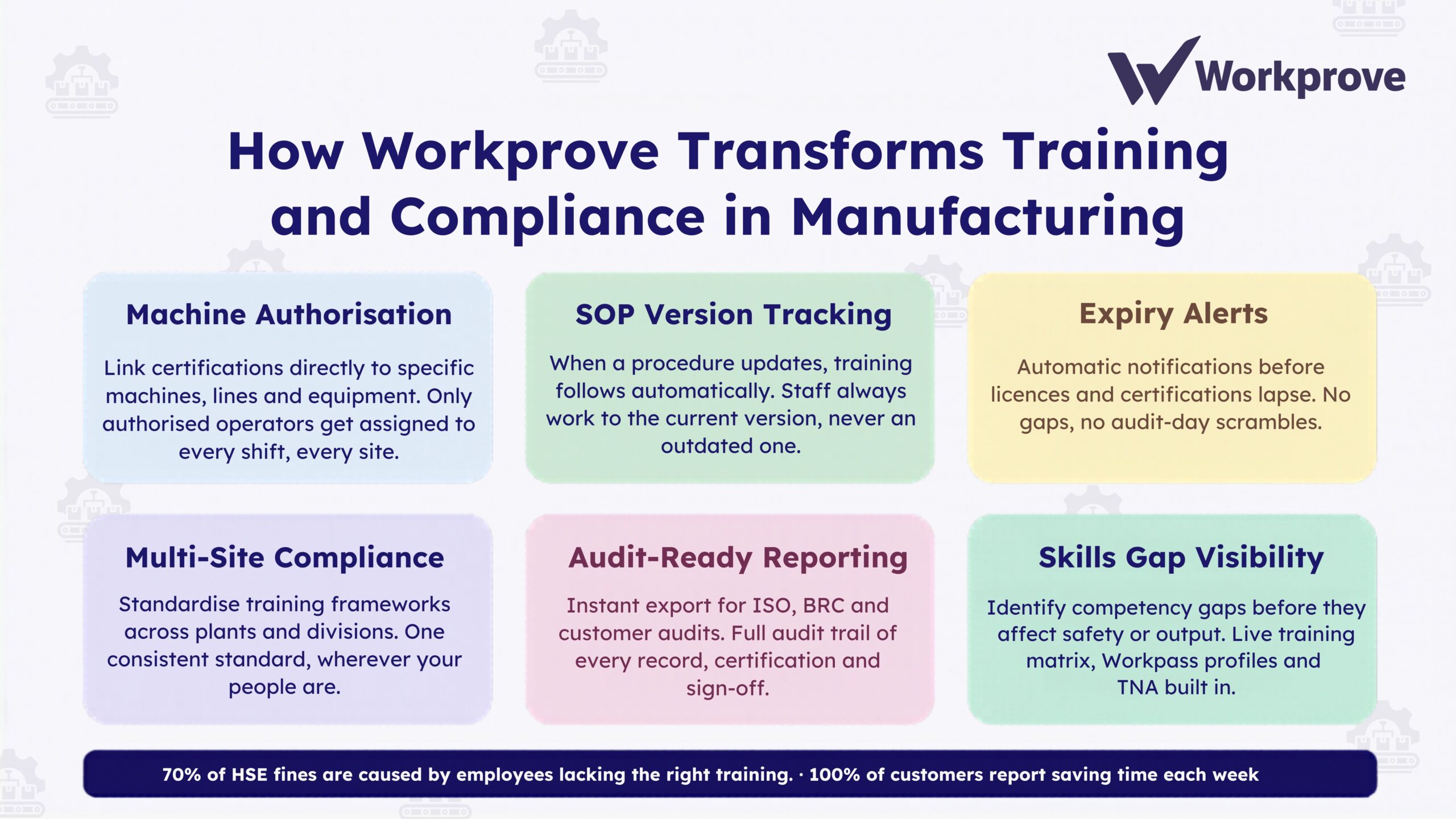
Rather than treating competence as a static record, it enables organisations to define clear role-based requirements and continuously map individuals against those expectations. This creates a live operational view of workforce readiness across the organisation, strengthening manufacturing training compliance outcomes.

Key capabilities include:

  • Structured competency frameworks aligned to roles, tasks and equipment
  • Live skills matrices providing visibility across teams, shifts and locations
  • Digital tracking of training, certifications and expiry dates
  • Evidence-based assessments to validate practical competence
  • Automated identification of compliance gaps and risk areas
  • Audit-ready reporting with complete competence histories

In practice, this means supervisors can immediately identify who is qualified to operate equipment, carry out maintenance or perform safety-critical tasks, reducing reliance on informal knowledge or manual tracking systems.

📌 This approach has already been applied in manufacturing environments facing similar operational pressures. For example, Spartan UK restructured its approach to workforce competence and compliance using Workprove, improving visibility and control over critical capabilities. The full case study is available here.

For organisations assessing how to modernise their approach to workforce competence and compliance, speaking with the Workprove team can help map current processes against a structured, competency-based model and identify where operational risk can be reduced.

How workprove support manufacturing industry training compliance management

👉🏻 Know more: Manufacturing Workforce Competence and Operational Resilience in Modern Industry. A practical guide to how UK manufacturers can strengthen workforce capability, maintain compliance, and build operational resilience through structured training and visibility.

Conclusion

Manufacturing is entering a phase where operational performance is increasingly determined by workforce capability rather than infrastructure alone. As regulatory expectations tighten and production systems become more complex, organisations must be able to demonstrate not just training completion, but verified competence.

Traditional systems are no longer sufficient to meet this requirement. They provide records, but not assurance. Competency-based approaches bridge this gap by linking regulatory expectations directly to operational capability.

For manufacturers, this shift represents a structural change in how risk is managed, how compliance is demonstrated and how operational resilience is achieved.

FAQs

Why is competence critical in modern manufacturing operations?
Manufacturing environments involve complex machinery, regulated processes and safety-critical tasks. Ensuring competence reduces operational risk and supports consistent performance across production activities.

How does competence differ from training in a manufacturing context?
Training confirms that learning has taken place, whereas competence demonstrates that an individual can apply that knowledge safely and effectively in real working conditions.

What are the main risks of poor workforce competence visibility?
Lack of visibility can lead to incorrect task allocation, safety incidents, production errors, audit findings and inefficiencies in workforce planning.

Why do traditional systems struggle to manage competence effectively?
Most traditional systems focus on recording training activity rather than verifying capability. This creates fragmented data and limited real-time understanding of workforce readiness.

How does Workprove support manufacturing organisations?
Workprove enables organisations to define role-based competence requirements and maintain a live, structured view of workforce capability by linking training, assessments and authorisations in one system.

Can Workprove support multi-site manufacturing operations?
Yes. It standardises competency frameworks across sites and provides consistent visibility of workforce capability at an organisational level.

How does Workprove improve compliance and audit readiness?
It consolidates competence evidence into a single system, allowing organisations to quickly demonstrate training, certification and authorisation status during audits without manual data collection.

Has Workprove been used in real manufacturing environments?
Yes. For example, Spartan UK has used structured competence management to improve visibility of workforce capability and strengthen compliance processes.

References

Health and Safety Executive (2025) Industry and manufacturing statistics. Available at: https://www.hse.gov.uk/statistics/industry/.

Make UK (2024) UK Manufacturing: The Facts 2024. London: Make UK.

Make UK (2025) UK Manufacturing: The Facts 2025. London: Make UK.

Office for National Statistics (2025) UK manufacturers’ sales by product 2024. Available at: https://www.ons.gov.uk.

World Economic Forum (2025) Future of Jobs Report 2025. Geneva: World Economic Forum.

You might also like

View All Resources
What is a training matrix blog
Blog

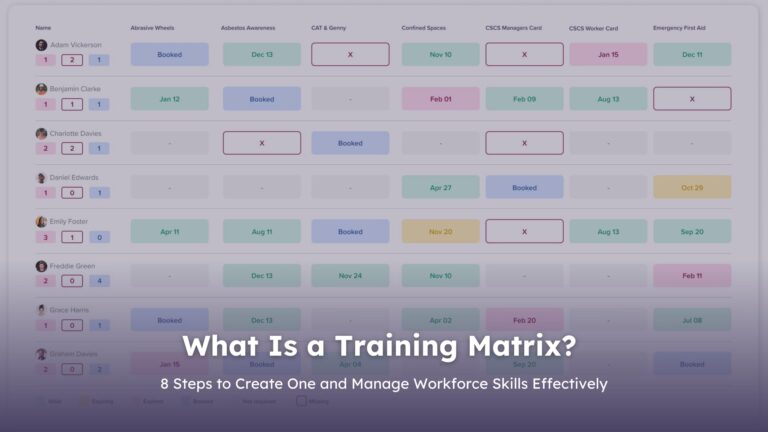
What is a Training Matrix? 8 Steps to Create One Effectively

Find Out More
Blog

Training and Compliance Management in Health and Social Care

Find Out More