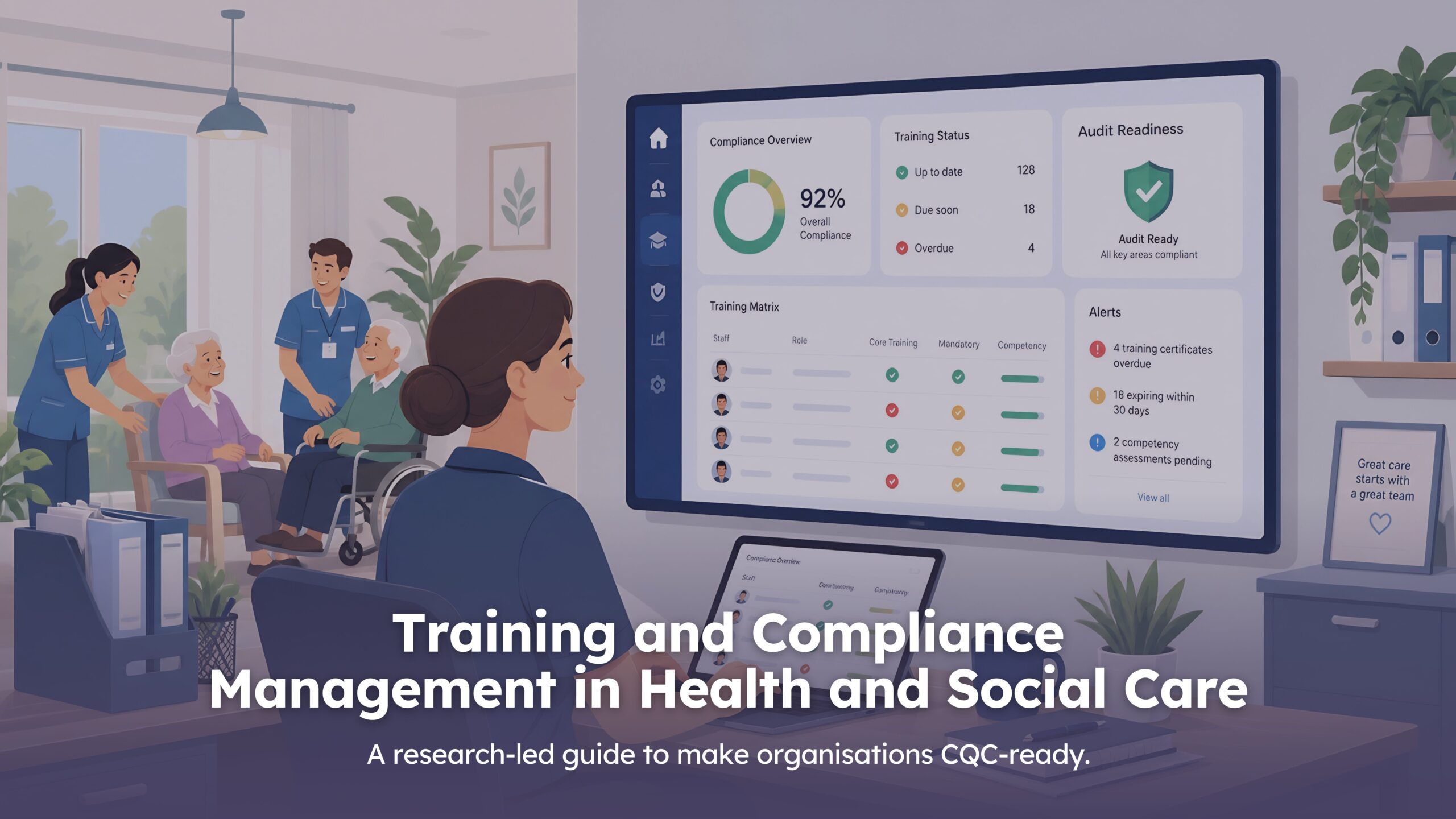
Training and Compliance Management in Health and Social Care
Skip to content

Training and Compliance Management in Health and Social Care

Moving Beyond Tick-Box Compliance to Continuous, Evidence-Based Readiness

Training and compliance management in health and social care is often presented as a solved problem. Mandatory modules are assigned, completion rates are tracked, and inspection folders are prepared. However, regulatory findings and sector-wide data suggest a different reality.

The Care Quality Commission (CQC) continues to highlight systemic pressures, workforce strain, and variation in care quality across services. In 2023–24, 6,230 inspections and assessments were conducted across thousands of providers, revealing ongoing inconsistency in how organisations manage quality, safety, and workforce capability (Care Quality Commission, 2024). At the same time, demand continues to rise, with requests for adult social care support increasing year-on-year, placing further pressure on already stretched systems (Care Quality Commission, 2025).

As a result, this creates a fundamental tension in training and compliance management in health and social care. As demand increases and workforce pressures intensify, the margin for error narrows. Therefore, in this context, training and compliance cannot remain administrative functions. Instead, they must operate as core systems of risk control, workforce capability, and inspection readiness.

The Current State: Gaps in Training Matrix and Compliance Systems

Across the sector, most organisations can demonstrate compliance on paper. Training matrices are populated, certificates are stored, and completion rates often exceed internal targets. However, operational realities frequently tell a different story.

Workforce instability plays a central role. The adult social care sector continues to face high vacancy and turnover rates, with approximately 152,000 vacancies and a turnover rate of around 28 percent reported in England (Skills for Care, 2023). Under these conditions, maintaining consistent, high-quality training becomes increasingly difficult. In addition, the CQC has also noted that workforce fatigue, workload pressures, and staffing shortages directly affect care quality and safety (Care Quality Commission, 2023).

To illustrate this, a practical example highlights the gap clearly. A care provider may report near-complete safeguarding training across staff. However, during an incident review, it emerges that key individuals had not refreshed their training within the required timeframe. The system recorded compliance, but the reality was different. In other words, the issue was not the absence of training, but the absence of timely visibility and enforcement.

Consequently, this disconnect between recorded compliance and actual readiness is one of the most critical risks facing training and compliance management in health and social care.

Why Training Completion Does Not Equal Audit Ready Training Records CQC Standards

A persistent misconception across health and social care is that training completion is synonymous with compliance. In reality, compliance is a broader and more demanding standard.

Training is an input. It provides knowledge and guidance.
Compliance is an outcome. It requires evidence that standards are met consistently in practice.

For compliance to be meaningful, training must be appropriate to the role, completed within the correct timeframe, retained by staff, and demonstrably applied in real-world care delivery. However, failures often occur at the intersection of these conditions.

For example, a staff member may complete medication training online but lack supervised practical validation. As a result, medication errors can still occur despite formal completion. Research increasingly emphasises that training effectiveness depends not just on completion, but on reinforcement, supervision, and practical application.

Accordingly, regulators are also shifting their focus. Inspections now look beyond records to assess whether staff are competent, confident, and able to deliver safe care in practice.

Structural Weaknesses in Traditional Compliance Models

The limitations of current approaches are not due to lack of intent, but due to structural design.

Firstly, one of the most common issues is the reliance on static training matrices. These are often generic and infrequently updated, failing to reflect evolving roles, regulatory expectations, or service-specific risks.

Secondly, another critical limitation is the absence of real-time visibility. Many organisations rely on periodic reporting. As a result, compliance gaps can remain undetected for extended periods. By the time they are identified, they have already introduced risk.

In addition, fragmented systems further compound the issue. Training records, HR data, and compliance documentation are often stored across multiple platforms. Consequently, this fragmentation makes it difficult to generate accurate, timely reports, particularly during inspections.

Finally, a further weakness lies in audit-driven behaviour. Compliance activity often intensifies shortly before inspections, leading to rushed completions and superficial readiness. Importantly, inspectors are increasingly able to distinguish between genuine, embedded compliance and last-minute preparation.

👉🏻 Suggested Reading: Training Matrix vs Spreadsheets: WhySpreadsheets Fail at Managing Training and Compliance. A practical guide showing where spreadsheets fails and how an automated training matrix can be helpful to manage workforce.
What High-Performing Organisations Do Differently

Organisations that consistently perform well under regulatory scrutiny adopt a fundamentally different approach. Instead of treating compliance as an event, they treat it as a continuous operational state.

In these organisations, compliance is visible in real time. As a result, leaders can identify gaps immediately, understand risk exposure, and take corrective action proactively. Moreover, training is aligned to roles and responsibilities, ensuring relevance and efficiency. Crucially, there is a clear link between training and practice, supported by competency assessments and ongoing supervision.

For instance, consider a domiciliary care provider managing a dispersed workforce. In a traditional model, compliance updates may lag behind reality. By contrast, in a high-performing model, managers have access to live dashboards showing compliance status across all staff, with automated alerts for expiring training and instant access to evidence. This, in turn, enables timely intervention and reduces the likelihood of compliance failures.

A Maturity Model for Continuous Compliance Health and Social Care

Compliance can be understood as a progression from basic tracking to continuous readiness.

At the foundational level, organisations record training completion, often using spreadsheets or isolated systems. Whilethis provides a record, it offers limited insight into risk.

As systems evolve, organisations introduce centralised platforms that provide consolidated visibility of training and compliance data. Consequently, this improves oversight but remains focused on completion metrics.

At a more advanced stage, organisations align training with specific roles, ensuring that requirements reflect actual responsibilities and risks. As a result, this improves both relevance and efficiency.

Furthermore, the next stage involves validating competency through assessments, observations, and supervision. This ensures that training translates into practice.

Ultimately, at the highest level, compliance becomes continuous and audit-ready. Real-time data, automated workflows, and integrated systems enable organisations to maintain readiness at all times, rather than preparing reactively for inspections.

The Role of Technology: From Record-Keeping to Risk Intelligence

Technology is increasingly recognised as a critical enabler of effective compliance. However, its value lies not in digitising records, but in enabling insight and action.

The CQC has emphasised the importance of data quality, digital systems, and integrated reporting in improving care delivery and oversight (Care Quality Commission, 2024). Therefore, organisations that use technology effectively are able to move beyond static record-keeping to dynamic risk management.

For example, automated alerts can ensure that expiring training is addressed proactively. Similarly, integrated dashboards can provide a clear view of compliance across teams and locations. In addition, digital audit trails can demonstrate not only that training has been completed, but that issues have been identified and resolved.

In contrast, systems that function purely as repositories of certificates add administrative burden without improving outcomes.

Where Workprove Fits: Enabling Continuous Compliance and Workforce Confidence

Against this backdrop, platforms such as Workprove are designed to address the structural limitations of traditional compliance models.

Workprove brings together training, compliance, and workforce data into a single, unified system. As a result, this eliminates fragmentation and provides a clear, real-time view of organisational readiness.

A key strength lies in visibility. Managers can instantly see compliance levels across teams, identify gaps, and prioritise actions based on risk. This significantly reduces reliance on manual tracking and improves responsiveness.

Furthermore, the platform supports role-based training alignment, ensuring that staff receive training relevant to their specific responsibilities. This is particularly important in complex care environments where generic training matrices are insufficient.

In addition, automated workflows enhance compliance by ensuring that expiring training is flagged and addressed in a timely manner. Consequently, organisations shift from reactive to proactive compliance management.

CapabilitySpreadsheets (or Manual Tracking)Workprove
Compliance visibilityStatic, quickly outdated viewsReal-time dashboards across teams and roles
Training trackingScattered across files and foldersCentralised system for all training and records
Expiry managementManual tracking, prone to missesAutomated alerts for expiring training
Role alignmentGeneric, one-size-fits-all listsTraining mapped to specific roles
Competency validationNo structured validation beyond completionBuilt-in assessments and competency tracking
Audit readinessTime-consuming manual evidence gatheringInstant, audit-ready reports
Multi-site oversightDifficult to consolidate and compareStandardised view across locations
Admin effortHigh manual workload and duplicationAutomated workflows reduce admin burden

From an inspection perspective, Workprove enables rapid generation of audit-ready reports, providing clear and structured evidence of compliance. This directly addresses one of the most common challenges faced during inspections: the ability to produce accurate and comprehensive documentation under pressure.

Ultimately, this means organisations are not only compliant on paper, but demonstrably prepared in reality.

👉🏻 To see how Workprove supports health and social care training and compliance management by delivering real time visibility, protection and a single source of truth for complete clarity, explore here

Inspection Readiness as a Continuous State

Inspection readiness is often treated as a phase of preparation. In reality, it must be an ongoing condition.

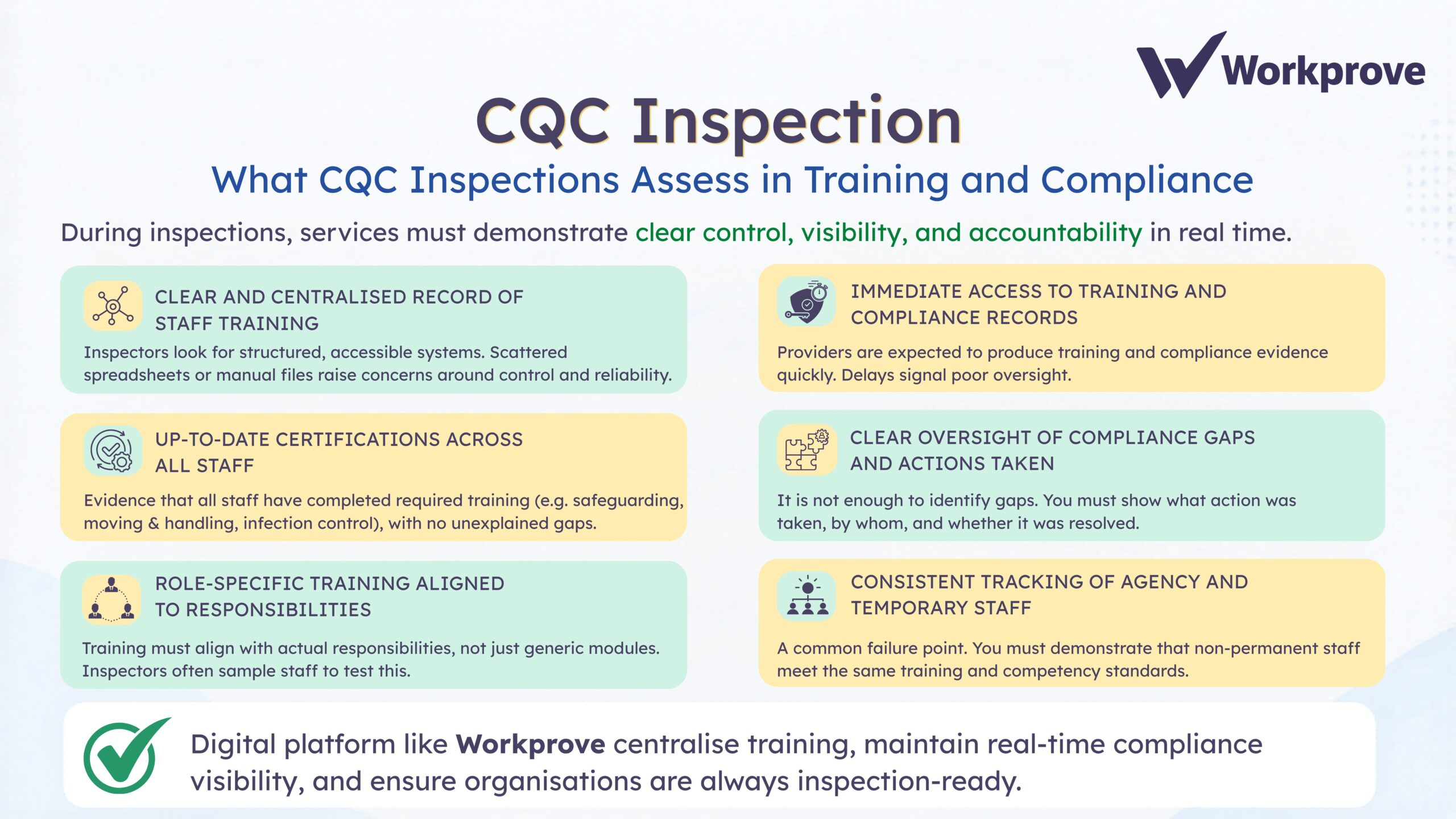
Organisations need to be able to answer, at any given moment, who is non-compliant, where risks exist, and what actions are being taken. If not, and these answers require significant time or manual effort, the system is not truly ready.

Given that demand is rising, workforce challenges persist, and regulatory expectations are increasing, continuous readiness is no longer optional. Therefore, organisations that adopt this approach are better equipped to manage risk, respond to inspections, and deliver consistent quality of care.

In practice, inspection outcomes are shaped not just by whether training exists, but by how clearly organisations can demonstrate control, visibility, and accountability across their workforce.

training management health and social care. what does CQC inspection include and workprove can be useful?

This is where many organisations fall short, not due to lack of training, but due to fragmented systems, delayed visibility, and inconsistent oversight.

Conclusion: From Compliance Burden to Strategic Capability

The health and social care sector does not lack training. Rather, it lacks systems that ensure training translates into consistent, measurable, and evidence-based compliance.

Recent regulatory findings and workforce data highlight the limitations of traditional approaches. Specifically, completion-based models are no longer sufficient in an environment characterised by complexity, scrutiny, and rising demand.

Therefore, organisations must move towards models that provide real-time visibility, align training with risk, and validate competency in practice. In doing so, they will not only perform better in inspections, but also deliver safer and more effective care.

Ultimately, compliance is no longer an administrative requirement. It is a strategic capability.

References

Care Quality Commission (2023) The state of health care and adult social care in England 2022/23. London: Care Quality Commission. Available at: https://www.cqc.org.uk/publications/major-report/state-care/2022-2023.

Care Quality Commission (2024) Annual report and accounts 2023/24**.** London: Care Quality Commission. Available at: https://www.cqc.org.uk/publications/annualreport/2023-2024.

Care Quality Commission (2025) The state of health care and adult social care in England 2024/25**.** London: Care Quality Commission. Available at: https://www.cqc.org.uk/publications/major-report/state-care/2024-2025.

Skills for Care (2023) The state of the adult social care sector and workforce in England 2023. Leeds: Skills for Care. Available at: https://www.skillsforcare.org.uk/Adult-Social-Care-Workforce-Data/Workforce-intelligence/documents/State-of-the-adult-social-care-sector/The-state-of-the-adult-social-care-sector-and-workforce-in-England-2023.pdf.

You might also like

View All Resources
What is a training matrix blog
Blog

What is a Training Matrix? 8 Steps to Create One Effectively

Find Out More
personnel management blog cover image. A comprehensive blog that covers all about personnel management.
Blog

Personnel Management: A Comprehensive Guide to Managing People, Performance and Compliance

Find Out More
Training and Compliance Management for Schools and Nurseries Blog Cover image
Blog

Training and Compliance Management for Schools and Nurseries

Find Out More