Common Gaps in Traditional Personnel Management
Despite its importance, many organisations struggle with execution.
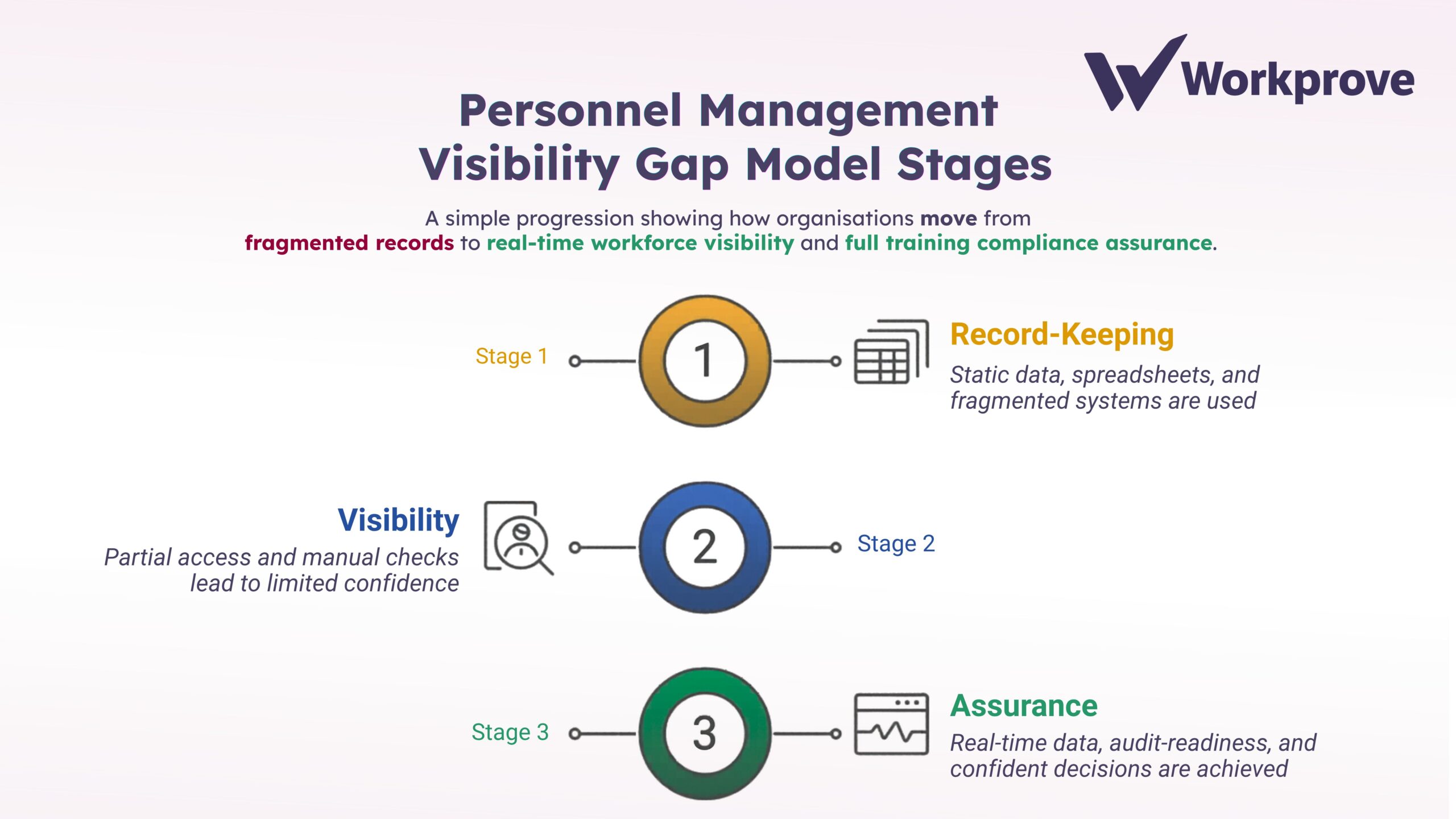
A key issue is fragmentation. Data exists, but it is spread across multiple systems, making it difficult to access or trust.
Another challenge is the lack of real-time visibility. Information may be accurate when recorded but becomes outdated quickly.
Most critically, training compliance is often reactive. Organisations discover gaps only when audits or incidents occur, rather than preventing them.
These challenges highlight a fundamental issue. Personnel management is often treated as record-keeping, rather than as a system for ensuring workforce readiness.
| Traditional Approach | Modern Approach |
| Static records | Real-time workforce visibility |
| Spreadsheet-based | Centralised system |
| Reactive compliance | Continuous compliance |
| Manual checks | Automated tracking |
| Assumption-led decisions | Data-driven decisions |
How Workprove Enables Modern Personnel Management
The effectiveness of personnel management depends not only on processes, but on the systems used to execute them. Many organisations still rely on fragmented tools or manual tracking, which limits visibility and increases compliance risk. As a result, personnel management often becomes reactive, only scrutinised when issues arise.
Workprove addresses this by bringing workforce data, training and compliance into a single, connected system. Instead of managing records in isolation, organisations gain a clear, real-time view of their workforce, allowing them to understand who is trained, who is compliant and where gaps exist, without relying on outdated or manual checks.
By centralising employee records and linking them directly to training and competency data, Workprove strengthens audit readiness and removes the uncertainty that often surrounds compliance. It also ensures that personnel management is no longer disconnected from operations, enabling more confident, day-to-day decisions about workforce capability.
The result is a shift from static record-keeping to continuous visibility and proactive control, where organisations are no longer reacting to issues, but preventing them.
If you want to see how this works in practice, you can explore it in more detail on workprove.com or book a short walkthrough with the team.
Book a Discovery Call
Conclusion
Personnel management is often treated as a background function, something that quietly keeps records in order. In reality, it determines whether an organisation can operate with confidence.
When visibility is limited, decisions become assumptions. When records are fragmented, compliance becomes reactive. And when training is disconnected from operations, capability cannot be trusted.
The difference between organisations that struggle and those that operate with control is not whether they manage personnel, but how well they can see and verify their workforce at any given moment.
This is where personnel management shifts from administration to assurance.
Because ultimately, it is not about maintaining records. It is about knowing, with certainty, that the right people are trained, compliant and ready to perform when it matters.
References
Armstrong, M. and Taylor, S. (2014) ARMSTRONG’S HANDBOOK OF HUMAN RESOURCE MANAGEMENT PRACTICE I. Available at: https://e-uczelnia.uek.krakow.pl/pluginfile.php/604792/mod_folder/content/0/Armstrongs%20Handbook%20of%20Human%20Resource%20Management%20Practice_1.pdf.
CIPD (2023) People management fundamentals. Available at: https://www.cipd.org/globalassets/media/knowledge/knowledge-hub/reports/2023-pdfs/2023-people-management-productivity-8458.pdf.
Deloitte (2023) Deloitte 2023 Global Human Capital Trends, Deloitte Insights. Deloitte. Available at: https://www.deloitte.com/us/en/insights/topics/talent/human-capital-trends/2023/future-of-workforce-management.html.
Gallup (2023) State of the Global Workplace Report. Available at:
https://www.gallup.com/workplace/349484/state-of-the-global-workplace.aspx.
Health and Safety Executive (HSE) (2024) Managing for health and safety (HSG65). Available at:
https://www.hse.gov.uk/pubns/priced/hsg65.pdf.