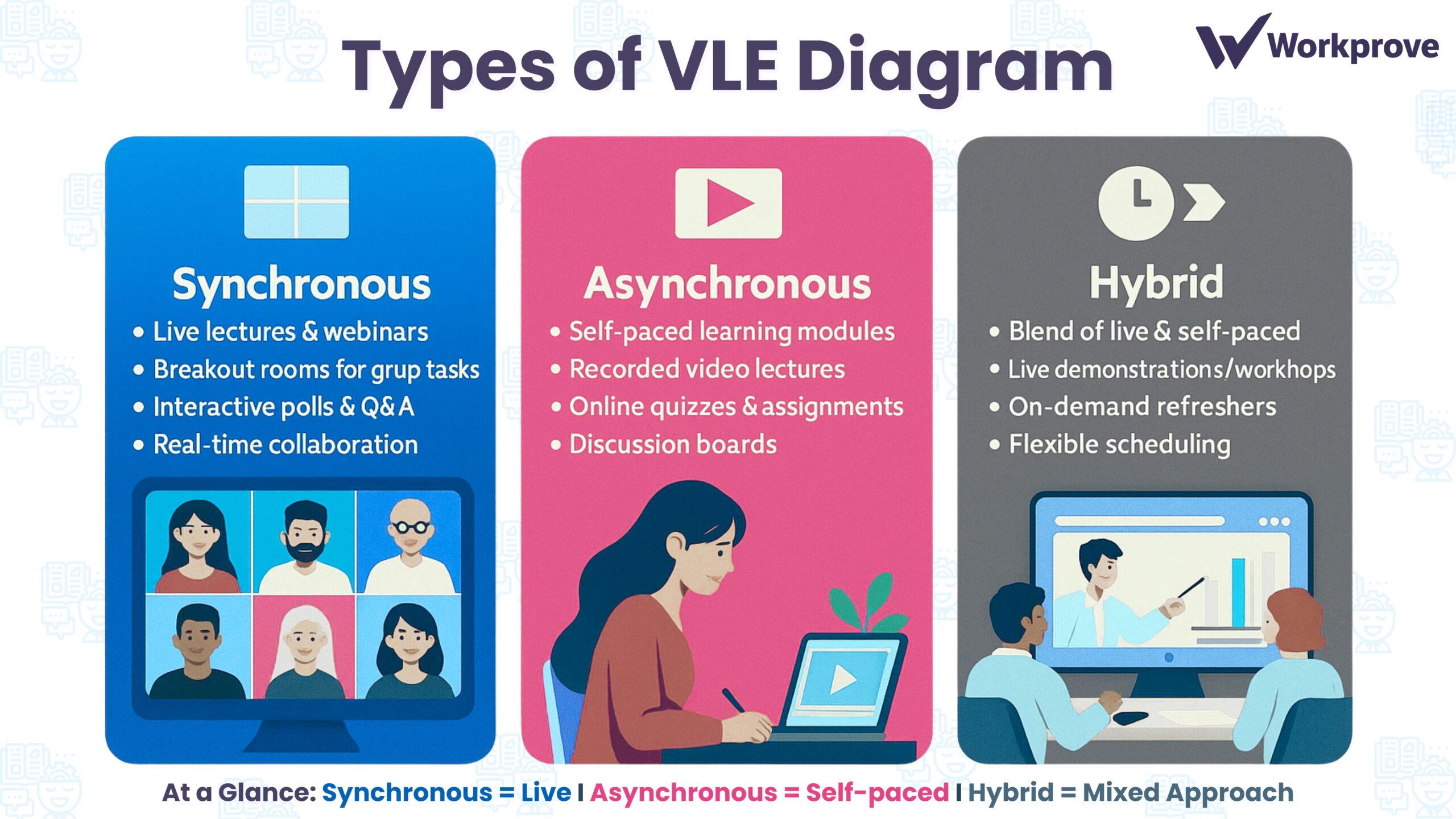
The OECD Digital Education Outlook (2023) notes that blended approaches are increasingly embedded in education ecosystems because they balance accessibility with accountability (OECD, 2023).
Key Features of a Strong VLE
A high-quality VLE goes beyond file storage. Core features include:
- Content delivery & standards: SCORM and xAPI support ensures content is portable and learning events can be tracked consistently. Moreover, the ADL Initiative (2023) confirms xAPI is now an IEEE standard, enabling cross-platform analytics.
- Collaboration tools: Discussion boards, chat, and peer review build community and boost retention. Similarly, these tools help replicate the interactivity of a classroom environment.
- Assessment & feedback: From auto-graded quizzes to observation forms, giving learners timely insights. Consequently, learners and instructors can adjust quickly to improve outcomes.
- Analytics dashboards: To monitor progress, completion, and performance trends. Therefore, administrators gain valuable data to guide future training or teaching strategies.
- Accessibility: Compliance with WCAG 2.2, finalised in October 2023, ensures usability for learners with disabilities (W3C, 2023). As a result, learning becomes more inclusive and equitable.
- Mobile & offline access: Vital for learners in low-connectivity regions. In addition, this flexibility supports remote and hybrid learning environments.
👉 Related reading: Schön’s Reflective Practice to explore how reflection can be built into digital learning.
Benefits
When implemented effectively, VLEs deliver measurable value:
- Flexibility & access: Learners can study anytime, anywhere. As a result, education becomes more adaptable to different schedules and lifestyles.
- Positive learner experiences: In Jisc’s 2024/25 survey, 86% of higher education students rated their digital learning environment as “above average,” and 84% rated the quality of their digital learning experience positively (Jisc, 2025). This demonstrates that well-designed VLEs can significantly boost learner satisfaction.
- Support with technology: 77% rated institutional support for learning with technology as above average (Jisc, 2025). Moreover, such support ensures that students are not left behind due to technical barriers.
- Cost efficiency: Reduced reliance on physical classrooms and print materials. Therefore, organisations can reinvest savings into improving content and delivery.
- Scalability: From dozens to thousands of learners without scaling admin burden. In addition, this makes VLEs suitable for both small teams and large institutions.
Challenges
Despite their benefits, VLEs face challenges that require careful planning:
- Infrastructure & access: In the same Jisc survey, many students reported issues with Wi-Fi or suitable devices, showing how uneven access still limits participation (Jisc, 2025). Consequently, this often stems from reliance on home internet quality and personal device ownership.
- Staff workload & confidence: In Jisc’s 2023/24 survey, 60% of teaching staff rated their digital environment positively, down from 64% the year before (Jisc, 2024). Respondents highlighted lack of time, limited training, and infrastructure gaps as key barriers. These challenges often occur because staff are balancing teaching, admin, and research alongside adopting new technologies.
- Governance & equity: The OECD (2023) emphasises that digital education systems must be trustworthy and equitable. However, without careful governance, rapid tech adoption risks deepening divides.
- Content quality: Even the best VLE fails if it is treated as a file dump rather than a structured, interactive learning environment. This typically happens when organisations prioritise “delivery” over learning design.
Industry Applications of VLEs
VLEs are now widely used beyond education:
- Higher Education: Blended classrooms, flipped learning, and HyFlex models.
- Corporate Training: Onboarding, leadership development, and skill refreshers.
- Healthcare: Simulation training and CPD tracking across hospitals.
- Vocational Training: Online theory combined with workplace-based assessment.
- Safety & Compliance: Automating renewals, tracking certificates, and evidencing compliance.
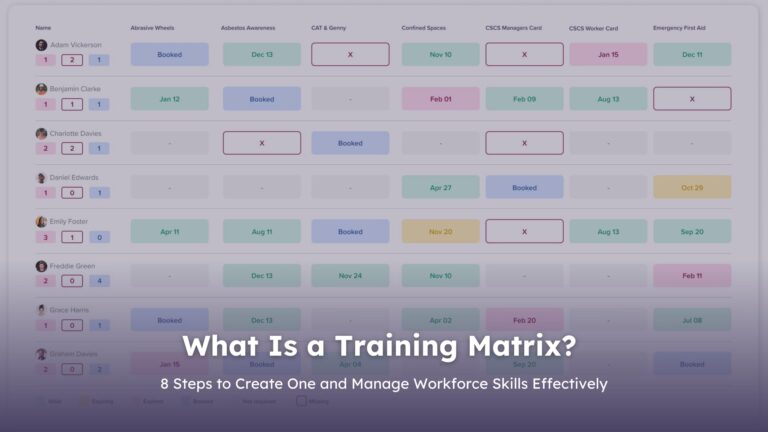
👉 This is where the Workprove Training Matrix adds value to the organisations by linking training outcomes within a VLE to compliance needs, ensuring staff are not only trained but audit-ready.
Future of VLEs
Looking ahead, VLEs are expected to evolve with:
- AI-driven personalisation: tailoring pathways and automating marking.
- HyFlex teaching models: giving learners the choice to attend live or online.
- Data ecosystems: OECD (2023) highlights interoperability between national learning platforms and assessments. As a result, institutions will be able to integrate learning data across systems for deeper insights.
Altogether, these trends show that VLEs are becoming not just supportive tools, but rather essential digital infrastructures shaping education’s future.
Bonus Resource: VLE Evaluation & Selection Checklist
Choosing the right VLE can feel overwhelming with so many platforms available. To make this process easier, we’ve created a bonus checklist you can use if you’re actively exploring or comparing solutions.
Download the VLE Evaluation Checklist
This free resource includes:
- Goal alignment prompts
- Accessibility quick-check (WCAG 2.2)
- SCORM/xAPI compliance
- Integration requirements (HRIS, SIS, SSO)
- ROI and analytics considerations
It’s not essential to understanding VLEs, but it’s a practical tool if you want to move from theory into real-world decision-making.
Conclusion
Virtual Learning Environments (VLEs) have moved from being optional tools to becoming core infrastructure for modern education and training. They provide flexibility, scalability, and inclusivity, allowing learners to engage in ways that suit their context. At the same time, they give educators and organisations valuable insight through data and analytics to improve learning design and outcomes.
The challenge now is not simply adopting a VLE but making sure it is used to its full potential, supporting active engagement, critical reflection, and meaningful application of knowledge. By combining sound pedagogy with the right digital tools, VLEs can foster deeper learning and prepare both students and professionals for the demands of rapidly changing environments.
FAQs
What is a VLE?
A digital hub that combines content, communication, and tracking in one space.
How is a VLE different from an LMS?
VLEs focus on learning experiences, while LMSs focus on compliance and administration.
Do VLEs need SCORM/xAPI?
Yes. SCORM ensures portability, while xAPI enables richer analytics across systems (ADL Initiative, 2023).
Which accessibility standard applies?
WCAG 2.2, published in October 2023 (W3C, 2023).
Are VLEs only for schools?
No. They are widely used in corporate training, healthcare, vocational education, and compliance-heavy industries.
References
ADL Initiative (2023) ‘xAPI officially becomes a published IEEE standard’. ADL Initiative. Available at: https://adlnet.gov/news/2023/11/22/xAPI-Officially-Becomes-a-Published-IEEE-Standard/ (Accessed: 22 September 2025).
EDUCAUSE (2023) 2023 EDUCAUSE Horizon Report: Teaching and Learning Edition. Available at: https://library.educause.edu/-/media/files/library/2023/4/2023hrteachinglearning.pdf (Accessed: 22 September 2025).
Jisc (2024) Teaching staff digital experience insights survey 2023/24: UK higher education findings. Available at: https://repository.jisc.ac.uk/9702/1/DEI-2024-teaching-staff-he-report.pdf (Accessed: 22 September 2025).
Jisc (2025) Student digital experience insights survey 2024/25: UK higher education findings. Available at: https://repository.jisc.ac.uk/10242/1/DEI-2025-student-he-report.pdf (Accessed: 22 September 2025).
OECD (2023) OECD Digital Education Outlook 2023: Towards an Effective Digital Education Ecosystem. Paris: OECD Publishing. Available at: https://www.oecd.org/en/publications/oecd-digital-education-outlook-2023_c74f03de-en.html(Accessed: 22 September 2025).
UNESCO (2023) 2023 Global Education Monitoring Report: Technology in education – A tool on whose terms?Paris: UNESCO. Available at: https://unesdoc.unesco.org/ark:/48223/pf0000386165 (Accessed: 22 September 2025).
W3C (2023) What’s new in WCAG 2.2. World Wide Web Consortium. Available at: https://www.w3.org/WAI/standards-guidelines/wcag/new-in-22/ (Accessed: 22 September 2025).