Food Manufacturing Training and Competence Management
Skip to content

Food Manufacturing Training and Competence Management

Food manufacturing training and competence management blog image cover

Introduction: a scenario most food manufacturing leaders recognise

A food manufacturing site prepares for a customer audit. The team updates training records, signs off on inductions and completes HACCP sessions. At the same time, line supervisors confirm that operators are “trained for the role”. Effective food manufacturing training and competence management should ensure these standards hold up under scrutiny.

However, Midway through the audit, the auditor selects a recent allergen changeover and asks a simple question:
Who authorised the clean, signed off the line release, and confirmed that the individual was competent for that task on that specific shift?

The team struggles to retrieve the data. The training file shows allergen awareness training completed eighteen months ago. The SOP lists a role title, but a supervisor reassigned the operator from another line to cover that shift. But the authorisation matrix still reflects the structure before the most recent restructure.

Consequently, no one can confidently demonstrate competence at the moment of execution. Consequently, what appeared compliant on paper fails under scrutiny.

This scenario is not unusual. It actually reflects a structural issue in the sector’s approach to safety assurance. Failures rarely occur because systems are absent, but because competence becomes invisible as production pressure, workforce turnover and operational changes increase. It highlights a deeper weakness in food manufacturing training and competence management, where training records exist but real-time authorisation and control visibility do not.

The reality of risk and workforce complexity in food manufacturing

Food manufacturing operates under a unique convergence of risk. Worker safety, product integrity and consumer safety are inseparable. A failure in competence can harm employees, contaminate product, trigger recalls and damage brand trust simultaneously.

Operationally, environments are defined by constant movement:

  • Multi-shift operations with frequent handovers
  • High reliance on temporary and agency labour
  • Regular product changeovers and line reconfigurations
  • Strict hygiene zoning and allergen controls
  • Safety-critical machinery, chemicals and confined processes

The Health and Safety Executive identify food and drink manufacturing as a sector with persistent injury risk, particularly related to machinery, slips and trips, and manual handling (HSE, 2025). In addition, wet floors, washdown regimes and fast-paced environments increase exposure to hazards that escalate quickly when competence assumptions fail.

Furthermore, food safety frameworks such as HACCP, BRCGS and FSSC 22000 rely on people executing controls correctly. Preventive controls only function if those responsible are competent at the time the task is performed.

Despite this, many organisations manage competence indirectly through fragmented training records, rather than through a structured food manufacturing training and competence management framework. As operators move between lines, cover absences, or take on temporary responsibilities, competence assumptions often persist long after the evidence has expired.

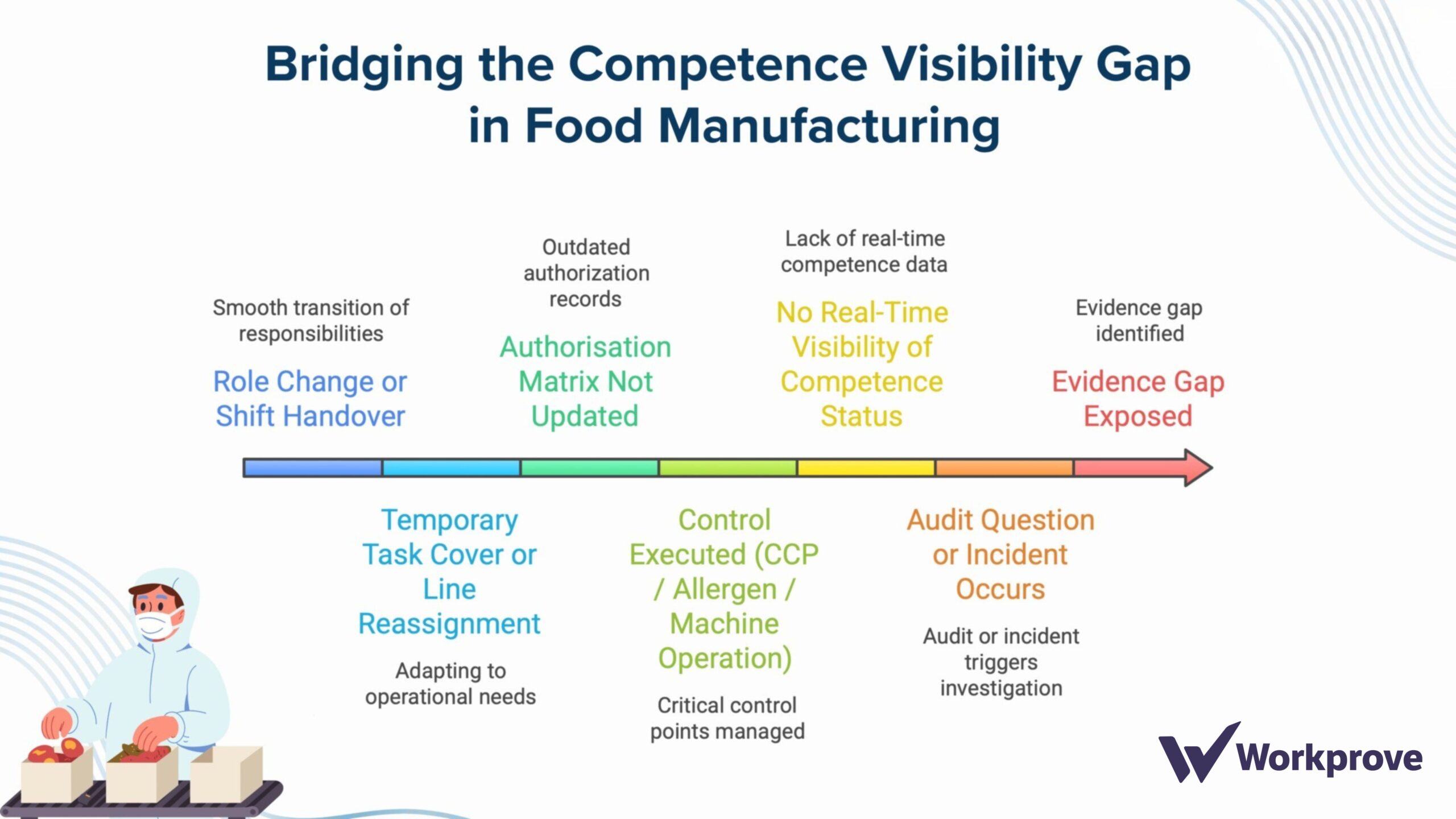
Flow diagram showing how shift changes and role reassignment can create competence visibility gaps in food manufacturing operations.

In complex food manufacturing operations, competence rarely fails abruptly. Instead, it erodes through routine operational changes that are not reflected in authorisation records or role assignments. For instance, the diagram above outlines how everyday shifts in responsibility can create exposure long before an audit or incident reveals the gap.

What recent research and regulatory guidance reveal about competence failures

Recent guidance and research consistently conclude that competence is an operational control, not just an administrative outcome. In other words, it must function in practice, not only on paper.

1. Regulatory Enforcement Focuses on Implementation
Firstly, the Food Standards Agency emphasises that food safety management systems must be implemented and maintained effectively, not merely documented (FSA, 2024). Also, HACCP principles depend on defined responsibilities, verification activities and corrective actions carried out as part of an effectively implemented food safety management system.

2. Preventive Controls Require Qualified Individuals
The US Food and Drug Administration’s preventive controls framework reinforces that hazard analysis and controls are effective only effective only when executed by a “Preventive Controls Qualified Individual” (PCQI) or under their oversight (FDA, 2019).

3. High Turnover Increases Injury Risk
OSHA’s analysis of severe injuries in food processing highlights risks associated with machinery operation and lockout/tagout procedures. These risks are exacerbated by inadequate task-specific competence, particularly in environments with high workforce turnover (OSHA, 2024).

4. Competence vs. Training
Research into safety competence indicates that occupational competence integrates knowledge, skills as well as behaviours, serving as a primary predictor of safety performance (Rahman, 2022). Furthermore, academic studies on safety culture support the view that defined professional competencies underpin sustainable safety outcomes in high-risk environments (Abikenova et al., 2023).

Regulatory bodies do not require digital systems explicitly. However, they increasingly expect employers to demonstrate that workers are competent for the tasks they perform, that competence is refreshed as risk changes, and that evidence can withstand retrospective scrutiny during audits, investigations or enforcement action (HSE, 2025; FSA, 2024).

Why training records alone are no longer sufficient

Traditional training records answer a narrow question:
Has this person completed a course?

They do not answer the questions that matter most in food manufacturing:

  • Is this person competent to perform this task on this line today?
  • Are they authorised to sign off on allergen changeovers or CCP monitoring?
  • Has their role changed since their last assessment?
  • Are refresher requirements triggered by product, process or risk changes?
  • Can the organisation evidence competence at a specific point in time?

This is where food manufacturing training and competence management must move beyond attendance tracking and towards operational control. For example, training records stored in spreadsheets or disconnected systems may degrade in multi-shift environments. In addition, certifications expire without alerts, and temporary role changes may go unrecorded. Agency workers are onboarded quickly but not consistently integrated into competence frameworks.

When audits or incidents occur, organisations often struggle to evidence who was competent, when and for what task.

👉 Suggested reading: Automated Training Matrix: The Key to Smarter Workforce Planning. This explores how structured competence frameworks improve visibility and operational control.

Assumed Competence ModelVerified Competence Model
Training attendance recorded as proof of capabilityRole-based competence mapped against operational risk
Competence inferred from job titleExpiry logic is built into structured tracking with visibility
Expiry dates tracked manually in spreadsheetsTraining, assessment and formal authorisation are treated as separate control stages
No clear distinction between training, assessment and authorisationAgency and temporary workers are integrated into the same competence control framework
Shift coverage assumed based on staffing levelsShift-level competence coverage confirmed before production
Agency and temporary workers onboarded with basic induction onlyAudit evidence is retrievable instantly with historical traceability
CCP and allergen responsibilities linked to role namesCCP and allergen responsibilities linked to named, authorised individuals
Audit preparation reactive and evidence gathered manuallyGaps are identified proactively before operational exposure
Compliance is perceived as administrativeCompetence is treated as an operational control
Audit preparation, reactive and evidence gathered manuallyGaps discovered during the audit or incident

The role of a skills matrix in food manufacturing safety and food safety management

A skills matrix is central to effective food manufacturing training and competence management because it shifts the focus from training activity to demonstrable competence. It maps roles against required skills, authorisations, certifications and assessment status, creating visibility of capability across the workforce.

In food manufacturing, this is critical for safety- and quality-critical roles such as:

  • CCP monitoring and verification
  • Allergen changeover verification and line release
  • Sanitation and chemical handling
  • Machine operation, isolation and guarding checks
  • Quality hold and release authority
  • Hygiene zoning and foreign body inspections

A well-designed skills matrix allows organisations to:

  • Identify competence gaps before production starts
  • Allocate people to roles based on verified capability
  • Prioritise training and assessment based on risk
  • Support audit and investigation requirements with instant evidence

Industry guidance increasingly emphasises structured competence development within food safety management systems. (FSA, 2024; GFSI, 2024). In particular, regulators highlight the need for clear role definition, documented responsibilities and ongoing verification of capability.

Therefore, to support early assessment, a free food manufacturing skills matrix checklist can help organisations identify immediate weaknesses in competence visibility and control. Here you can find our Free food manufacturing skills matrix checklist to download.

Download Free Food Manufacturing Skills Matrix Checklist
Why spreadsheets break down at scale

While spreadsheets are commonly used, they often lack the automation required for dynamic risk management.

At a small scale, they may appear manageable. However, as soon as organisations operate multiple lines, shifts or sites, spreadsheets introduce operational risk:

  • Manual updates create a data lag
  • No automated alerts for expiring authorisations
  • Weak version control across departments
  • Limited audit trails for competence decisions
  • Inability to evidence competence at a historical point in time

In food manufacturing, where incidents often require retrospective analysis, this lack of defensible history is a critical weakness. As a result, organisations face increased regulatory, commercial and reputational exposure.

Therefore, competence management becomes an operational control, not an administrative task. In practice, it requires live data, role-based logic and reliable traceability.

A platform built for live competence control in food manufacturing

Effective food manufacturing training and competence management requires competence to be managed dynamically, with visibility, consistency and defensible evidence.

Workprove connects roles, skills, authorisations and certifications into a single operational view that supports risk-informed decision making. For instance, it includes:

    • Mapping competence to roles and tasks rather than just job titles
    • Providing real-time visibility across roles, teams and sites
    • Automatically tracking expiries for training, certifications and role-based requirements, with automated alerts and weekly reminders
    • Capturing assessments, verifications and sign-offs through digital forms
    • Enabling instant competence verification on the shopfloor using Workpass QR codes

As a result, allows production managers to allocate teams confidently, and quality teams to respond to audits without data recovery delays.

Explore How Workprove supports the food and beverage industry here.

For growing operations, Workprove turns competence management into a proactive control rather than a reactive burden.

If your team relies on spreadsheets, fragmented records or assumptions during shift handovers, hidden competence risks may already exist within your operation.

Schedule a free 15-minute discovery call with our industry specialists to evaluate your food manufacturing training and competence management framework and strengthen audit readiness.

Book a Free 15-Minute Demo with Experts

👉 Suggested reading: How to Avoid Workplace Injury Cases Through Proactive Prevention. This demonstrates how organisations reduce incidents by shifting from reactive compliance to proactive competence-led risk control.

What effective competence management delivers in practice

When competence is visible, current and defensible, safety and food safety systems function as intended.

In practice, effective competence management delivers:

  • Controls that reflect reality on the factory floor
    HACCP plans, SOPs and risk assessments align with actual workforce capability, not assumptions.
  • Stronger, risk-focused supervision
    Supervisors spend less time checking paperwork and more time managing live risk, as competence status is pre-verified.
  • Confident role and shift allocation
    Cover arrangements and temporary assignments are supported by evidence, not informal judgment.
  • Audit readiness without disruption
    Audits become confirmation exercises rather than high-stress data recovery events.
  • Reduced incidents linked to competence gaps
    Failures caused by expired authorisations, informal task escalation or unclear responsibilities become significantly less likely.
  • Competence is treated as an operational control
    Training and skills management sit alongside production, quality and safety controls, not in isolation.

Conclusion: making competence visible, current and defensible

Food manufacturing failures rarely stem from a lack of training. They often stem from weaknesses in food manufacturing training and competence management, where competence becomes invisible as operations evolve.

Static records and spreadsheets cannot keep pace with the complexity of modern food manufacturing. A skills matrix provides the structure to define capability requirements, but at scale, it must be supported by systems that keep competence current, connected to operations and defensible under scrutiny.

Platforms such as Workprove are built for this reality. By linking roles, skills, certifications and authorisations into a single live view, Workprove enables food manufacturers to protect workers, safeguard consumers and maintain confidence when audits, incidents or regulatory reviews arise.

In an industry where trust is everything, making competence visible is no longer optional. It is foundational.

FAQs

What is the difference between training and competence in food manufacturing?
Training is participation in learning activities. In contrast, competence is the demonstrated ability to perform a task correctly, safely and consistently within your specific process.

Why is food manufacturing particularly exposed to competence gaps?
High turnover, shift work, temporary labour and frequent process changes make manual systems difficult to maintain accurately. As a result, visibility and control can deteriorate quickly.

Do regulators require digital competence systems?
Regulators require effective competence control and evidence. However, digital systems increasingly provide the most reliable way to achieve this at scale.

References

Abikenova, S.K., Oshakbayeva, Z.O., Bekmagambetov, A.B. and Sarybayeva, I.E. (2023) ‘The role of professional competencies in developing a culture of safety in the workplace’, European Journal of Sustainable Development, 12(4), pp. 237–246. Available at: https://doi.org/10.14207/ejsd.2023.v12n4p237.

Food Standards Agency (2024) Food safety management for businesses. Available at: https://www.food.gov.uk/business-guidance/business-guidance/food-safety-management-for-businesses.

Food Standards Agency (2024) Allergen guidance for food businesses. Available at: https://www.food.gov.uk/business-guidance/allergen-guidance-for-food-businesses.

Global Collaboration, Enhanced Food Safety: The Benchmarking Requirements 2024 Unveiled – MyGFSI (2024) MyGFSI. Available at: https://mygfsi.com/news_updates/global-collaboration-enhanced-food-safety-the-benchmarking-requirements-2024-unveiled/.

Health and Safety Executive (2025) Food and drink manufacture: safety hazards. Available at: https://www.hse.gov.uk/food.

Occupational Safety and Health Administration (2024) Severe injuries in the food processing industry (OSHA 4407). Available at: https://www.osha.gov.

Rahman, F.A. (2022) ‘A safety competencies systematic literature review’, Sustainability, 14(11), p. 6885. Available at: https://www.mdpi.com/2071-1050/14/11/6885.

Center for Food Safety and Applied Nutrition (2019) Draft Guidance on Hazard Analysis and Risk-Based Preventive ControlsU.S. Food and Drug Administration. Available at: https://www.fda.gov/regulatory-information/search-fda-guidance-documents/draft-guidance-industry-hazard-analysis-and-risk-based-preventive-controls-human-food.

You might also like

View All Resources
What is a training matrix blog
Blog

What is a Training Matrix? 8 Steps to Create One Effectively

Find Out More
Transport, Logistics and Warehousing Training & Compliance Management full guide blog
Blog

Transport, Logistics and Warehousing Training and Compliance Management

Find Out More
EDI in safety-critical Industries and how workprove supports EDI- equity, diversity and inclusion
Blog

EDI in the real world: why frontline teams are being left behind

Find Out More
smarter training and compliance tools and platform in 2026
Blog

What to Expect from Smarter Training Management and Compliance Tools in 2026

Find Out More