The Three Layers of Organisational Learning
At their core, LMS, TMS, and CMS exist because “training” isn’t one thing, but a series of connected experiences. To understand where these systems fit and why the LMS vs TMS vs CMS comparison matters, try thinking of learning in three layers:
- Learning – gaining new knowledge or understanding (usually through study or e-learning).
- Training – developing or practising skills under supervision.
- Competence – demonstrating that those skills are applied effectively and safely on the job.
Each layer demands a different toolset, and confusing them can lead to inefficiencies. It’s like using a thermometer to measure speed; you might get data, but not the right kind.
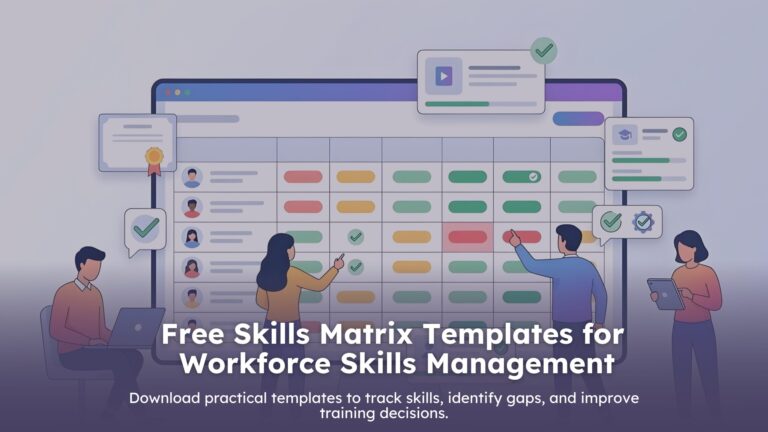
👉 Related Reading: Skill Matrix Template for a quick guide to mapping employee skills and identifying training needs effectively.
Learning Management System (LMS): Delivering and Measuring Learning
A Learning Management System (LMS) forms the digital backbone of modern organisational learning. It creates, delivers, and tracks digital or blended learning, making it the first pillar in the LMS vs TMS vs CMS framework. It is the organisation’s virtual classroom, ensuring consistency and visibility across teams.
Through the LMS, companies can upload e-learning courses, video modules, microlearning content, or compliance training programs and then automatically track enrolment, completion rates, and assessment scores.
For distributed or hybrid teams, this consistency is invaluable. The LMS ensures everyone receives the same learning experience, reduces administrative effort, and provides measurable data to demonstrate learning. From onboarding to compliance, it adds structure and scalability that manual tracking can’t achieve.
Still, completing a module or passing a quiz doesn’t guarantee on-the-job competence. The LMS measures knowledge acquisition, not practical ability. To bridge that gap, organisations often pair it with systems that manage and validate training performance.
Training Management System (TMS): Planning, Scheduling, and Coordinating
Suppose a LMS focuses on the what of learning, the Training Management System (TMS) focuses on the how. It involves planning, coordination, and logistical execution of training activities, particularly those that include instructors, physical locations, or blended programs. Where spreadsheets once managed classroom bookings and instructor calendars, a TMS now centralises all that information in a single system, ensuring smooth operations across departments and regions.
Within a TMS, administrators can allocate instructors, book rooms, manage resources, and set budgets. The system tracks attendance, collects feedback, and generates completion records for internal or external training sessions. Many training providers also use their TMS to automate client interactions such as course registrations, payment processing, and post-training evaluations. By connecting with CRM or finance systems, the TMS becomes both a scheduling engine and a business management tool.
The value of a TMS becomes clear as organisations scale. Coordinating hundreds of courses, venues, and trainers quickly becomes overwhelming without automation. A robust TMS ensures the right people are in the right place, at the right time, with the right materials. It prevents double-bookings, reduces cancellations, and provides accurate visibility into training operations, budgets, and instructor utilisation.
However, while it significantly improves efficiency, a TMS still captures attendance rather than competence. It can show who participated, but it cannot confirm whether the learning achieved its intended outcome or whether the employee can now perform a task to standard. It remains primarily an administrative and scheduling powerhouse rather than a true measure of ability. To complete the picture, organisations turn to the third piece of the puzzle, the Competency Management System.
Competency Management System (CMS): Validating and Maintaining Capability
While the LMS and TMS manage learning and logistics, the Competency Management System (CMS) ensures that all that activity translates into actual, demonstrable skill on the job. The CMS shifts the focus from what training happened to what competence was achieved. It allows organisations to define the precise skills, behaviours, and proficiency levels required for every role and then evaluate employees against those standards through evidence-based assessments.
Furthermore, managers can record on-the-job assessments, upload supporting documents, and capture verification from supervisors or mentors. The system brings together training history, certifications, and field evaluations to give a real-time view of who’s competent, who’s in training, and who’s due for renewal. As a result, with built-in expiry alerts and audit-ready reports, a CMS becomes the cornerstone of compliance assurance.
This is especially critical in regulated, safety-sensitive sectors. Survey data shows broad adoption of competency practices in core talent workflows, indicating that 68.4% attach competencies to job descriptions, 73.7% use them in hiring, and 77.2% use multi-level proficiency scales (HRSG, 2024).
Unlike an LMS or TMS, which focus on delivering and organising training, a CMS validates outcomes. It answers the essential question: “Can this person perform their job safely and competently today?” And when integrated with the other systems, it creates a continuous loop between learning, training, and verification.
How They Fit Together: The Closed Learning-Competence Loop
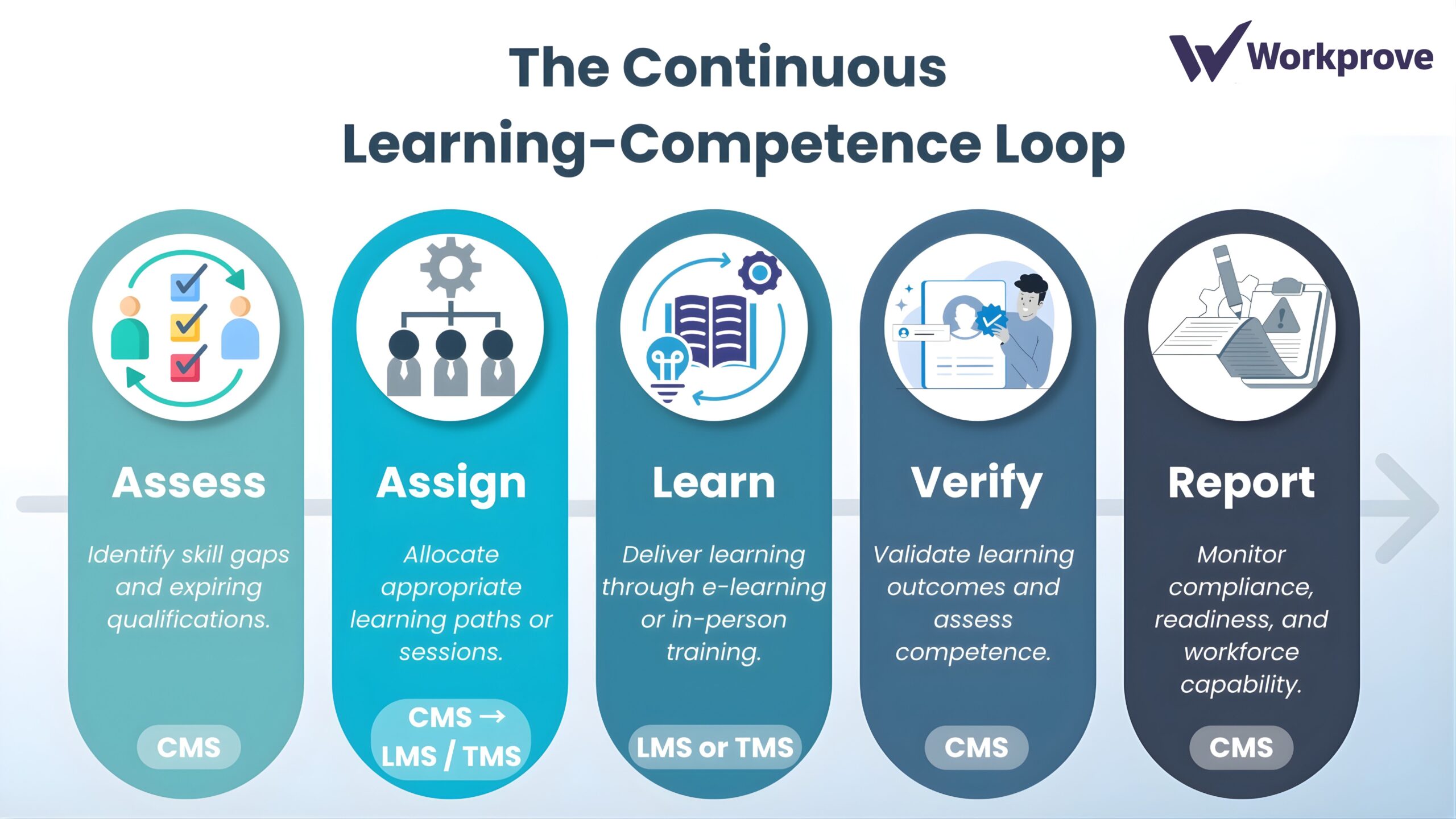
When connected, an LMS, TMS, and CMS form a closed, continuous cycle of learning and validation. The CMS identifies gaps, assigns learning via the LMS or TMS, employees complete training, competence is verified, and reports are generated, forming the backbone of modern workforce capability.
This integrated workflow is why LMS vs TMS vs CMS is not just a comparison, but a framework for building a connected learning ecosystem.
Comparison at a Glance: LMS vs TMS vs CMS
To clarify how each system supports this continuous learning loop, the table below summarises their core purposes, strengths, and limitations within a connected ecosystem.
| System | Primary Purpose | Core Functions | Best For | Strengths | Limitations |
| LMS – Learning Management System | To create, deliver, and track digital or blended learning. | Hosts e-learning courses, manages enrolments, tracks completion, supports SCORM/xAPI, delivers assessments and reports. | Organisations delivering online learning, onboarding, compliance courses, and professional development. | Standardises learning delivery, ensures access anywhere, automates reporting and tracking. | Measures knowledge gained but not proven ability on the job. |
| TMS – Training Management System | To plan, schedule, and manage instructor-led or practical training sessions. | Coordinates sessions, instructors, venues, budgets, and feedback; manages resources and attendance; integrates with CRM and finance tools. | Training providers, apprenticeship programmes, and large enterprises with extensive classroom or blended training. | Streamlines logistics and administration, reduces duplication and scheduling errors. | Tracks attendance but not whether participants are competent or job-ready. |
| CMS – Competency Management System | To validate and maintain workforce competence and compliance. | Defines roles and required competencies, records assessments, stores evidence, issues alerts, produces audit-ready reports. | Regulated and safety-critical industries where proof of competence is mandatory. | Demonstrates capability and compliance, identifies skill gaps, links learning with real-world performance. | Usually relies on LMS/TMS data for learning and training delivery. |
Why This Matters More Than Ever
The pace of change in work and regulation means organisations can’t afford disjointed systems. Every year brings new frameworks and safety standards, from ISO 45001 to GDPR and digital upskilling requirements. Consequently, proof of competence has become a baseline expectation, not a formality.
Beyond compliance, integrated learning ecosystems offer real business value. They reduce downtime, prevent safety incidents, and give employees clearer development paths. They turn learning data into actionable intelligence, helping organisations anticipate needs instead of reacting to failures.