👉 Compare with our Honey & Mumford Learning Styles guide, which highlights individual learning preferences.
Applications of Cognitive Learning
In Education
- Teachers can design lessons layered from foundational to advanced ideas, using scaffolding and reflective prompts.
- Example: In a biology class, instead of just lecturing, students might explore a model, answer guided questions, and then map connections.
In Workplace Training
Download Cognitive Lesson Plan
Strengths and Weaknesses of the Cognitive Perspective
Like any approach, the cognitive perspective has both advantages and challenges. On the one hand, its strengths include the following:
Strengths
- Firstly, it encourages deep learning, reflection, and transfer of knowledge.
- Next, it applies across multiple domains such as academic, professional, and technical settings.
- Moreover, it supports learner autonomy and self-regulation, giving individuals more control over their own learning process.
Weaknesses
- To begin with, cognitive approaches are often more time-intensive than simple behaviourist drills.
- Also, some learners may feel lost without more direct instruction and structure.
- Finally, effective use requires skilled design to avoid cognitive overload, which can overwhelm learners.
Nevertheless, recent studies show promise in using AI-driven feedback loops to adaptively optimise cognitive load in real time, reducing overload and supporting diverse learners (Ma et al., 2024; Wong et al., 2025).
Comparison of Cognitive Learning Theories Approaches
To illustrate the differences between learning theories, see the comparison table below.
| Aspect | Cognitive Approach | Behaviourist Approach | Constructivist Approach |
| Focus | Internal mental processes (thinking, memory, problem-solving). | Observable behaviours shaped by external stimuli. | Learner’s active role in constructing meaning from experiences. |
| Key Theorists | Piaget, Vygotsky, Bandura, Bloom. | Pavlov, Skinner, Watson. | Vygotsky, Bruner, Dewey. |
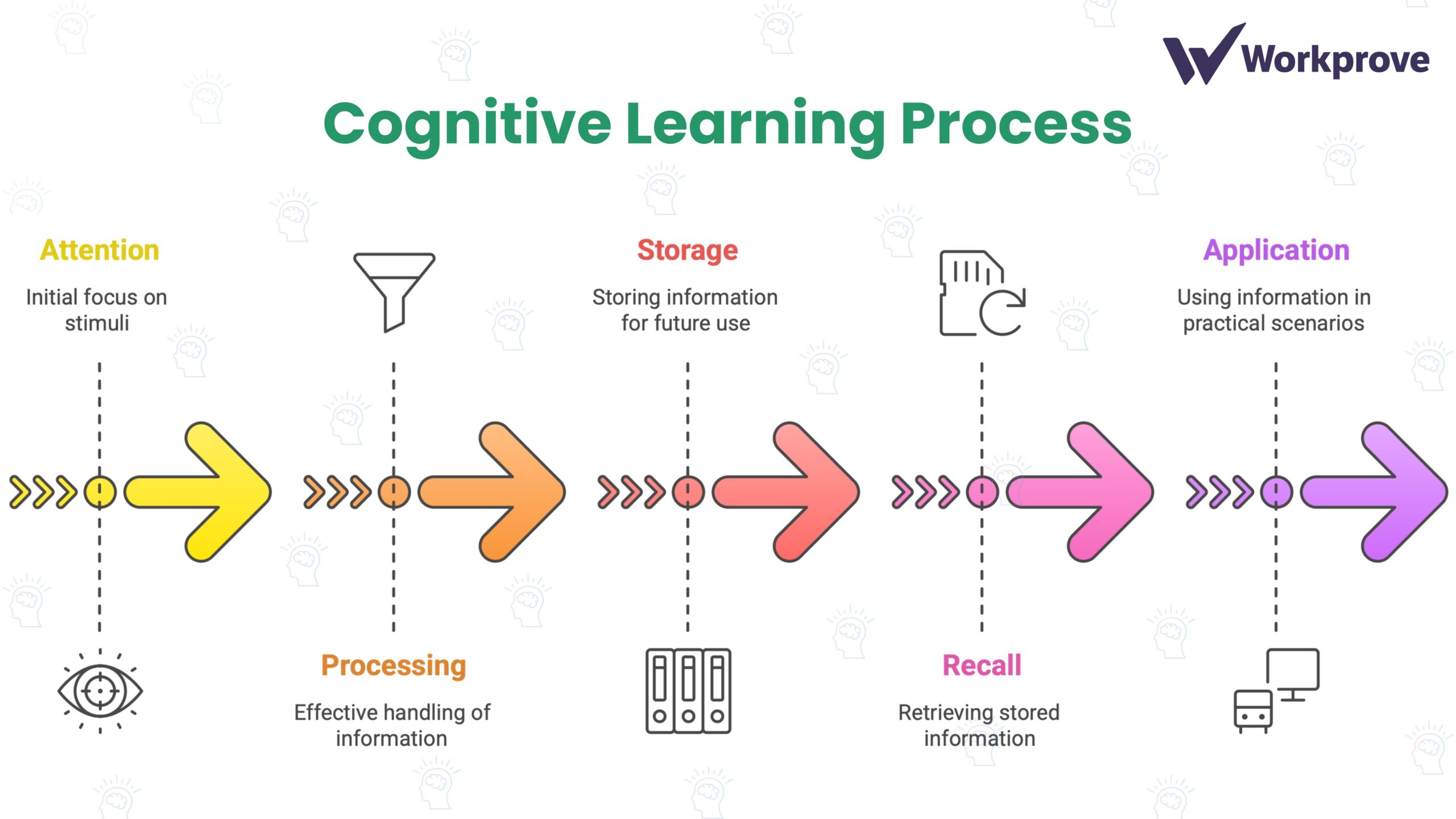
| Learning Process | Information is processed, stored, recalled, and applied. | Behaviour is reinforced through rewards and punishments. | Knowledge is built through exploration, collaboration, and reflection. |
| Strengths | Encourages deep understanding. Improves critical thinking and promotes long-term retention. | Clear, measurable outcomes. Effective for habit formation and skill drills. Easy to implement. | Learner-centred. Builds problem-solving skills. Encourages creativity and adaptability. |
| Weaknesses | More time-intensive. Requires skilled instruction. Risk of cognitive overload. | Focuses only on observable behaviour. Ignores internal thought processes. Can lead to rote learning. | Hard to measure outcomes. Requires high learner motivation. Can be inconsistent without guidance. |
| Best Applied In | Formal education, workplace training, critical thinking tasks. | Skill-based training, compliance, basic drills, behavioural conditioning. | Project-based learning, group work, experiential learning. |
Table 1: Comparison of Cognitive, Behaviourist, and Constructivist Approaches
👉 Tie to our Competency-Based Assessment guide, since both focus on applying knowledge to real skills.
FAQs
What are the 3 main cognitive learning theories?
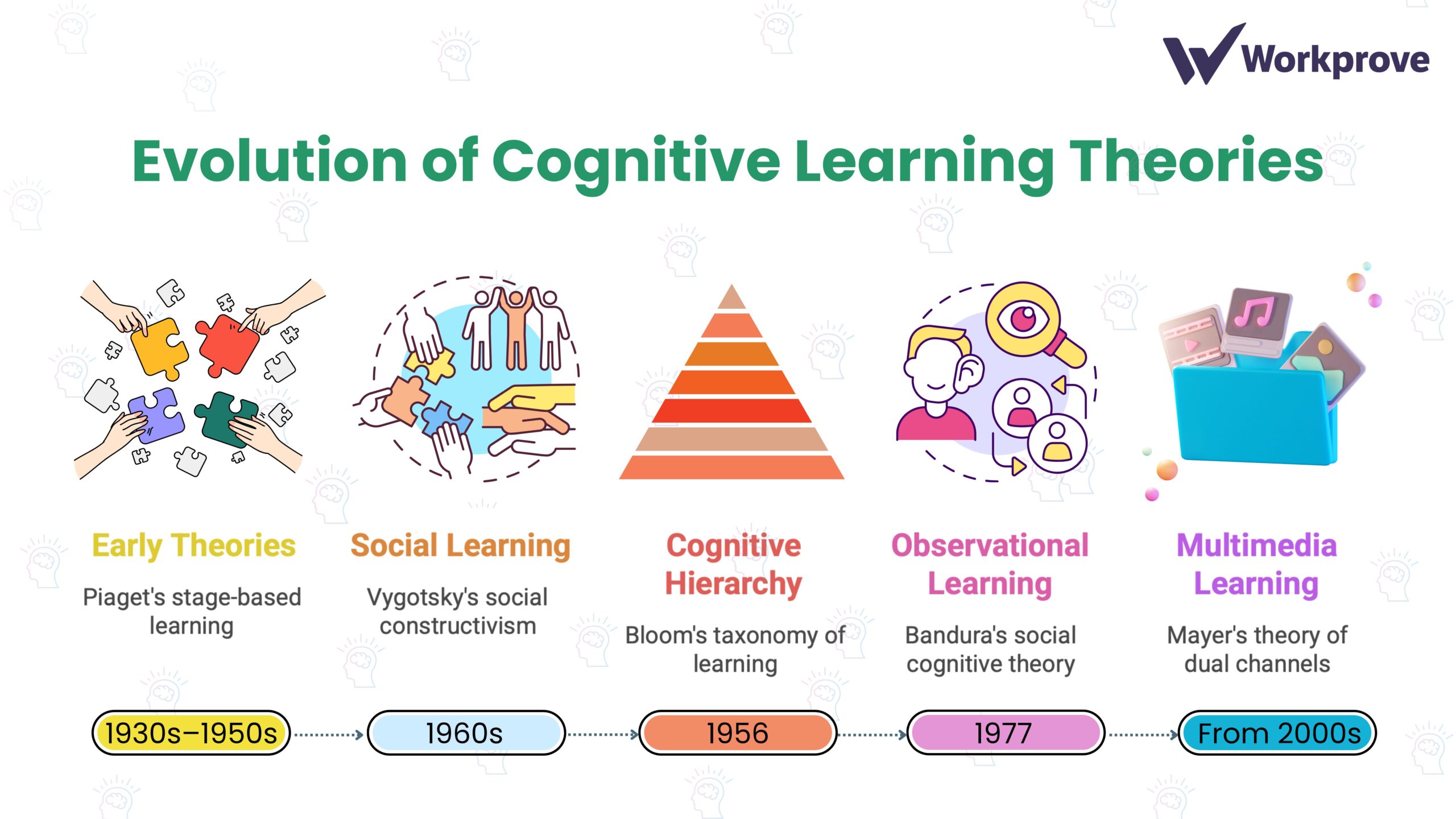
To begin with, Piaget’s Developmental Theory explains stages of thinking. In addition, Vygotsky’s Social Constructivism focuses on collaboration and guidance. Finally, Bloom’s Taxonomy outlines a hierarchy of learning objectives. Moreover, Bandura’s Social Cognitive Theory is often added for its emphasis on observation and modelling.
Why is cognitive learning important in 2025?
Because both education and workplaces increasingly demand critical thinking, adaptability, and deeper conceptual understanding over rote memorisation. Also, modern tools like multimedia and adaptive AI now make it possible to design learning environments optimised via cognitive science.
How is cognitive learning used in workplace training?
In practice, it is applied through scenario-based tasks, peer-learning, feedback loops, reflection, and also by modelling. As a result, organisations move away from passive slide lectures towards active and engaging learning experiences.
Conclusion
Thus, cognitive learning theories go beyond memorisation and nurture learners who think, reflect, and adapt. Whether you teach in schools or train in corporate settings, applying these strategies leads to deeper engagement, more durable learning, and improved transfer.
📥 Don’t forget to download your FREE Cognitive Learning Templates to start applying these strategies today.
References
Bandura, A. (1977) Social learning theory. Englewood Cliffs, NJ: Prentice Hall.
Bloom, B.S. (ed.) (1956) Taxonomy of educational objectives: The classification of educational goals. Handbook I: Cognitive domain. New York: David McKay.
Gkintoni, E., Antonopoulou, H., Sortwell, A. and Halkiopoulos, C. (2025) ‘Challenging Cognitive Load Theory: The role of educational neuroscience and artificial intelligence in redefining learning efficacy’, Brain Sciences, 15(2), 203. Available at: https://doi.org/10.3390/brainsci15020203 (Accessed: 29 September 2025).
Mayer, R.E. (2001) Multimedia learning. Cambridge: Cambridge University Press.
Mayer, R.E. (2024) ‘The past, present, and future of the cognitive theory of multimedia learning’, Educational Psychology Review, 36, Article 8. Available at: https://link.springer.com/article/10.1007/s10648-023-09842-1 (Accessed: 29 September 2025).
Piaget, J. (1952) The origins of intelligence in children. New York: International Universities Press.
Ruiz-Martín, H., Blanco, F. and Ferrero, M. (2024) ‘Which learning techniques supported by cognitive research do students use at secondary school? Prevalence and associations with students’ beliefs and achievement’, Cognitive Research: Principles and Implications, 9, Article 44. Available at: https://cognitiveresearchjournal.springeropen.com/articles/10.1186/s41235-024-00567-5 (Accessed: 29 September 2025).
Twabu, K. (2025) ‘Enhancing the cognitive load theory and multimedia learning framework with AI insight’, Discover Education, 4, Article 160. Available at: https://link.springer.com/article/10.1007/s44217-025-00592-6 (Accessed: 29 September 2025).
Vygotsky, L.S. (1978) Mind in society: The development of higher psychological processes. Cambridge, MA: Harvard University Press.