Smarter Training Management and Compliance Tools in 2026
Skip to content

What to Expect from Smarter Training Management and Compliance Tools in 2026

smarter training and compliance tools and platform in 2026

Why 2025 was just the beginning of a structural shift towards smarter training management and compliance tools in 2026.

In 2025, most organisations reached the same hard understanding: compliance training alone is not enough. Companies have invested in LMS platforms, compliance modules, and even AI-based personalisation. However, the gap between training delivery and real organisational competence remains stubbornly wide, highlighting the limits of traditional systems compared to smarter training management and compliance tools in 2026. In reality, the problem is not tools; it is how work, risk, and learning come together in complex environments.

As a result, leaders in regulated industries, from financial services to healthcare and manufacturing, now face a set of pressures that traditional training and compliance tooling were never designed to solve:

  • Firstly, regulatory expectations are moving from evidence of activity (checklists, certificates) to evidence of capability and risk reduction
  • Secondly, talent mobility and hybrid work have increased skill drift and uncertainty in role competence
  • Finally, operational risk environments have increased faster than compliance functions can measure control effectiveness

In this context, 2025 was the year organisations discovered what they don’t know they don’t know. Looking ahead, in 2026, smarter training management and compliance tools must close this gap, not just automate more paperwork.

What 2025 Taught Us About Training Management and Compliance

These lessons explain why organisations are now reassessing whether their existing systems can evolve into smarter training management and compliance tools in 2026.

1. Automation Alone Doesn’t Create Confidence

By late 2025, it was clear that automating workflow reminders, completions, and certificates did not equate to a reduced risk. Tools that only digitise compliance tasks give a false sense of security: dashboards light up, but underlying capability stagnates (StartUs Insights, 2025). Compliance metrics became box-checking exercises, not reflections of organisational readiness.

This pattern aligns with findings from broader compliance trend analyses, which indicate that many digital compliance initiatives fail not due to tooling, but because data quality and business process alignment were not adequately addressed (StartUs Insights, 2025).

2. AI Hype Met Reality

Across industries, organisations experimented with AI to personalise learning and accelerate content delivery. However, two key limitations emerged:

  • AI recommendations often lacked contextual grounding in operational risk
  • There was no governance framework to ensure AI outputs were explainable, valid, or auditable

Consequently, AI was useful for suggestions, not decision assurance (Glean, 2026). Organisations found that AI-generated noise, when detached from risk models and domain governance.

3. Fragmented Data Systems Exposed Weaknesses

Most companies discovered that LMS, HR, and compliance systems operate in silos with inconsistent identifiers, definitions, and logic. As a result, even basic aggregations of training completion by role are unreliable. Consequently, the result was inflated completion rates that obscured real knowledge gaps.

This is not unique to training: data fragmentation is one of the biggest obstacles to high-quality analytics across risk and compliance functions (Deloitte, 2024).

DimensionTypical state in 2025What smarter tools need to deliver in 2026
Training focusCourse completion and attendance trackingContinuous competence and capability assurance
Compliance evidenceStatic records and certificatesTime-bound, contextual, and auditable evidence
AutomationReminders and workflow routingRole- and risk-triggered reassessment and escalation
Use of AIContent recommendations and summariesContext-aware prioritisation with governance and human oversight
AnalyticsRetrospective dashboardsForward-looking indicators linked to risk and control health
System integrationLMS and compliance tools loosely connectedIntegrated training, HR, risk, and compliance data layers
GovernanceLMS and compliance tools are loosely connectedGovernance logic embedded by design
Management confidenceBased on reported completionLMS and compliance tools are loosely connected

👉 Suggested Reading: Training Management in 2025 Review. Reflects on the limits of completion-led training models and the operational lessons organisations learned before the shift to 2026.

The Forces Shaping 2026: Trends and Pressures

  • Regulators Demand Capability, Not Checklists
    In several jurisdictions, regulators are increasingly emphasising evidence of effective controls and competent personnel over mere documentation of activities. For example, risk frameworks are shifting toward demonstrating ongoing competence within control functions, rather than relying solely on annual training completion certificates. In effect, compliance is fast becoming an operational discipline rather than a reporting one (StartUs Insights, 2025).
  • Workforce Dynamics Are Unpredictable
    The rise of hybrid work, role fluidity, and contingent labour has accelerated the pace at which competencies change. Annual or bi-annual training cycles cannot keep pace with this dynamic environment. As a result, continuous training models that adapt to real-time organisational needs are becoming essential.
  • Risk and Control Complexity Escalate
    The modern risk landscape, shaped by cyber threats, supply chain dependencies, and digital transformation, requires organisations to integrate training assessments into risk management processes. Analytics must answer not just “Did they complete training?” but “Do they have the capabilities to manage risk today?” (World Economic Forum, 2025).

What Smarter Tools in 2026 Will Look Like

Rather than adding another set of features, smarter tools will embed training management into compliance as an operational capability that:

  • Predicts where competence erosion is most likely
  • Surfaces risk signals meaningfully
  • Connects training outcomes to control effectiveness
  • Governs AI use responsibly
  • Integrates analytics into decision processes

Below are the core elements of this evolution.

1. Contextual Intelligence Over Generic AI

Many tools today promote “AI-powered personalisation” but by 2026, such features will be table stakes. Instead, the real differentiator will be contextual intelligence: adaptive logic that understands risk, role definitions, operational processes, and control requirements.

For example, rather than simply recommending learning modules, smarter systems will:

  • Adjust learning pathways based on role-specific risk profiles
  • Trigger reassessments based on operational events or incidents
  • Correlate training performance with control outcomes and real-world behaviour

This is a shift from recommendation engines to risk-context optimisation.

Thus, AI will not replace human judgment; it will augment decision pathways and highlight high-impact gaps, not fill in checkboxes (Glean, 2026).

2. Continuous Competence Monitoring, Not Periodic Reporting

Traditional systems operate in snapshots: training due, training completed. Smarter tools in 2026 will measure competence continuously, driven by models that link performance data to risk outcomes. As a result, these tools will:

  • Track decay rates of critical skills
  • Alert when a key compliance capability drifts below thresholds
  • Integrate with operational data (e.g., incident reports, audit findings)

The output is not a list of completions but a health score of capability readiness.

3. Analytics Designed for Decision (Not Dashboards)

Analytics have historically been presentation-focused. Smarter systems will focus on actionable insights, for example:

  • Which groups have competence gaps correlated with control failures
  • Which training modules are predictive of improved performance
  • What sequence of interventions yields the best risk reduction

These analytics are risk-centric, not activity-centric, a key distinction that will define the 2026 tooling advantage.

4. Integration with Operational Risk and Performance Systems

Smarter training and compliance tools will no longer live in isolation. They will integrate with:

  • HR and role definitions
  • Incident and risk event systems
  • Performance management
  • Control libraries and audit management

This integration is essential for meaningful analytics because competence cannot be inferred in isolation.

5. Governance as a Core Capability

By 2026, governance will be non-negotiable. This is especially true for AI and analytics. Smarter tools will include built-in governance frameworks that ensure:

  • Traceability of decisions
  • Explainability of analytics and recommendations
  • Compliance with regulatory and internal risk standards

Without this, AI features risk becoming black boxes that reduce confidence rather than enhance it.

How organisations do workforce capability management. how to do smarter training and compliance tools in 2026.

👉 Suggested Reading: Construction Safety, Training and Competence: Why Visibility Is the Control the Industry Is Missing. It shows how real-time visibility of competence functions as a critical control in safety-critical environments.

Adopting smarter training management and compliance tools in 2026

By the end of 2025, many organisations had already invested heavily in modern learning platforms, compliance systems and automation. What became increasingly clear, however, is that more sophisticated tools did not necessarily lead to stronger organisational control or confidence in workforce capability. As attention turns to 2026, the shift in training management and compliance is less about adopting new technologies and more about confronting the structural limits of how existing systems are used.

A persistent challenge has been the fragmentation of data across HR systems, learning platforms and compliance or risk tools. Industry and professional services research consistently points to data quality and integration as fundamental constraints on effective oversight. Deloitte’s analysis of compliance reporting highlights how organisations can gain confidence in reports without improving underlying risk control when data structures and logic remain misaligned (Deloitte, 2024). In practice, this often leaves training records, role definitions and compliance evidence insufficiently connected to support reliable analysis or decision-making.

Engagement with mandatory training has also proven difficult to sustain, particularly where learning is delivered through repetitive, fixed annual cycles with limited relevance to daily work. Learning research suggests that shorter, targeted interventions delivered closer to the point of need support stronger knowledge retention than long, infrequent courses (eLearning Industry, 2025). This does not imply a single solution, but it helps explain why tools emerging for 2026 are increasingly designed to support adaptive, role-specific learning rather than uniform schedules.

The expanding use of AI within training and compliance systems has further exposed the importance of governance. While AI-driven insights can help surface patterns and prioritise attention, professional analysts caution against treating these outputs as definitive judgments. Gartner’s research on legal, risk and compliance technologies emphasises that human oversight, explainability and clear accountability remain essential to avoid false assurance and regulatory risk (Gartner, 2024). In response, organisations moving towards smarter tooling are beginning to embed governance alongside AI capabilities, rather than addressing it retrospectively.

Many organisations also continue to find it difficult to demonstrate how training contributes to improved compliance or reduced risk. Training metrics are often reviewed separately from incident data, audit findings or control performance indicators, limiting insight into whether learning interventions address real exposure. Broader risk management literature, particularly in cyber and operational resilience, increasingly stresses the need to link human capability with control effectiveness, rather than treating training as a standalone obligation (World Economic Forum, 2025).

Taken together, these developments suggest that the effectiveness of training management and compliance tools in 2026 will depend less on individual features and more on how well organisations align data integrity, learning relevance, governance and outcome linkage. Technology can support this shift, but it cannot compensate for weak foundations or unclear ownership.

A quiet shift is already underway

Across safety-critical and care-critical industries, there is a growing recognition that compliance cannot be sustained through documentation alone. Organisations operating in environments where errors have real human consequences are increasingly rethinking how training, competence, and oversight are managed on a day-to-day basis.

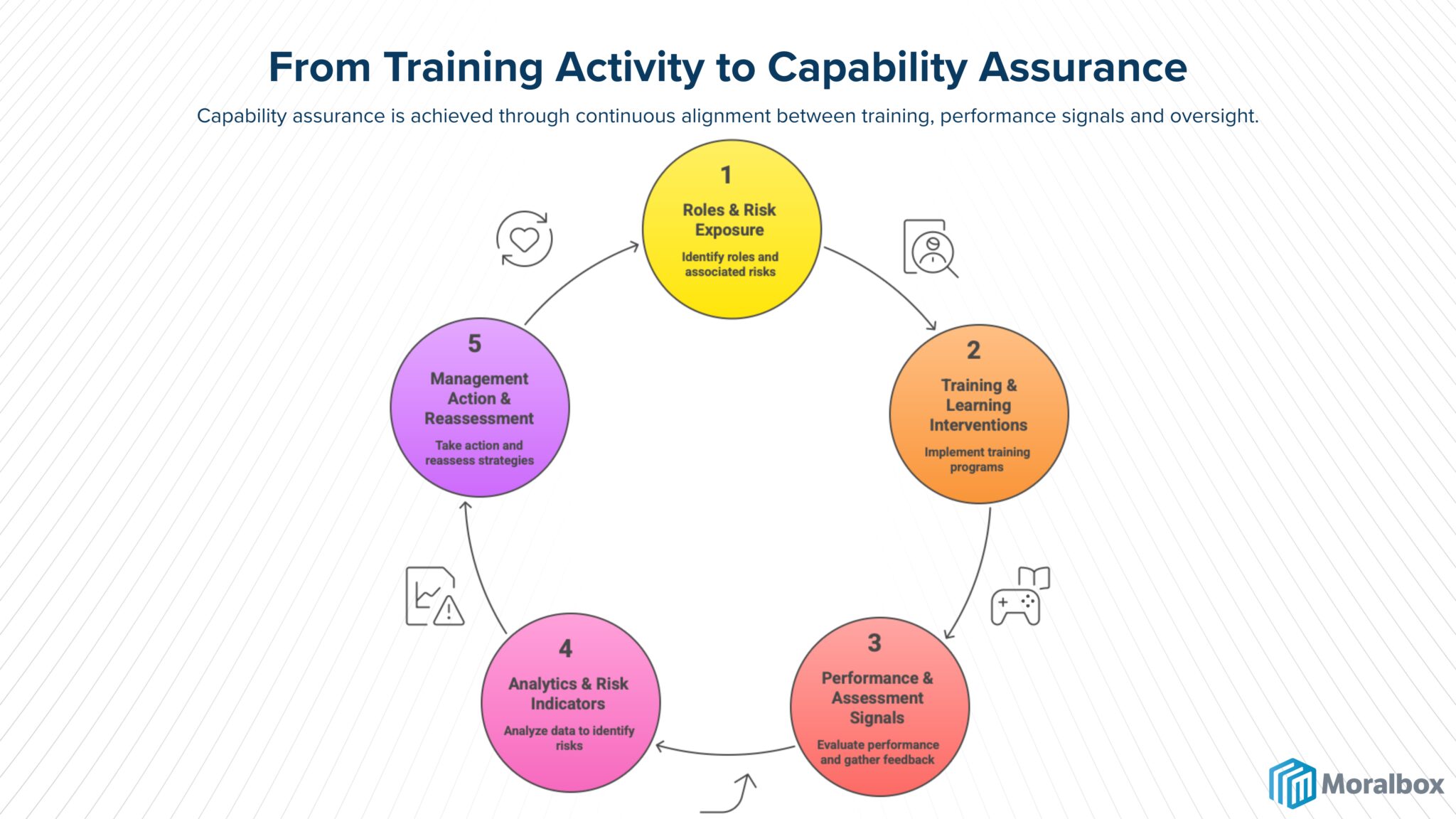
Platforms such as Moralbox reflect this shift by treating training management as a living system rather than a static record, emphasising role-based capability, visibility of gaps, and continuous assurance over periodic checks. The underlying idea is simple but demanding: if organisations expect people to work safely and competently in complex conditions, they must create systems that support that expectation continuously, not retrospectively. For many, this represents not just a tooling change, but a cultural one, moving from proving compliance to actively maintaining capability.

How to Evaluate Smarter Tools in 2026

Your evaluation criteria should shift from feature checklists to operational capabilities:

DimensionWhat to Assess
Data IntegrationCan the system unify training, HR, compliance, and risk data consistently?
Predictive IntelligenceDoes analytics meaningfully predict risk, not just flag completions?
GovernanceAre AI outputs explainable and auditable?
Role-Context LogicCan the system dynamically adjust based on role requirements and risk levels?
Outcome MeasurementDoes the system link training effectiveness to control performance?

This evaluation framework ensures the selection of tools that improve real organisational capability.

FAQs

Q. Will AI replace compliance or training professionals by 2026?
No. AI will augment decision-making and highlight high-impact gaps, but accountability, judgment, and governance remain human responsibilities.

Q. What is the biggest mistake organisations make with training and compliance tools?
Focusing on completions and reports rather than competence and risk outcomes. The smarter approach measures the ability to do the job, not just log it.

Q. How do I measure whether training is actually effective for compliance outcomes?
By correlating training performance with risk indicators such as control failures, audit exceptions, and incident trends, rather than tracking completions alone.

References

Deloitte (2024) Deloitte Compliance Reporting App. Available at: https://www.deloitte.com/global/en/products/deloitte-compliance-reporting-app.html

eLearning Industry (2025) Future-Proofing Compliance: Strategic Training Priorities for Business Leaders. Available at: https://elearningindustry.com/future-proofing-compliance-strategic-training-priorities-for-business-leaders

Glean (2026) How AI Enhances Training Compliance Tracking Across Organizations. Available at: https://www.glean.com/perspectives/how-ai-enhances-training-compliance-tracking-across-organizations

StartUs Insights (2025) Top 10 Compliance Trends in 2026. Available at: https://www.startus-insights.com/innovators-guide/digital-transformation-trends/

World Economic Forum (2025) Global Cybersecurity Outlook 2025. Available at: https://reports.weforum.org/docs/WEF_Global_Cybersecurity_Outlook_2025.pdf.
You might also like

View All Resources
What is a training matrix blog
Blog

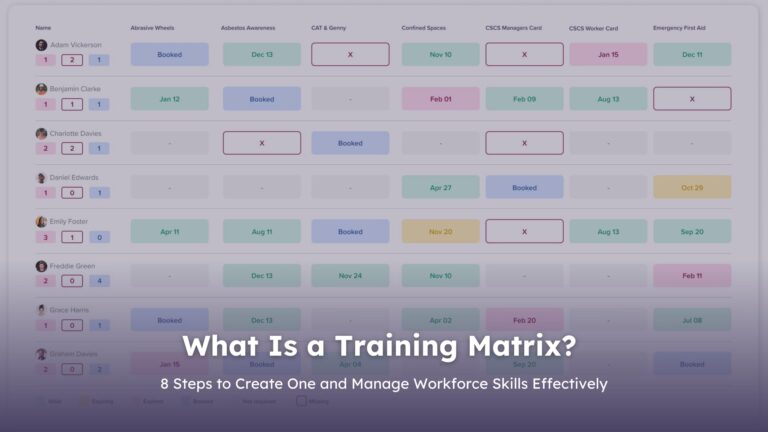
What is a Training Matrix? 8 Steps to Create One Effectively

Find Out More
Transport, Logistics and Warehousing Training & Compliance Management full guide blog
Blog

Transport, Logistics and Warehousing Training and Compliance Management

Find Out More
EDI in safety-critical Industries and how workprove supports EDI- equity, diversity and inclusion
Blog

EDI in the real world: why frontline teams are being left behind

Find Out More