EDI in reality: why safety-critical industries are being left behind
Skip to content

EDI in the real world: why frontline teams are being left behind

EDI in safety-critical Industries and how workprove supports EDI- equity, diversity and inclusion

Equality, diversity and inclusion have become central to how organisations present themselves. Most companies now have policies, commitments and public statements that clearly outline their intent.

Yet the reality on the ground often tells a different story.

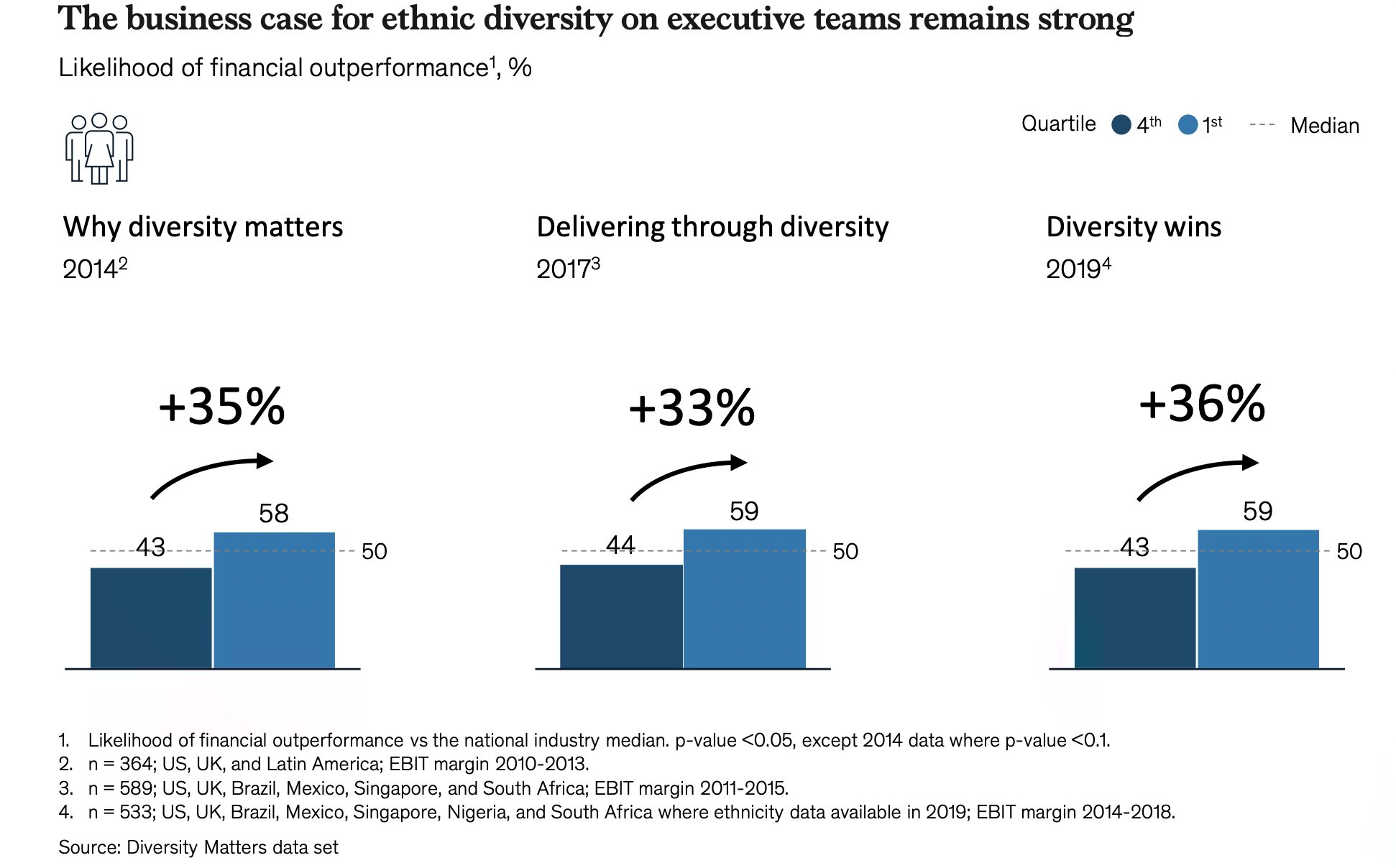
There is strong evidence that diversity delivers value. Organisations in the top quartile for ethnic and cultural diversity are 36% more likely to outperform those in the bottom quartile (McKinsey & Company, 2020). Despite this, many organisations still struggle to translate EDI strategy into consistent, day-to-day practice.

Likelihood of financial outperformance. Source: McKinsey & Company (2020). EDI in safety-critical industries

Title: Likelihood of financial outperformance
Source: McKinsey & Company (2020)

This challenge is particularly visible in sectors such as construction and manufacturing. In the UK construction industry, for example, only around 15% of the workforce are from minority ethnic backgrounds, and women represent just 15% of the workforce, highlighting both underrepresentation and ongoing inclusion challenges (CITB, 2023; ONS, 2023). At the same time, these sectors rely heavily on diverse, often transient labour forces, making consistent and inclusive workforce training significantly more complex.

Research from the Chartered Institute of Personnel and Development highlights that while organisations are increasingly focused on EDI, practical implementation, particularly through line management and people development, remains inconsistent (CIPD, 2022).

The issue is not intent, but the execution.

The kind of diversity we do not talk about enough

When EDI is discussed, the focus often centres on visible or demographic differences. While these are important, they are only part of the picture, especially when thinking about EDI in construction or other safety-critical industries.

In practice, diversity is far more operational.

Workforces are made up of individuals with different levels of education, varying confidence with written communication, and different ways of learning. In England alone, around 18% of adults aged 16 to 65, equivalent to approximately 6.6 million people, have very low literacy skills (National Literacy Trust, 2024).

In sectors like construction and manufacturing, where multilingual teams are common, language differences add further complexity. Many workers are highly skilled in practice but may not engage effectively with traditional, text-heavy training formats.

These are not edge cases. They are everyday realities.

Yet many workplace systems, including those used for inclusive workforce training in the UK, are still designed around an assumption of uniformity. And this is where exclusion begins, often unintentionally.

Where EDI quietly fails: training

Training is one of the most overlooked pressure points in EDI in safety-critical industries.

A standardised approach, such as assigning the same e-learning module to every employee, is often seen as fair. But equal access to the same content does not guarantee equal understanding.

Global engagement research consistently shows that many employees feel disconnected from workplace learning when it is not relevant or accessible to them (Gallup, 2021). In frontline environments, this challenge is often amplified by language barriers, literacy levels and the practical nature of the work itself.

For some individuals, text-heavy training creates friction. For others, theoretical content without practical application fails to translate into real understanding.

Over time, the outcome is familiar. Training is completed but not fully absorbed. Compliance is recorded, but competency can vary significantly.

This is where many approaches to skills-based workforce management fall short. Without understanding the individual, even well-intentioned training programmes struggle to deliver consistent results.

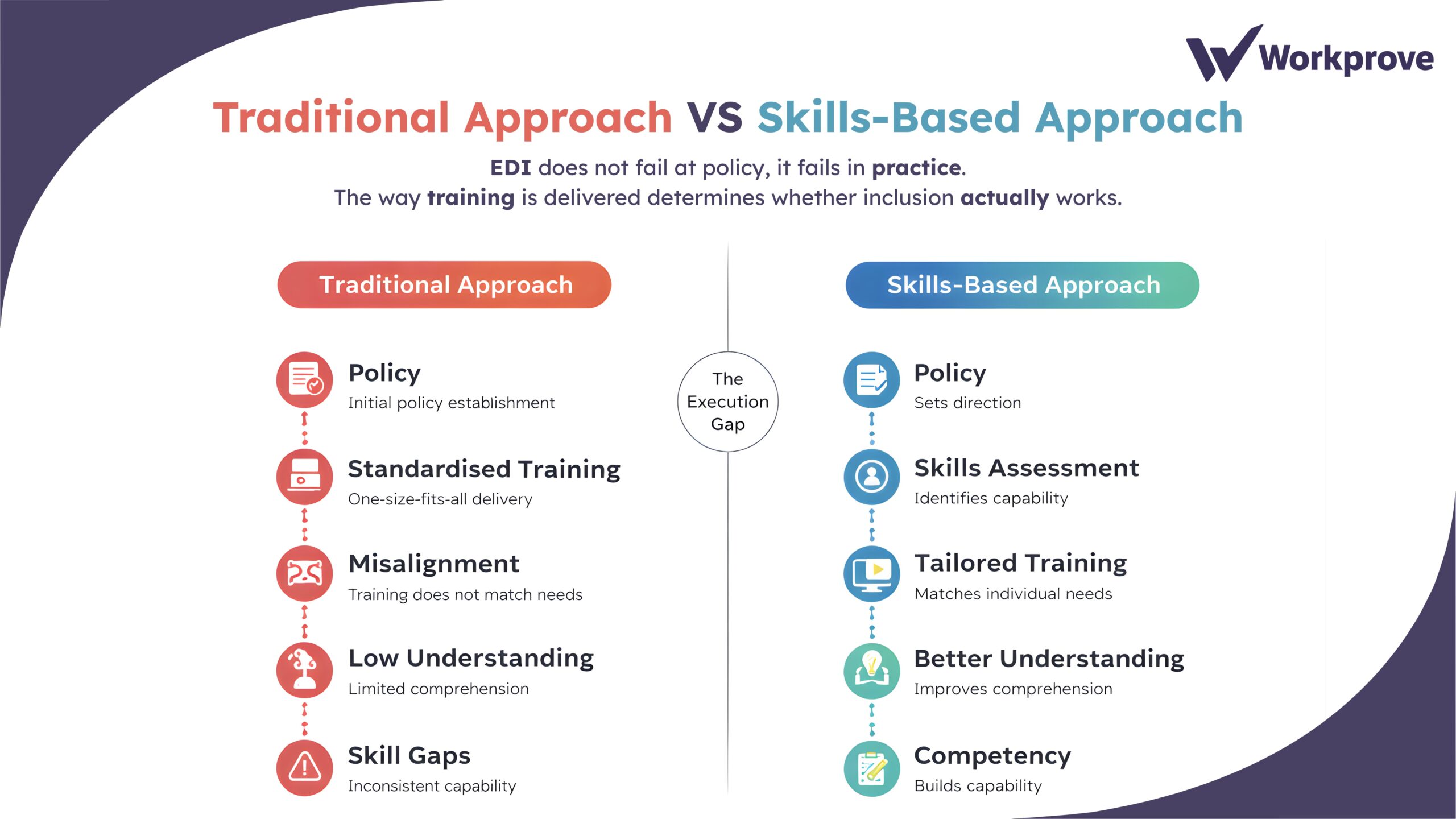
Traditional Training ApproachSkills-Based Workforce Management
Same training for everyoneTraining tailored to individual needs
Assumes equal starting pointAssesses actual skill levels first
Text-heavy, standard deliveryMultiple formats (visual, practical, classroom)
Limited language supportMultilingual training delivery
Completion = complianceUnderstanding = competency


Traditional Approach vs Skills-Based Approach- EDI Blog. EDI in safety-critical industries

Inclusion is not about uniformity. It is about alignment.

👉 Suggested Reading: Benefits of using a Training Matrix. Understand how training matrices help organisations track skills, identify gaps and ensure workforce competency across safety-critical roles.

How Workprove supports EDI in practice

Workprove is designed to embed this thinking into everyday workforce operations.

It begins with visibility. By assessing skills at an individual level, organisations can build a clearer understanding of where people are starting from, rather than relying on assumptions linked to job roles or experience. This is a core principle of skills-based workforce management, ensuring that development is driven by evidence rather than assumption.

From there, training can be delivered in a way that reflects real-world needs. In diverse teams, this often includes adapting content for different languages and providing a mix of learning formats. Some individuals may engage more effectively with visual or video-based content, while others benefit from practical or instructor-led approaches.

This flexibility is essential for delivering inclusive workforce training in the UK, particularly in industries where traditional e-learning alone is not sufficient.

Clear, effective training is particularly important in environments where safety is critical. Guidance from the UK Health and Safety Executive emphasises that employers must ensure workers have the necessary information, instruction and training to carry out their roles safely (HSE, n.d.). This is not simply about delivering training but ensuring it is appropriate and effective.

Over time, organisations can also build a more complete picture of their workforce. Patterns in skills, development and engagement become visible, allowing for more targeted support and better decision-making.

Inclusion, in this sense, becomes something practical and measurable.

👉 Suggested Reading: Why Corporate Training Fails: TheScience Behind Poor Retention andHow to Fix It. Turn failed training into real performance, also explore how lack of reinforcement, retrieval and real-world application leads to rapid knowledge decay.

Why this matters beyond compliance

EDI is often framed as a compliance requirement or a moral responsibility. While both are important, they do not fully capture its operational impact.

When inclusion is embedded into how people are trained and developed, the benefits become tangible. Teams are more capable because learning is effective. Engagement improves because individuals feel supported. And organisations are better positioned to maintain consistent standards across a diverse workforce.

There is also a clear commercial dimension. Diverse organisations are more likely to outperform their peers, particularly when inclusion is actively supported (McKinsey & Company, 2020).

In industries like construction and manufacturing, where performance, safety and workforce capability are closely linked, this is not optional. It is fundamental.

Moving from intention to action: Inclusive workforce training

The gap between EDI policy and real-world impact is not caused by a lack of commitment. It is caused by a disconnect between strategy and execution.

Closing that gap requires a more grounded approach. One that reflects the realities of diverse workforces and adapts accordingly.

Because inclusion is not achieved by treating everyone the same.

It is achieved by making sure everyone has what they need to succeed.

FAQS

What is EDI in safety-critical industries?
EDI in safety-critical industries refers to ensuring that all workers, regardless of background, language or learning style, have equal access to training, development and safe working practices. It focuses on making workforce systems inclusive so that everyone can meet required competency and safety standards.

Why does EDI often fail in practice?
EDI often fails at the execution stage rather than at policy level. Standardised training approaches do not account for differences in language, literacy or learning styles, leading to gaps in understanding and inconsistent workforce competency.

How does Workprove support EDI in practice?
Workprove enables organisations to move beyond policy by embedding EDI into workforce operations. It provides visibility into individual skills, supports tailored and accessible training, and helps ensure that competency is achieved across diverse teams. This allows organisations to deliver inclusive training at scale while maintaining safety and performance standards.
References

CIPD (2022) CIPD | Inclusion at Work 2022, CIPD. Available at: https://www.cipd.org/uk/knowledge/reports/inclusion-work/.

CITB (2023) Construction Workforce Diversity and Skills Report. UK: Construction Industry Training Board. Available at: https://www.citb.co.uk/about-citb/construction-industry-research-reports/search-our-construction-industry-research-reports/construction-skills-network-industry-outlook-2023-2027/

Equality, Diversity, and Inclusion Annual Report 2022-23 (no date). Available at: https://www.citb.co.uk/media/z32dhdg4/annual-equality-diversity-and-inclusion-report-2022-23-v10.pdf.

Gallup (2025) State of the Global Workplace Report, Gallup. Available at: https://www.gallup.com/workplace/349484/state-of-the-global-workplace.aspx.

HSE (n.d.) Health and safety training: A brief guide (INDG345). UK: Health and Safety Executive. Available at: https://www.hse.gov.uk/pubns/indg345.htm.

LinkedIn (2023) 2023 Workplace Learning Report | LinkedIn Learning, Linkedin.com. 2023 Workplace Learning Report | LinkedIn Learning. Available at: https://learning.linkedin.com/resources/workplace-learning-report-2023.

McKinsey & Company (2020) Diversity wins: how inclusion matters, McKinsey & Company. Available at: https://www.mckinsey.com/~/media/McKinsey/Featured%20Insights/Diversity%20and%20Inclusion/Diversity%20wins%20How%20inclusion%20matters/Diversity-wins-How-inclusion-matters-vF.pdf.

National Literacy Trust (2024) Adult Literacy, National Literacy Trust. National Literacy Trust. Available at: https://literacytrust.org.uk/parents-and-families/adult-literacy/.

Freeman, D. (2023) Labour Market overview, UK – Office for National Statistics, www.ons.gov.uk. Available at: https://www.ons.gov.uk/employmentandlabourmarket/peopleinwork/employmentandemployeetypes/bulletins/uklabourmarket/december2023.

You might also like

View All Resources
What is a training matrix blog
Blog

What is a Training Matrix? 8 Steps to Create One Effectively

Find Out More
Transport, Logistics and Warehousing Training & Compliance Management full guide blog
Blog

Transport, Logistics and Warehousing Training and Compliance Management

Find Out More
smarter training and compliance tools and platform in 2026
Blog

What to Expect from Smarter Training Management and Compliance Tools in 2026

Find Out More