👉 Suggested reading: Training Matrix vs Spreadsheets: Why Spreadsheets Fail at Managing Training and Compliance– An evidence-based comparison of why spreadsheets fail to capture real capability and how automated matrices improve accuracy, accountability and decision making.
What Recent Research Tells Us About Skills and Why Visibility Counts
The case for an automated skills matrix stems directly from how the labour market is evolving and how organisations are responding to it. Several recent findings stand out.
Skills are changing quickly and at scale
WEF’s Future of Jobs 2023 estimated that 44% of workers’ skills would be disrupted within five years (World Economic Forum, 2023). The 2025 edition updates that picture and suggests that, on average, 39% of current core skill sets will transform or become outdated by 2030 (World Economic Forum, 2025). The change has moderated slightly, but it still represents a profound shift in what people need to be able to do.
The skills gap is hurting performance
Springboard’s 2024 report found that 70% of corporate leaders report a skills gap that is already limiting innovation and growth, with nearly three-quarters of C-suite respondents believing their organisation is operating with a deficit of critical skills (Springboard, 2024). This is not about hypothetical future shortages. It is about present-day constraints.
L&D is under pressure to focus on skills, but capacity is stretched
CIPD’s Learning at Work research notes that addressing skills gaps has become a central priority for many learning practitioners, yet they still report a lack of capacity and inconsistent support from the wider business (CIPD, 2023; HR Grapevine, 2023). An automated skills matrix helps relieve some of that pressure by providing a shared, objective view rather than leaving L&D to piece together data manually.
Skill allocation, not just skill level, drives productivity
Analysis of the 2023 OECD Adult Skills Survey reveals that productivity is higher where skill mismatches are lower, and that differences in skill levels account for approximately a quarter of productivity differences between the OECD average and top performers (Andrews et al, 2025; OECD, 2024a). This means it is not enough to have skilled people somewhere in the organisation. They must be deployed where they are actually needed.
Collectively, the research suggests a straightforward conclusion. When skills are changing this fast, and when misallocation is this costly, organisations need a system that tells them who has which capabilities and how those capabilities align to the work. A centralised, automated skills matrix is precisely that system.
How an Automated Training Matrix Works in Practice
A well-designed matrix changes how you plan, deploy and develop people.
First, it gives you a shared language of skills. Instead of every department inventing its own labels, you create a skills taxonomy that defines, for example, “Data literacy level 3” or “Confined spaces safety certified” in consistent terms. This avoids confusion and allows apples-to-apples comparison across teams.
Second, it provides live visibility. When automated, the matrix leverages your training systems, HRIS and possibly project tools. As someone completes an accredited course, passes an internal assessment or renews a licence, their skill level updates. Skills matrix software, including Workprove, can display this information in real-time, so managers are not working from outdated spreadsheets.
Third, it supports decision-making at multiple levels.
- Team leaders can identify who is ready to take on new responsibilities, who has identified a targeted area of development and where single points of failure exist.
- HR and L&D can plan programmes based on aggregate data, not just requests. If the matrix shows that a large group is stuck at an intermediate level in a critical skill, you can design interventions accordingly.
- Executives can effectively link workforce planning to the overall strategy. If the business aims to expand into a new service line, you can model whether the skills already exist internally or whether recruitment is necessary.
Finally, it creates a feedback loop. As you deliver training, you monitor whether proficiency levels rise and whether those new skills are actually being used in roles. Over time, this allows you to refine your learning strategy instead of repeating ineffective programmes.
Application Across Sectors
A centralised automated skills matrix is versatile, but the emphasis differs by sector. It is worth looking at how it plays out in a few contrasting environments.
In manufacturing, skills are closely tied to safety, throughput and regulatory compliance. Organisations need to know which operators are authorised for which machines, which technicians hold relevant safety certificates and where upcoming expiries lie.
Here, a centralised matrix helps you:
- Maintain compliance by tracking licences and mandatory training across shifts and sites.
- Avoid bottlenecks, for example, where only one person can run a critical process.
- Plan cross-skilling so that supervisors are not forced to choose between production targets and safety.
When combined with real-time data, the matrix can feed directly into scheduling and workforce planning, ensuring that every shift has the right mix of skills available.
Technology firms operate in an environment where tools, languages and platforms change rapidly. Analytical thinking, creative problem solving and AI or big data skills are among the most in-demand capabilities according to WEF, and their importance is expected to grow further by 2027 (World Economic Forum, 2023, 2025).
A centralised skills matrix allows tech organisations to:
- Track which teams have emerging AI, data or cloud skills and which are still reliant on older stacks.
- Identify internal candidates for new projects rather than defaulting to external hiring.
- Support internal mobility by mapping transferable skills between roles.
Instead of guessing who can support a new product line, leaders can quickly see which people have the closest match of skills and experience.
Healthcare combines strict regulation with rapid innovation in treatments and technologies. Clinicians, technicians and support staff require up-to-date certifications, and when those lapse, the risks are significant.
A centralised matrix, integrated with training and HR systems, provides a single view of:
- Mandatory clinical competencies and their renewal dates.
- Specialist skills, such as operating particular diagnostic devices.
- Multi-disciplinary coverage across departments and sites.
This helps managers reduce the risk of staffing a ward or lab with an unsafe skills mix, and supports audit readiness when regulators review training and competence.
Beyond these three sectors, a centralised skills matrix plays an equally valuable role across services, retail, hospitality, utilities, logistics, construction and professional services. Although the specific skillsets differ, the underlying challenges are similar. Organisations need to understand who can perform which tasks, where single points of failure sit, which teams have leadership depth and where capability gaps are holding performance back.
A centralised matrix allows these industries to track product knowledge, digital skills, customer service capability, compliance requirements and leadership behaviours in one place, aligning training with real gaps rather than assumptions. Across all these sectors, the consistent benefit is clear: centralised, real-time skills data enables leaders to make decisions based on evidence rather than intuition, and that directly supports a smarter, more resilient workforce.
How Workprove’s Automated Training Matrix Fits In
Many organisations start with spreadsheets and templates. These are a good first step, and even Workprove’s own resources recognise their value, with free skills matrix templates that help teams get started. However, there is a clear distinction between static templates and software-based skills matrices. Software-based matrices provide dynamic, real-time insights into team capabilities, track progress, identify gaps and align skills with business goals in ways static templates cannot.
Workprove’s automated training matrix software is designed to deliver this next level of capability. In practical terms, Workprove helps organisations to:
Centralise skills and training data
Skills, roles, training records and compliance requirements sit in one environment rather than scattered across spreadsheets, folders and different systems.
Automate updates from training activity
When employees complete courses, renew certifications or pass assessments, the matrix updates automatically. There is no need for manual re-entry, which reduces errors and keeps the picture up to date.
Link roles, skills and compliance
You can define what skills and qualifications are required for each role and then immediately see whether individuals meet that standard. This makes it easier to evidence competence in audits and ensures that only suitably qualified people are assigned to safety-critical tasks.
Expose gaps and risks visually
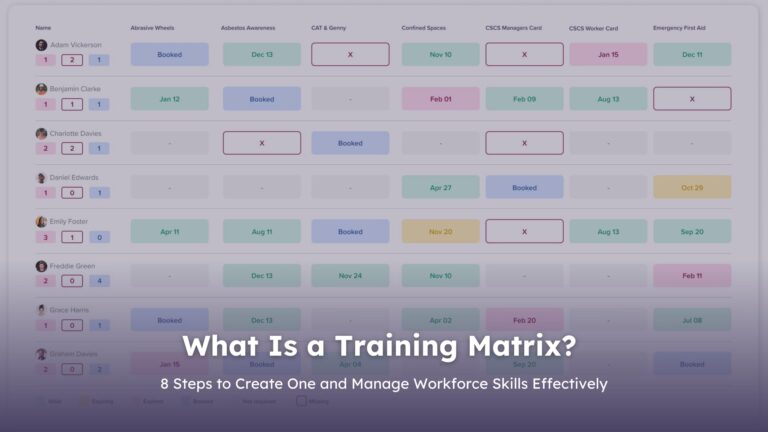
Colour-coded matrices, dashboards and reports allow managers to identify gaps by team, site or division. Instead of generic statements about “skills issues”, you can see exactly which skills and which groups need attention.
Support workforce planning and development
Because the matrix shows not only current proficiency but also training in progress, leaders can plan. If a new contract requires more people at a particular competency level, you can model whether upskilling existing staff will be sufficient or whether recruitment is needed.
Workprove moves the organisation from static training records to a living, automated skills system that underpins smarter decisions about hiring, development, deployment and compliance, exactly what a “smarter workforce” requires.
Conclusion
The evidence from all the research mentioned above points in the same direction. Skills are changing rapidly, gaps are already constraining performance, and organisations that cannot see and allocate skills effectively will struggle to remain competitive (World Economic Forum, 2023, 2025; OECD, 2023; Springboard, 2024; CIPD, 2023; Skillsoft, 2024).
A centralised skills matrix, particularly when automated, provides the missing visibility. It turns skills from something organisations talk about vaguely into something they can measure, manage and improve. It links individual development to business strategy, supports compliance, reduces project risk and improves productivity by cutting mismatches between capability and work.
If your current approach relies on scattered spreadsheets, informal knowledge and occasional audit exercises, there is a clear opportunity. Moving to a centralised, automated skills matrix is not just a technical upgrade; it is a structural change in how your organisation understands and deploys its most important asset: the skills of its people.
Workprove’s automated training matrix is one way to put that into practice. By centralising skills data, automating updates, and clearly exposing gaps, it provides the foundation for a genuinely smarter workforce, not just a better set of training records.
FAQs
Is a centralised skills matrix only for big organisations?
Not at all. Smaller teams benefit even more because gaps and single points of failure have a great impact. A matrix gives immediate clarity on who can do what.
How is an automated skills matrix different from basic training records?
Training records show course completion. A skills matrix displays actual competence, proficiency levels and operational readiness across roles.
How quickly can an organisation see value?
Often within weeks. Once data is centralised, capability gaps, risks and development priorities become visible almost instantly.
References
Andrews, D., Égert, B. and de la Maisonneuve, C. (2025) ‘Adult skills and productivity’, OECD Economics Department Working Papers [Preprint]. Available at: https://doi.org/10.1787/12ac6e8c-en.
CIPD (2023) Learning at work 2023 survey report, CIPD. Available at: https://www.cipd.org/uk/knowledge/reports/learning-at-work/.
Grapevine, H. (2023) L&D professionals facing ‘significant challenges’ when tackling skills gaps, Hrgrapevine.com. Available at: https://www.hrgrapevine.com/content/article/2023-06-27-ld-professionals-facing-significant-challenges-when-tackling-skills-gaps (Accessed: 24 November 2025).
OECD (2023) OECD Skills Outlook 2023: Skills for a resilient green and digital transition. Paris: OECD Publishing. Available at: https://www.oecd.org.
OECD (2024a) Do adults have the skills they need to thrive in a changing world? Survey of Adult Skills 2023. Paris: OECD Publishing. Available at: https://www.oecd.org/en/publications/2024/12/do-adults-have-the-skills-they-need-to-thrive-in-a-changing-world_4396f1f1.html.
Skill Reporter (2024) ‘SkillSoft released report on workforce skill development – Skillsoft Lean Into Learning report’, Skill Reporter, 8 March. Available at: https://www.skillreporter.com/news/skilldevelopment/skillsoft-lean-learning-report-skill-development-crisis-workforce-upskilling-artificial-intelligence-ai/.
Skillsoft (2024) ‘Skillsoft’s Lean Into Learning report shows multidimensional skills crisis driving demand for workplace learning’, Business Wire press release, 5 March. Available via Nasdaq at: https://www.nasdaq.com/press-release/skillsofts-lean-into-learning-report-shows-multidimensional-skills-crisis-driving.
Springboard (2024) Workforce Skills Gap Trends 2024: Survey Report, Springboard Blog. Available at: https://www.springboard.com/blog/business/skills-gap-trends-2024/.
World Economic Forum (2023) The Future of Jobs Report 2023. Geneva: World Economic Forum. Available at: https://www.weforum.org/publications/the-future-of-jobs-report-2023.
World Economic Forum (2025) The Future of Jobs Report 2025. Geneva: World Economic Forum. Available at: https://www.weforum.org/publications/the-future-of-jobs-report-2025.