For a long time, this approach seemed sufficient.
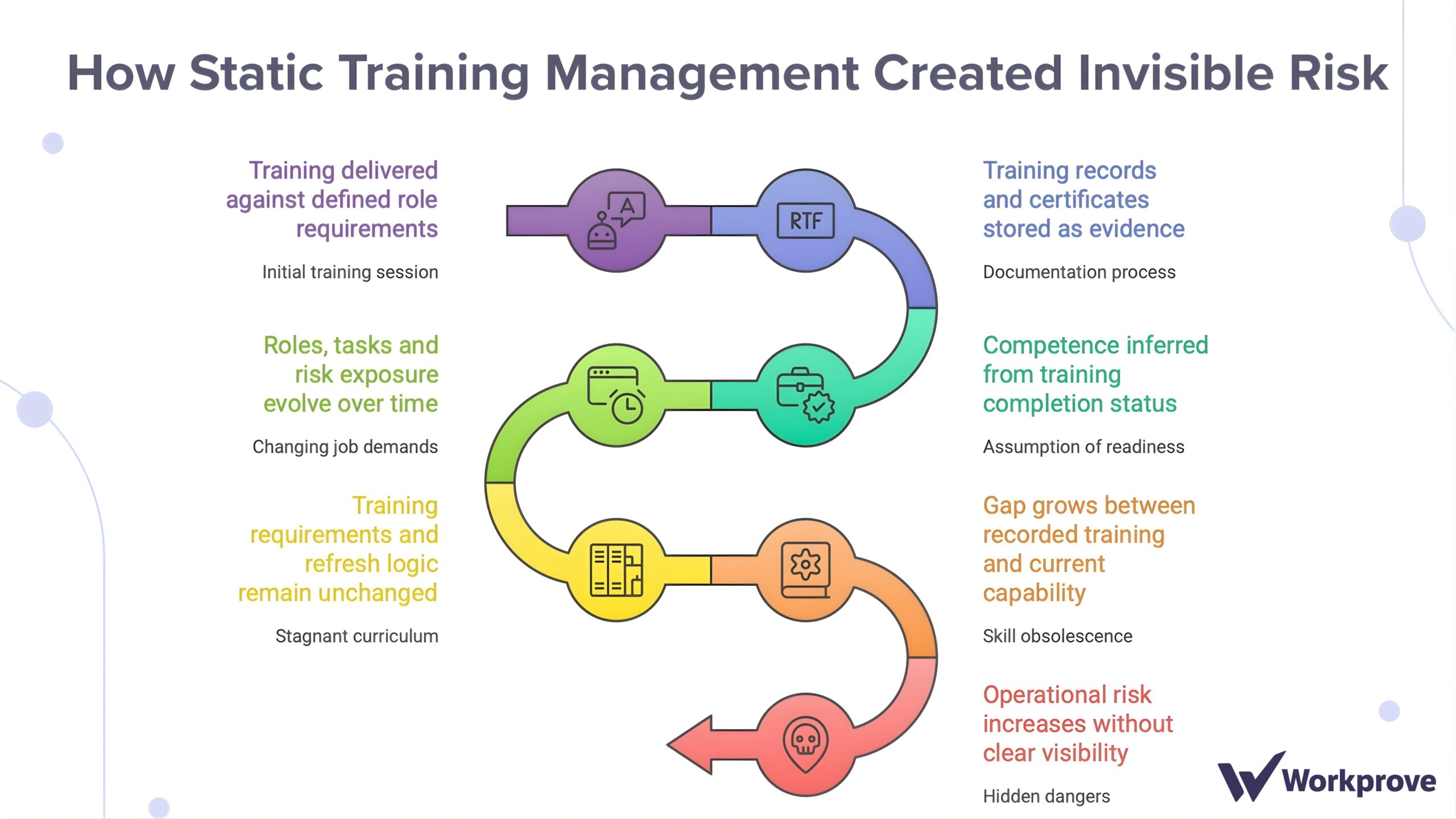
However, conditions changed faster than systems adapted. Workforces became more fluid. Contractors and temporary labour increased. Roles blurred across sites and projects. Equipment, processes and regulatory expectations evolved mid-cycle.
Yet training logic often stayed the same.
Research supports how widespread this challenge has become. PwC’s Global Risk Survey found that nearly 60% of organisations struggled to maintain workforce capability during periods of rapid change, particularly in complex and regulated environments (PwC, 2023).
Importantly, this breakdown did not announce itself through immediate failure. Training records stayed green while real capability quietly drifted. The gap between documented training and operational readiness widened without clear warning signs.
2025: When Skill Volatility Became Operational Risk
Although industry discussions had highlighted skill volatility for years, its impact became operationally unavoidable in 2025.
The World Economic Forum also reported that six in ten workers globally will require training by 2027, yet organisations are expected to provide adequate training opportunities to only around half of them (World Economic Forum, 2023). In safety-critical sectors, this gap is not an abstract workforce issue. It directly affects risk exposure.
Training delivered even 12 to 24 months earlier could no longer reliably indicate current capability. People changed roles more frequently. Knowledge decayed without visible triggers. New hazards emerged faster than refresh cycles could respond.
Consequently, organisations had to confront a question they had long avoided. How do we know our people remain competent today, not merely trained in the past?
Static training systems could not answer this convincingly. 2025 exposed that limitation clearly.
👉 Suggested Reading: Construction Safety, Training and Competence: Why Visibility Is the Control the Industry Is Missing. This explains how limited visibility into training and competence creates hidden risk in safety-critical environments, and why real-time insight has become a core safety control.
From Training as an HR Function to Training as a Risk Control
Historically, organisations treated training management as an administrative or developmental activity, often placing it under HR ownership. Compliance and safety teams relied on its outputs but rarely influenced how organisations designed training systems.
By 2025, this separation began to collapse.
International standards such as ISO 9001 have long required organisations to determine the competence needed for specific roles, ensure that competence is achieved, and evaluate the effectiveness of the actions taken, rather than simply recording attendance (International Organisation for Standardisation, 2015). In practice, however, many organisations interpreted this requirement narrowly.
Regulatory guidance increasingly challenged that interpretation. The UK Health and Safety Executive stressed that organisations must be able to demonstrate and maintain competence and ensure it remains appropriate to the task being performed, particularly in safety-critical work (Health and Safety Executive, 2023).
As a result, training management moved closer to operations, safety and risk. It became evident that training quality was not a supporting process, but a leading indicator of compliance and safety performance.
The Three Training Management Shifts That Defined 2025
Rather than presenting a long list of superficial trends, we can understand 2025 through three fundamental shifts in how organisations manage training.
1. From Static Training Plans to Living Training Systems
Annual training plans proved insufficient in environments where roles, sites and hazards changed continuously.
By 2025, training requirements needed to respond dynamically to role changes, contractor onboarding, site assignments, incident learnings and regulatory updates. Static matrices struggled under this pressure because they assumed predictability.
Living training systems, by contrast, treated requirements as conditional and responsive. Training obligations evolved as work evolved. This shift was foundational and unavoidable.
2. From Attendance to Demonstrated, Ongoing Competence
The second shift was more philosophical but equally consequential.
Completion certificates lost their authority as proof. Attendance alone no longer satisfies auditors, regulators or safety leaders. The central question shifted from “Has this course been completed?” to “Does this person still meet the competence threshold for this task?”
This aligns with broader governance research showing that outcome-based assurance provides more reliable control than process-based assurance in complex systems (OECD, 2023).
Therefore, training management had to reflect validity, recency and relevance, not simply completion status.
3. From Training Records to Training Intelligence
Finally, 2025 marked a shift from storing training data to using it as intelligence.
Organisations increasingly needed to see where competence risk was emerging, which roles carried the highest exposure, and which sites accumulated training debt. This required aggregation, filtering and contextual views that manual tools could not reliably provide.
Training management became a decision-support capability rather than a record-keeping exercise.
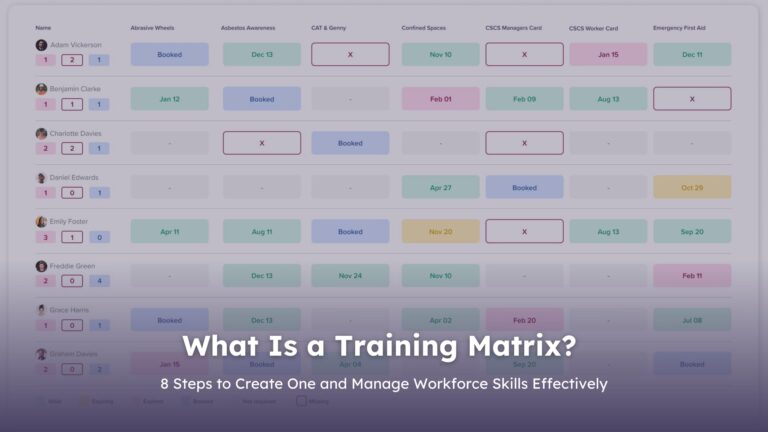
👉 Suggested Reading: Training Matrix vs Spreadsheets: Why Spreadsheets Fail at Managing Training and Compliance. It examines why spreadsheet-based training management leads to false confidence, delayed risk detection, and fragile audit readiness as workforce complexity increases.
How Training Management Changed in 2025
| Traditional Training Management | Training Management Reality in 2025 |
| Training matrices designed around stable roles | Training requirements adapt to changing roles, sites and tasks |
| Training completion treated as proof of readiness | Competence assessed in terms of validity, recency and relevance |
| Fixed refresh cycles defined by policy | Training updates triggered by real operational events |
| Evidence is reviewed periodically for audits | Training is managed primarily as an HR activity |
| Gaps are often discovered during audits or incidents | Readiness monitored continuously, not retrospectively |
| Gaps often discovered during audits or incidents | Training is recognised as an operational risk control |